
3 Health Insurance Stocks Facing Pressure From GLP 1 Weight Loss Drug Prices
GLP-1 weight loss drugs just turned into one of the biggest fault lines between drugmakers and insurers, with CVS Health publicly flagging that current monthly costs near US$617 to US$766 only look affordable for payers if prices fall toward about US$350. That kind of pressure can reshape medical-claims trends and profit pools. This article walks through three stocks most exposed to that tug-of-war and what that could mean for a diversified portfolio.
The three insurers below are a useful starting sample, while the full screen surfaced 17 more managed care and health insurance companies with equally detailed narratives not covered here. To go deeper into this theme, head straight to the U.S. Managed Care & Health Insurance Providers screener to identify, analyze, and prioritize your highest-conviction plays.
Humana (HUM)
Humana is a central player in this managed care theme because Medicare Advantage and medical claims drive its economics, and GLP-1 pricing debates directly touch that core, according to yiannisz, an investor in the Simply Wall St Community who wrote a detailed thesis on the insurer.
Humana Inc. is a US-focused health insurer anchored in Medicare Advantage and related services, with the Insurance segment generating about US$147.6b of its US$154.4b revenue and CenterWell contributing roughly US$26.0b, and the group valued at about US$54.0b in market cap.
"As Medicare Advantage enrollment grows and billing operations become more data-driven, oversight agencies are paying closer attention to documentation accuracy and determinations of medical necessity."
What happens if a single unseen pressure inside those medical necessity reviews starts to reshape Humana’s long-term margin profile?
That quiet shift in review pressure is exactly what the full narrative for Humana unpacks, highlighting where Humana’s model could be masking emerging risks and accelerating advantages.

Molina Healthcare (MOH)
Molina Healthcare gives you clean exposure to how U.S. government backed managed care responds when drug pricing and medical claims trends start to shift, and the analyst consensus Narrative on Simply Wall St frames the opportunity in a very specific way.
"Molina Healthcare is targeting Medicaid margin recovery as markets that are currently about 300 basis points underfunded move closer to actuarial targets, with management outlining roughly 90 basis points of medical cost ratio improvement over three years, which would directly support higher pretax margins and earnings."
The real swing factor is how one understated change in the mix of medical and pharmacy costs ultimately filters through those future margins.
Molina Healthcare focuses on managed healthcare for low income members in U.S. Medicaid, Medicare, and state marketplaces, closely tied to the screener’s managed care theme. Most revenue comes from Medicaid at about US$32.2b, with Medicare at US$6.2b and Marketplace plans at US$3.1b, supporting a market value near US$10.9b.
That mix shift is exactly what the full narrative for Molina Healthcare breaks down, revealing how accelerating drug costs, funding catchup and margin repair could reshape Molina Healthcare’s earnings path.

Centene (CNC)
Centene is tightly linked to the U.S. managed care and health insurance theme, because it helps administer Medicaid, Medicare, and commercial coverage where medical and drug costs, including GLP-1 pricing, directly feed into profitability. The analyst consensus Narrative on Simply Wall St frames that tension in very clear terms.
"Centene's effort to restore Medicaid margins, supported by a 2026 composite rate yield outlook of roughly 5% and a targeted full year Medicaid HBR of about 93.5%, continues to point to earnings power that some investors may not yet fully reflect in valuation, with potential impact on segment net margins."
What happens if one quiet shift in how drug-cost savings are shared between Centene and its government partners tilts those margins again?
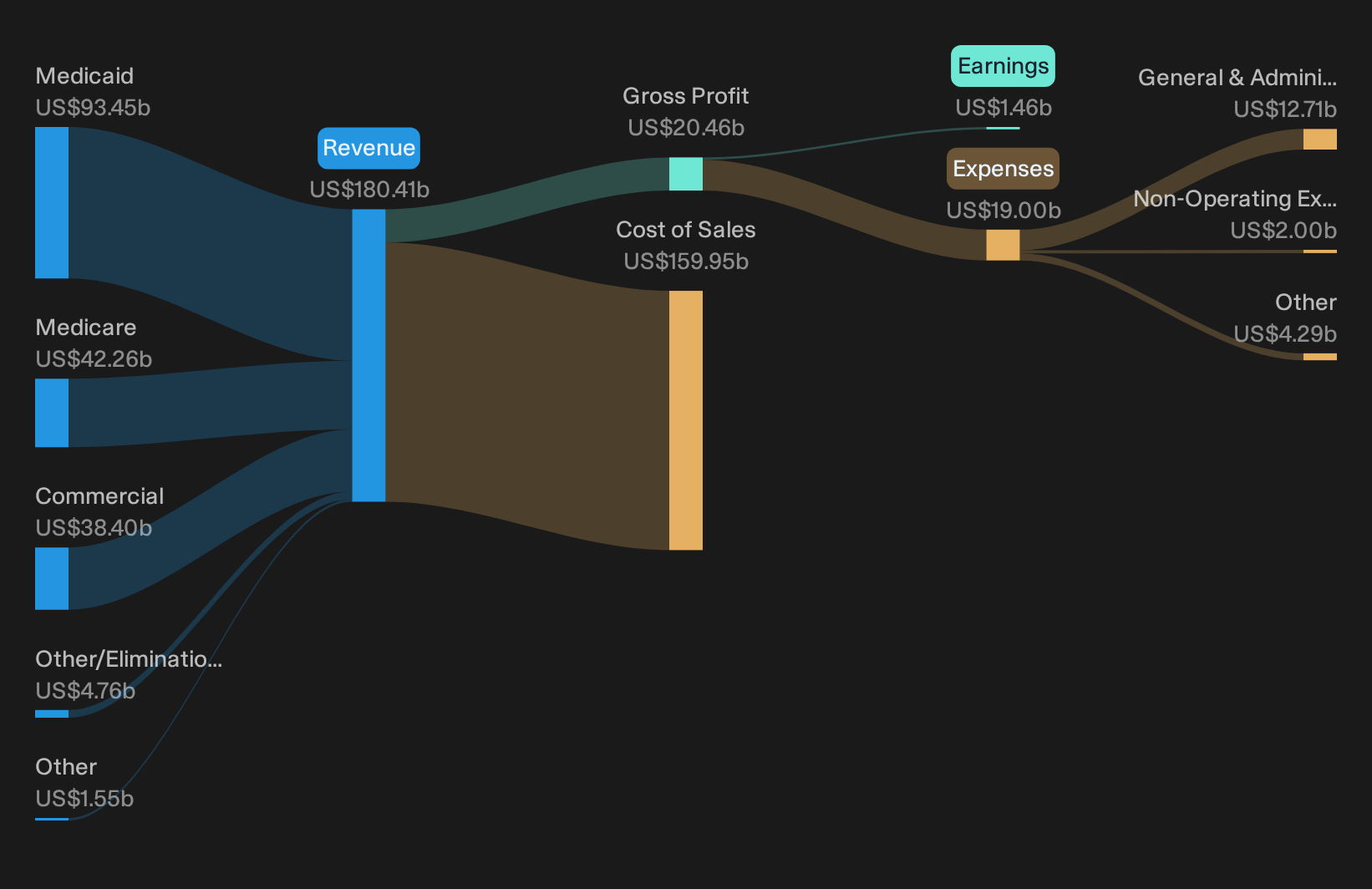
Centene runs a large U.S. managed care platform focused on government backed coverage, with Medicaid producing about US$93.4b of revenue, Medicare US$42.3b, Commercial plans US$38.4b, and other activities US$4.8b. Together these support a roughly US$35.3b market value.
If that sharing formula is what really moves Centene’s earnings power, the full narrative for Centene shows how pricing pressure, reimbursement and care mix could be quietly accelerating or stalling returns.
Curious About Alternative Breakout Ideas?
Fresh opportunities can move fast, and the cleanest entries often appear before the crowd spots the momentum. Do not watch the next breakout fly by; act now.
- Spot early strength in smaller companies before they get widely talked about by scanning the 12 elite penny stocks with strong financials that are already showing solid underlying financials.
- Ride the wave as artificial intelligence reshapes entire industries by tracking the 42 AI small caps that pair real business traction with rapid product adoption.
- Lock onto cash generative businesses that the market may be mispricing by scanning the 34 high quality undervalued stocks while those opportunities stay under the radar for now.
Have feedback on this article? Concerned about the content? Get in touch with us directly. Alternatively, email editorial-team@simplywallst.com