
Broadcom Stock Jumps as Nvidia’s Leadership Crisis Raises a Billion-Dollar Opportunity for Its AI Chip Business
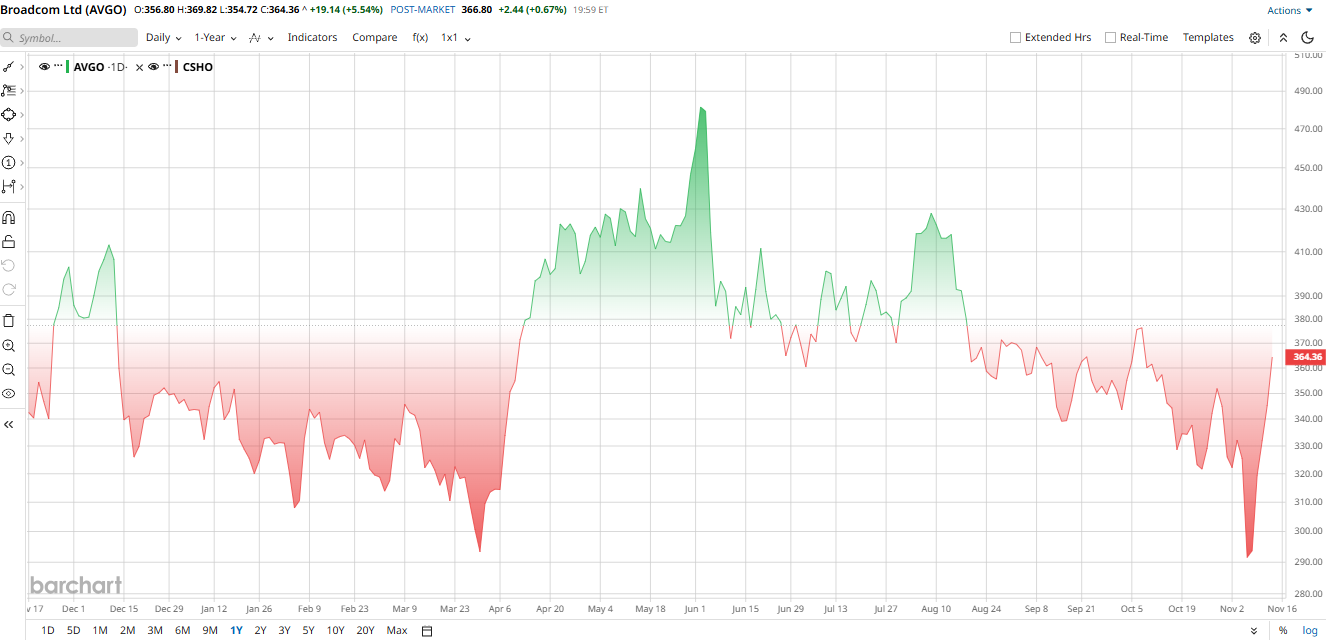
Broadcom (AVGO) has become an unlikely winner from Nvidia's (NVDA) turmoil. Shares of the chip company climbed more than 5% on Nov. 12, after Nvidia confirmed that CEO Jensen Huang had resigned and named CFO Colette Kress interim chief executive. Investors looked to rivals that could benefit if customers rethink their dependence on Nvidia. Broadcom is a natural candidate because it designs custom AI processors and data-center networking chips. The move, however, does not mean customers are switching.
But Broadcom is viewed as one possible alternative because it develops custom AI accelerators, known as application-specific integrated circuits, as well as networking chips used in data centers. Those products give cloud-computing companies another way to build AI infrastructure beyond relying on Nvidia’s graphics processors.
The rally came as expectations that some customers could diversify suppliers or reconsider their chip strategies following the disruption at Nvidia. It does not, however, confirm that any customer has moved orders to Broadcom.
Huang's Exit Could Open a Door
Nvidia's leadership change has a much bigger impact than people actually think because Huang built it into the dominant supplier of AI accelerators and a central data-center player. His departure adds uncertainty around a business whose strategy is in its business plan, customer relationships, and product development.
The lack of certainty may make cloud service providers and AI solution developers feel compelled to branch out to alternative suppliers. Broadcom will offer an alternative to custom chips, known as application-specific integrated circuits, or ASICs, that some buyers will seek. These processors are tailored for specific workloads and can provide customers greater control over performance, power consumption, and cost compared to Nvidia's general-purpose GPUs. Broadcom also provides networking products to connect processors within artificial intelligence data centers.
The company has been using the Nvidia opportunity as it is developing its own AI business. It features a proprietary high-performance AI infrastructure platform that will enable over 20GW of computation by 2028, with custom accelerators and networking solutions. Broadcom upped its revenue estimate for fiscal 2027 to around $115 billion due to AI chip sales. That rebalances chip buying among suppliers, which may benefit Broadcom. Nvidia's software system and engineering force, however, remains strong.
The Stock is Still Not Cheap
Despite Thursday's bounce, Broadcom's total return is weak, about 5% in 2026 and 2.5% over the past year, including dividends. Both trailed the S&P 500 ($SPX), which returned 10.9% and 10.8%, respectively. Shares pulled back from their $495 high after September results because its $34.8 billion fourth-quarter revenue forecast fell short of the $35.03 billion analyst estimate. Investors also worried about lower gross margins and whether lofty AI spending forecasts can hold.
On top of that, valuation leaves little room for mistakes. Broadcom traded at a price-to-sales of 17x compared to the sector’s 3.2x, and its price-to-book is 15.3x versus the sector’s 3.4x, both suggesting the stock is trading at a significant premium to peers. However, AVGO’s forward PEG is 0.50, considerably lower than the sector median of 1.1, indicating attractive value relative to growth.
A Powerful Quarter Is Behind the Story
Broadcom’s Q3 shows why it is attracting attention. Revenue in the third quarter came in at $29.59 billion, up 86% from a year prior and exceeding the $29.44 billion analysts' estimates. Adjusted earnings rose to $3.32 per share, beating the consensus estimate of $3.16, as lower consensus estimates and year-over-year growth were 96%. Income rose 216% to $13.09 billion.
The value of AI chip sales increased 221% to $16.7 billion. Broadcom had $13.7 billion in free cash flow and a cash balance of $24 billion at the end of the quarter.
CEO Hock Tan said that demand for custom AI accelerators and networking products has remained “very strong”. He predicts that AI semiconductors will contribute $21.7 billion of revenue for the fiscal fourth quarter, a 236% increase from the same quarter a year ago. Management anticipates total revenue of approximately $34.8 billion for the quarter, which is a 93% increase over the prior year. Wall Street projections for fiscal 2026 are $106 billion in total revenue and $10.2 in EPS.
Wall Street Remains Bullish on AVGO Stock
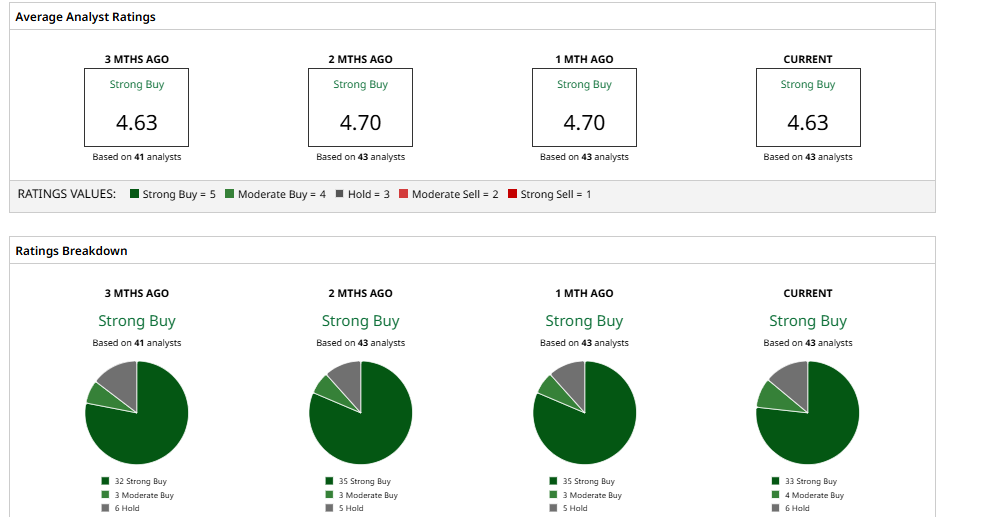
Wall Street remains overwhelmingly positive on Broadcom. The 43-analyst consensus stands at “Strong Buy” with a 12-month mean price target of $525, implying more than 44% upside potential.
Beyond that, several major firms have recently reaffirmed or raised their outlook. For example, in September, Goldman Sachs lifted its price target to $540 from $525 and kept a Buy rating, citing the company’s robust outlook.
Similarly, one of the most recognized firms, Bank of America, upped its target to $530, citing Broadcom’s spectacular 180% increase in guidance for AI revenue growth for FY2026.
The upgrades generally praise Broadcom’s AI-driven earnings power but caution that such momentum is already priced in. One note observes Broadcom’s PEG ratio still looks attractive but flags the stock as potentially “overvalued” on some metrics.
In conclusion, the increase in Broadcom's share price following the Nvidia shakeup could be a sign of short-term sentiment rather than sustainability on its road to continued AI growth. In Q3, it hit or beat high expectations, and analysts have attributed its top-line success to CEO Tan. “AI growth continues as planned at Broadcom”, wrote BofA's analysts, and new XPU customers, such as Anthropic and Meta Platforms (META), would complement its already large Google TPU base.
On the date of publication, Nauman Khan did not directly have a position in any of the securities mentioned in this article. All information and data in this article is solely for informational purposes. For more information please view the Barchart Disclosure Policy here.