
Nvidia Reports Earnings on Nov. 17. Here's What Investors Should Be Watching.
Key Points
Nvidia's Nov. 17 earnings report will be its first since Jensen Huang stepped down as CEO.
Its growth outlook and shrinking gross margins deserve particular attention.
Colette Kress is now both CFO and interim CEO, and investors will want clarity on who will take over Huang's responsibilities.
With its stock down over 30% from its October peak, Nvidia (NASDAQ:NVDA) has a lot to prove when it reports earnings on Nov. 17.
The chip designer is, of course, no stranger to big expectations. Indeed, for 14 consecutive quarters, its revenue has beaten even the upper end of management's forecast. Last quarter alone, Nvidia generated about $96 billion in sales, more than double the year before and more than $3 billion above the high end of its forecast.
Missed AI’s "Act 1"? Act 2 Could Be 15x Bigger. Most investors think they missed the AI boat because they didn't buy Nvidia in 2005. But according to our analysts, we’re only at the end of "Act 1"—the R&D phase. "Act 2" is the global rollout. Continue »
This earnings report feels different, though. And not only because Jensen Huang won't be leading the call. Even before his resignation on Nov. 11, several questions hung over the chip designer's future, chief among them whether its customers would continue spending heavily on AI data centers.
This earnings call is, therefore, significant in more than one way. There will be plenty for investors to digest. Here's what I'll be watching.

Image source: Nvidia.
More growth, and then some: Can Nvidia keep it up?
Nvidia, for starters, is best known for designing chips -- graphics processing units (GPUs), to be specific.
Since their early days in gaming, Nvidia's GPUs have proven adept at handling many computing tasks simultaneously, making them particularly well-suited to training and running AI models. Its AI chips are so widely used that whenever you ask an AI chatbot a question today, there's a good chance Nvidia's technology is helping generate the answer.
That dominant role means Nvidia has been growing like a weed; indeed, sales and profits have shot up dramatically. The question now is how long that growth can continue.
Very likely, growth will continue this quarter. Nvidia previously forecasted about $108 billion in revenue for the quarter it's about to report, plus or minus 2%. Many analysts, however, expect sales to approach $109 billion -- roughly 91% more than a year earlier -- and adjusted earnings of $2.47 per share.
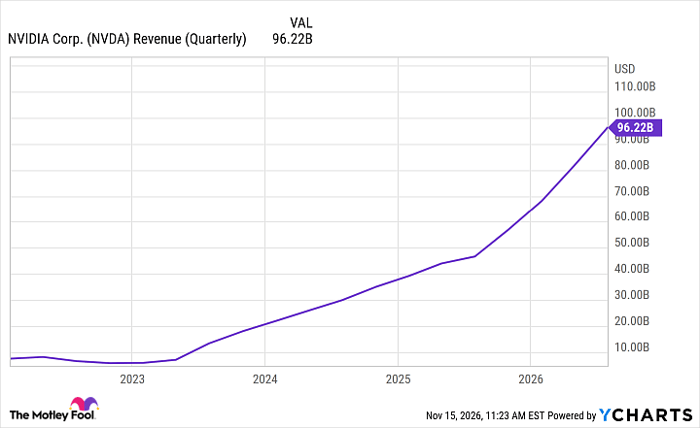
NVDA Revenue (Quarterly) data by YCharts
Impressive as that sounds (and let's not be jaded: it is very impressive), I'm more interested in what Nvidia forecasts for the fourth quarter and beyond.
Back in August, management projected revenue growth of about 70% in fiscal 2028, and investors will want to know whether that outlook still holds. At that time, CFO Kress said supply constraints were holding back further growth (Nvidia simply couldn't deliver enough hardware to meet customer demand). Any update on those constraints could reveal whether there's still room for faster growth.
One figure investors should pay particular attention to is gross margin, that is, the percentage of revenue left after covering the cost of products sold.
Nvidia projected gross margins of about 74% for this quarter, down from 75% last quarter, citing higher memory costs as the reason for this expected decline. Management also warned that margins could bottom at 71%-72% in the fourth quarter, meaning Nvidia could sell more chips while earning less gross profit per dollar of revenue.
The risks that come with Nvidia's customers
In addition to revenue outlook and margins, I'm also interested in the financial risks Nvidia is taking to support its customers, as well as the competition it might face from some of its biggest buyers.
About the former, Nvidia has been investing in certain AI developers, and even backing some customers' data center leases. In one sense, that can help customers fund expansion -- and ultimately buy more hardware from Nvidia -- but in another, it could leave Nvidia exposed if customers default. I'm curious how much more of this support Nvidia is planning on providing, and how it would limit its losses should customers run into trouble.
Regarding the latter, I'm referring specifically to Amazon's (NASDAQ:AMZN) Trainium chips and Alphabet's (NASDAQ:GOOG) TPUs.
Both companies are major Nvidia customers, but since their chips can perform certain AI tasks, they could end up spending a smaller share of their AI budgets on Nvidia's hardware. How that could affect Nvidia's growth is murky, but any clues about whether these alternatives are putting pressure on Nvidia's pricing power (or taking orders away) will be worth listening for.
An Nvidia without Jensen Huang
This will be the first earnings report without Jensen Huang as CEO. Colette Kress, CFO and interim CEO, will be on the call, and although she's not an unfamiliar voice, it will feel strange not hearing from the man in the black leather jacket.
Given that Huang resigned only days ago, I'm not expecting firm timelines for naming his replacement or any major revelations from the board's investigation into whether company secrets were compromised (the board said it has no reason to believe they were). Still, Kress will likely want to give investors a clearer picture of what Nvidia will look like without him, as well as any details on who will oversee product development, customer relationships, and his other responsibilities during the transition.
Steven Porrello has positions in Nvidia. The Motley Fool has positions in and recommends Alphabet, Amazon, and Nvidia. The Motley Fool has a disclosure policy.