
Is Whirlpool (WHR) Trading At A Discount Following Its Dividend Halt And GAAP Loss?
Whirlpool (WHR) halted its common dividend starting in the second quarter of 2026 and reported a third quarter GAAP loss, developments that put the stock squarely in focus for income oriented investors.
Recent trading reflects that strain. Whirlpool’s share price return is down 26.6% over the past 90 days and 61.0% year to date, while the 1 year total shareholder return has declined 57.6%. This suggests that momentum has been fading as the dividend halt and loss sharpen concern about risk.
Pressure test Whirlpool against peers and see which cash generative consumer stocks still offer income potential with our 6 dividend fortresses
Bulls see Whirlpool as a beaten down appliance leader repairing its balance sheet. Bears see a dividend free stock with recent losses. Which story does the current valuation really support?
Most Popular Narrative: 20.9% Undervalued
Whirlpool's analyst consensus Narrative on Simply Wall St sets a fair value of $36.73 per share, above the last close of $29.06. This frames the stock as discounted while also hinging heavily on execution of a multi year reset and cost program.
The main requirement is successful execution of the multi year factory consolidation, automation, and logistics footprint changes that are expected to deliver at least $150 million of 2026 cost savings and roughly $180 million or more of annualized EBIT benefits from 2027 onward. The current numbers, including guidance for about 4% ongoing EBIT margin in 2026 and liquidity above $3 billion after recent recapitalization steps, imply a Whirlpool share price that may not fully reflect the potential margin recovery and balance sheet repair that management is pursuing.
See why 30 investors see Whirlpool as 21% undervalued.
Result: Fair Value of $36.73 (UNDERVALUED)
Still, Whirlpool’s reliance on soft appliance demand in North America and its shift to a GAAP net loss margin of 2.2% for 2026 could easily pressure that undervaluation thesis.
Find out about the key risks to this Whirlpool narrative.
Another View: Whirlpool Through Cash Flows
The Simply Wall St DCF model presents a very different perspective on Whirlpool. On this view, the estimated value of future cash flows is $14.93 per share, while the stock trades at $29.06. That gap presents Whirlpool as overvalued based on these cash flow assumptions. Which narrative do you think is closer to reality?
For a closer look at how those assumptions compare, including discount rates and cash flow paths, Look into how the SWS DCF model arrives at its fair value.
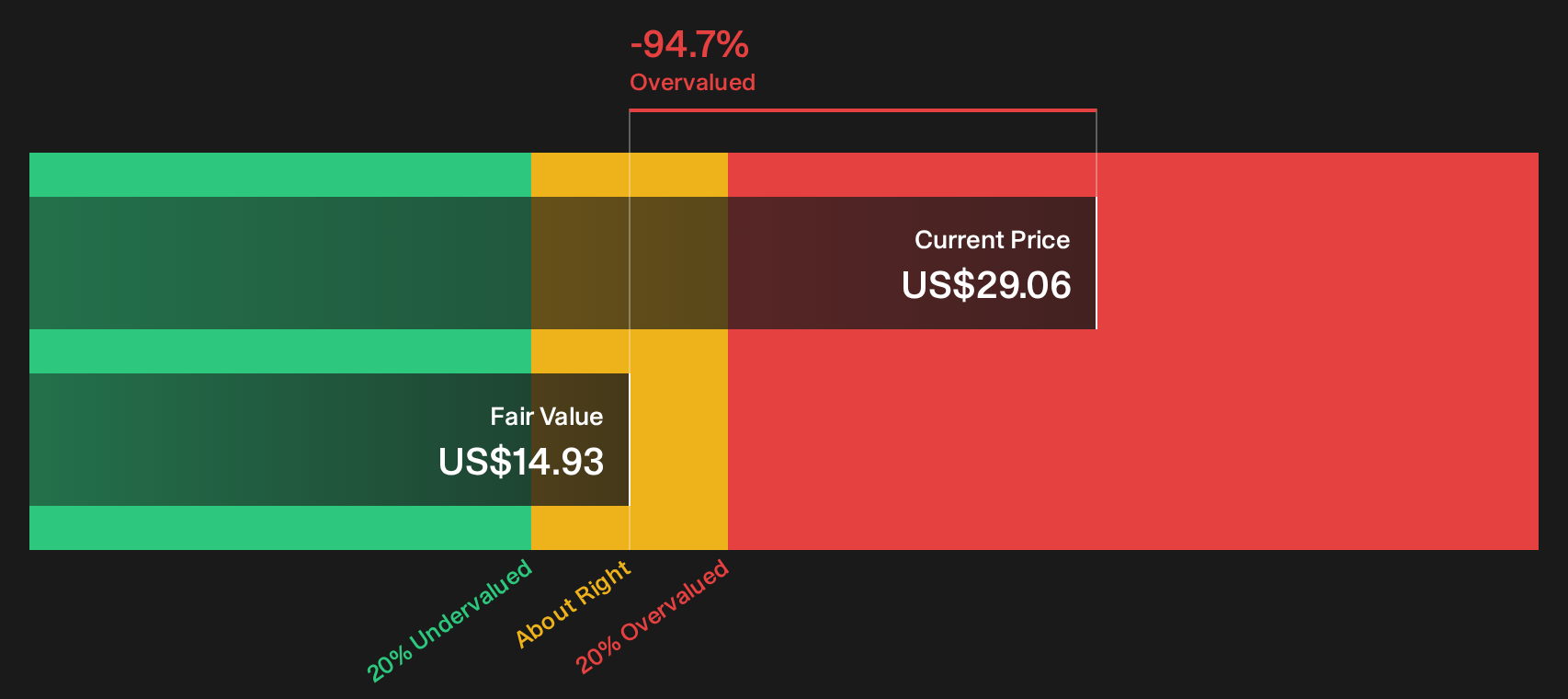
Simply Wall St performs a discounted cash flow (DCF) on every stock in the world every day (check out Whirlpool for example). We show the entire calculation in full. You can track the result in your watchlist or portfolio and be alerted when this changes, or use our stock screener to discover 34 high quality undervalued stocks. If you save a screener we even alert you when new companies match - so you never miss a potential opportunity.
Next Steps
Mixed signals around Whirlpool can feel confusing, and that is exactly why it helps to review the underlying data yourself instead of relying on headlines. Pull apart both the concerns and the upside, then weigh the 2 key rewards and 2 important warning signs.
Looking for more investment ideas beyond Whirlpool?
If Whirlpool’s story has you rethinking where your money works hardest, widen the lens and put a few fresh opportunities on your radar right now.
- Target resilient cash generators by scanning a 34 high quality undervalued stocks that couples solid financials with prices that may not fully reflect underlying strength.
- Hunt for tomorrow’s potential standouts with a 19 high quality undiscovered gems that highlights quality businesses still flying under most investors’ radars.
- Dial down portfolio stress by using a 29 resilient stocks with low risk scores designed to spotlight companies with sturdier balance sheets and lower risk profiles.
Have feedback on this article? Concerned about the content? Get in touch with us directly. Alternatively, email editorial-team@simplywallst.com