
What Investors Got Wrong About Tencent Before The Drop
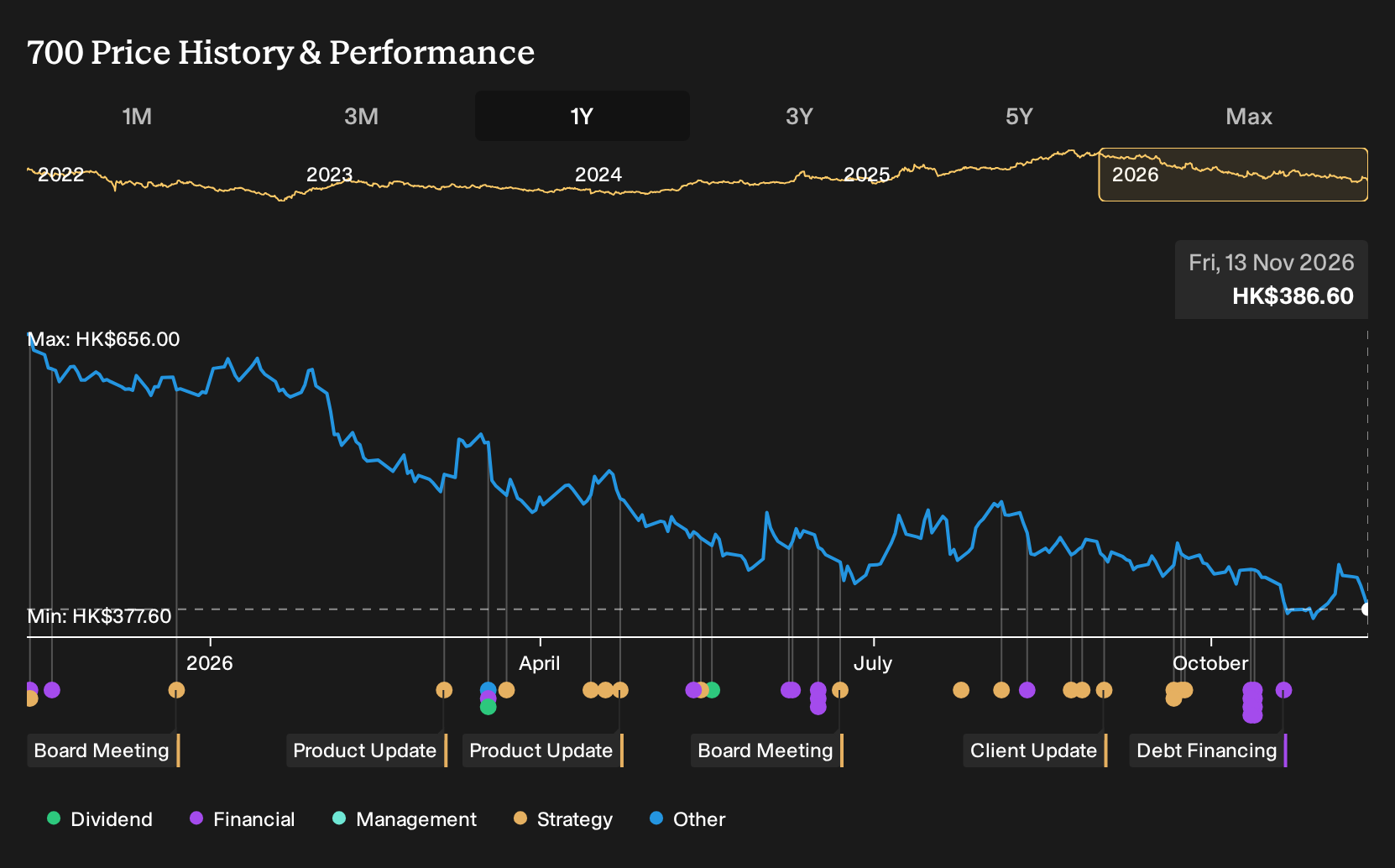
If you had backed Tencent on the promise of AI driven growth, heavier cloud usage and new monetisation inside WeChat, the past year has probably felt jarring. For Tencent shareholders, the loss over the past year was 39.0%, including dividends. The business still reported higher revenue and profit in recent quarters, so what exactly did the original case miss about margins, chip access and AI spending intensity that were already visible risks in late 2025, yet underweighted?
This theme extends beyond Tencent. See which of 53 AI infrastructure stocks may still merit a closer look.
The Two Tencent Stories Investors Were Pricing In
The shares cost HK$656 at the start of the period, leaving Tencent investors weighing two very different stories about what came next.
On the optimistic side, one thesis set a Fair Value of HK$814, a price implied by assumptions that Tencent could lift revenue by 15.0% with profit margins at 31.0%, backed by Weixin Video Accounts, games and AI tools such as Hunyuan.
A more cautious view pointed to a Fair Value of HK$508, based on Tencent only reaching 12.0% revenue growth, 24.0% profitability and tighter future regulation around data and gaming.
What The Tencent Evidence Actually Tested
Tencent poured money into AI, with Q2 2026 results showing revenue at CNY204.8b and net income at CNY56.0b while net margin slipped from 30.2% to 27.4%. Heavy capital spending on chips and models, along with cancelled overseas chip leasing and intermittent H200 shipments, challenged the higher margin path in the optimistic case. The evidence cut both ways.
The lesson is simple. When an investment pitch leans on AI efficiency and strong margins, track reported net margin and disclosed AI capex together, not just headline revenue or product launches.
What Tencent’s Current Price Already Assumes
Tencent now trades at HK$387, well below where many shareholders bought in over the past year. According to tripledub, an investor in the Simply Wall St Community who wrote the Narrative, the Fair Value in that workup sits above the current share price, based on cash flow expectations rather than sentiment.
The Narrative’s core question is whether heavy AI and infrastructure spending is misread as a permanent drag rather than an investment that current operations can support. A buyer today would need to judge whether those cash outlays eventually earn enough to cover higher depreciation and AI losses without eroding the existing profit engine.
"So the market looked at one of the world's most reliable cash machines, watched it pour a full quarter's operating cash flow and then some into silicon, and repriced it as though the machine were broken. That is the whole story of the chart."
One Narrative disagrees with today's price. → See where this Narrative says Tencent should trade
Tencent And One AI Parallel
Tencent’s AI push raises a practical question. Where else are enterprises renting heavy AI computing power?
Another large platform has been weaving AI into its cloud tools. It offers infrastructure and software that let businesses train models and embed them into everyday workflows.
Search, office software and security products all lean on that same AI engine. Customers use one pool of computing capacity to support many tasks at once.
If demand for Tencent style AI services keeps building, that blend of ads, cloud and embedded AI could matter far beyond its original business model.
It is written up in full, assumptions and all. → Explore the Narrative that puts this company 46% above its price
Have feedback on this article? Concerned about the content? Get in touch with us directly. Alternatively, email editorial-team@simplywallst.com