
Aramark’s Q3 CY2026 earnings results: Revenue in line with expectations

Food and facilities services provider Aramark (NYSE:ARMK) met Wall Street’s revenue expectations in calendar Q3 2026 [fiscal Q4 2026], with revenue up 4.8% year on year to $5.29 billion. Its non-GAAP profit of $0.71 per share was 5.9% below analysts’ consensus estimates.
For more on Aramark, read our full research report, available free.
Aramark Q3 CY2026 highlights:
- Revenue $5.29 billion vs analysts’ consensus estimates of $5.31 billion, according to S&P (4.8% year-on-year growth, in line)
- Adjusted EPS $0.71 vs analysts’ consensus estimates of $0.75, according to S&P (5.9% miss)
- Operating margin 5%, in line with the same quarter last year
- Free cash flow margin 21.9%, up from 20.8% in the same quarter last year
- Market capitalization $14.22 billion
“Fiscal 2026 was a phenomenal year for Aramark, defined by unprecedented performance across the Company, with this momentum continuing into the new fiscal year,” said John Zillmer, Aramark CEO. “Our achievements included 1) record gross new business wins of $1.9 billion; 2) an all-time high client retention rate of approximately 97%; 3) the launch of Aramark Nexus in April as a complement to our existing portfolio, which is already contributing to revenue and profitability; 4) the addition of $1.3 billion in new purchasing spend to our Global Supply Chain network; and 5) a reduction in our leverage ratio to 2.7x, our lowest level in nearly two decades. I couldn’t be more proud of our teams, whose unwavering commitment to serving clients drove record results across key operating metrics as we concluded the fiscal year.”
Revenue growth
Reviewing a company’s long-term revenue performance reveals insights into its quality. Any business can report a good quarter or two, but the best consistently grow over the long haul. Aramark’s 10.7% annualized revenue growth over the last five years was favorable. Its growth beat the average business services company and shows its offerings resonate with customers.
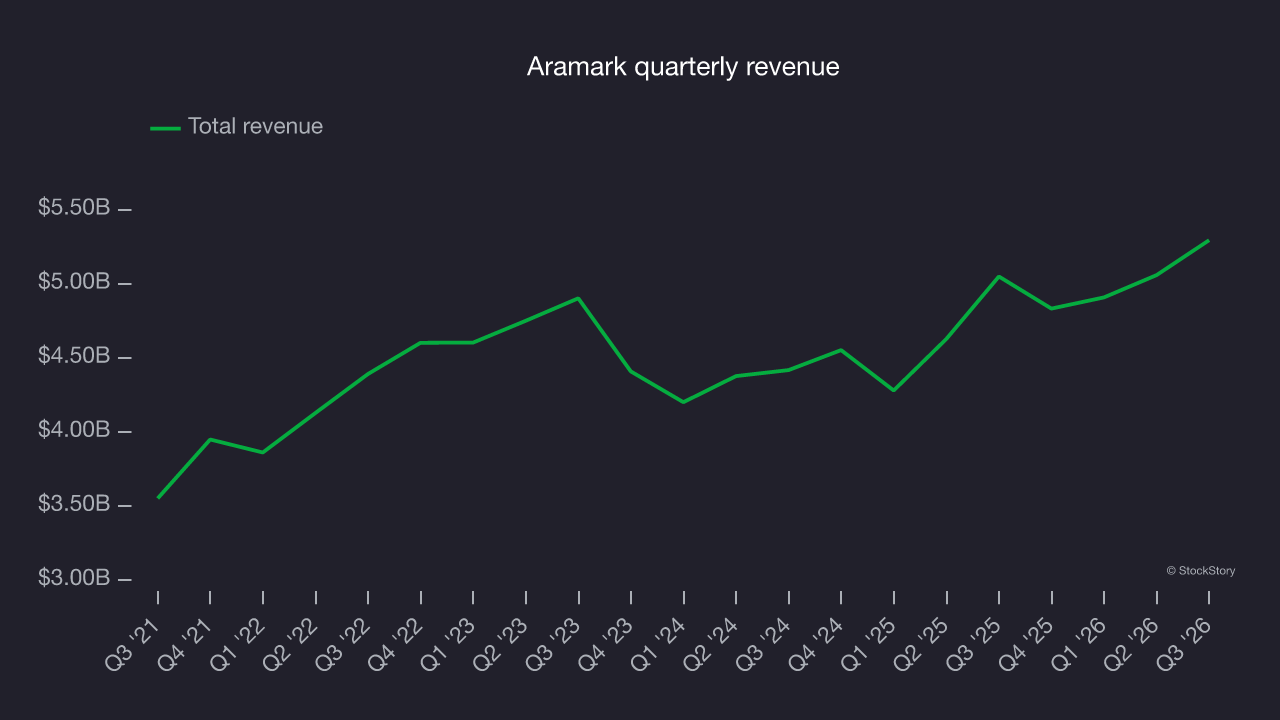
Long-term growth is the most important, but within business services, a half-decade historical view may miss new innovations or demand cycles. Aramark’s annualized revenue growth of 7.5% over the last two years is below its five-year trend, but the results still suggest healthy demand. 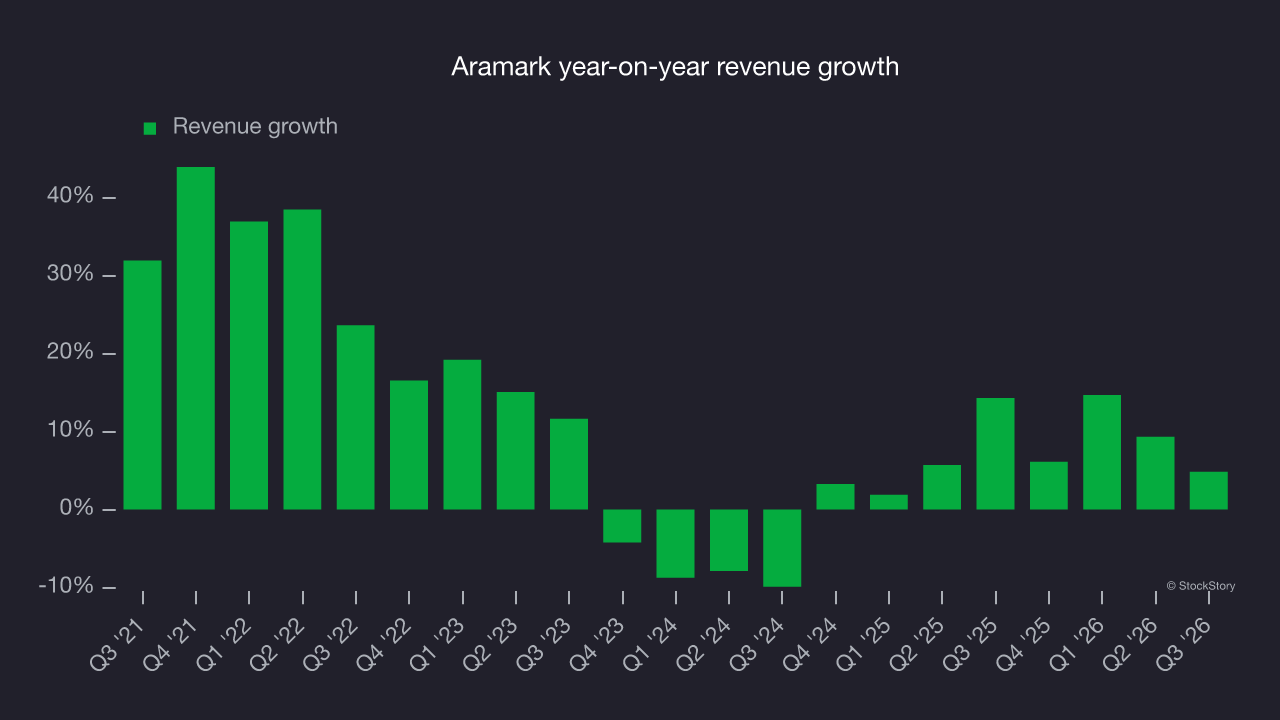
This quarter, Aramark grew its revenue by 4.8% year on year, and its $5.29 billion of revenue was in line with Wall Street’s consensus estimates.
Looking ahead, sell-side analysts expect revenue to grow 9.3% over the next 12 months, according to S&P, an improvement versus the last two years. This projection is particularly noteworthy for a company of its scale and suggests its newer products and services will fuel better top-line performance.
Adjusted operating margin
Adjusted operating margin is a key measure of profitability. Think of it as net income (the bottom line) excluding the impact of non-recurring expenses, taxes and interest on debt – metrics less connected to business fundamentals.
Aramark’s adjusted operating margin has generally stayed the same over the last 12 months, averaging 5.2% over the last five years. Profitability was poor for a business services company because of its suboptimal cost structure.
Looking at the trend in its profitability, Aramark’s adjusted operating margin might have fluctuated slightly but has generally stayed the same over the last five years. This raises questions about the company’s expense base because its revenue growth should have given it leverage on its fixed costs, resulting in better economies of scale and profitability.
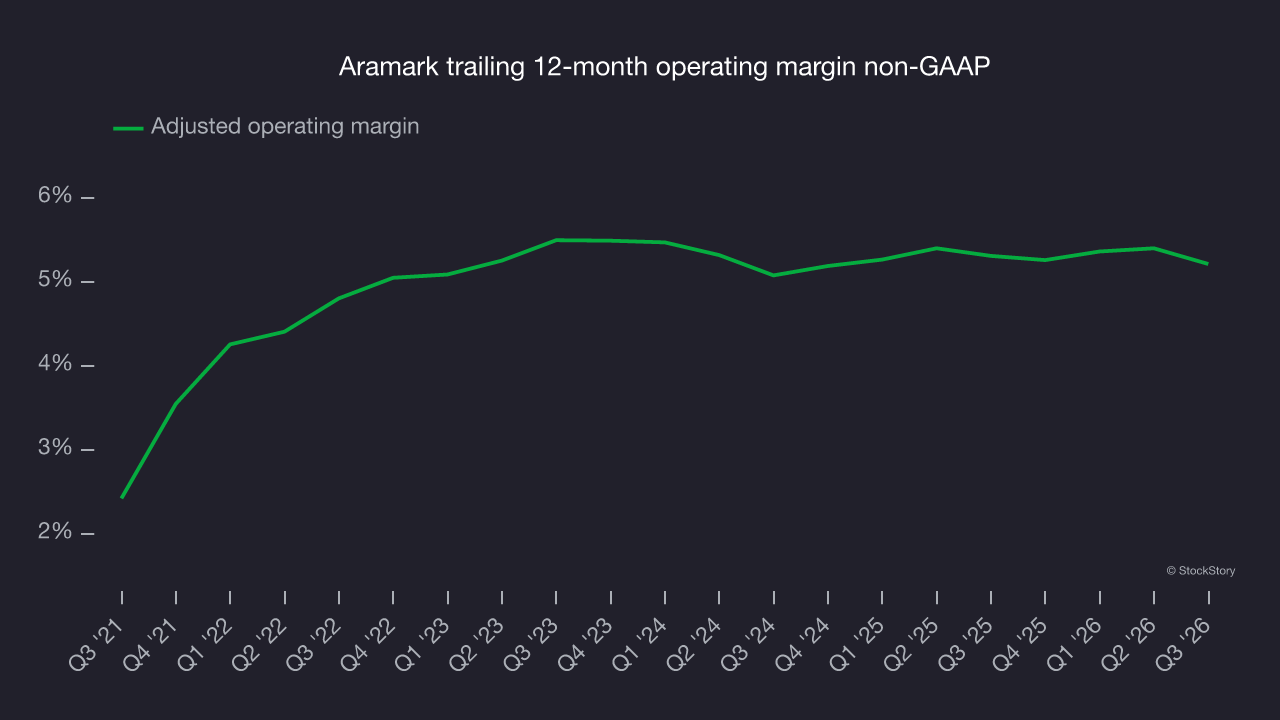
In Q3, Aramark generated an adjusted operating profit margin of 5%, in line with the same quarter last year. This indicates the company’s overall cost structure has been relatively stable.
Earnings per share
We track the long-term change in earnings per share, or EPS, for the same reason as long-term revenue growth. Compared to revenue, however, EPS highlights whether a company’s growth is profitable.
Aramark’s full-year EPS turned positive over the last five years, a positive development that marks a critical point for the business.
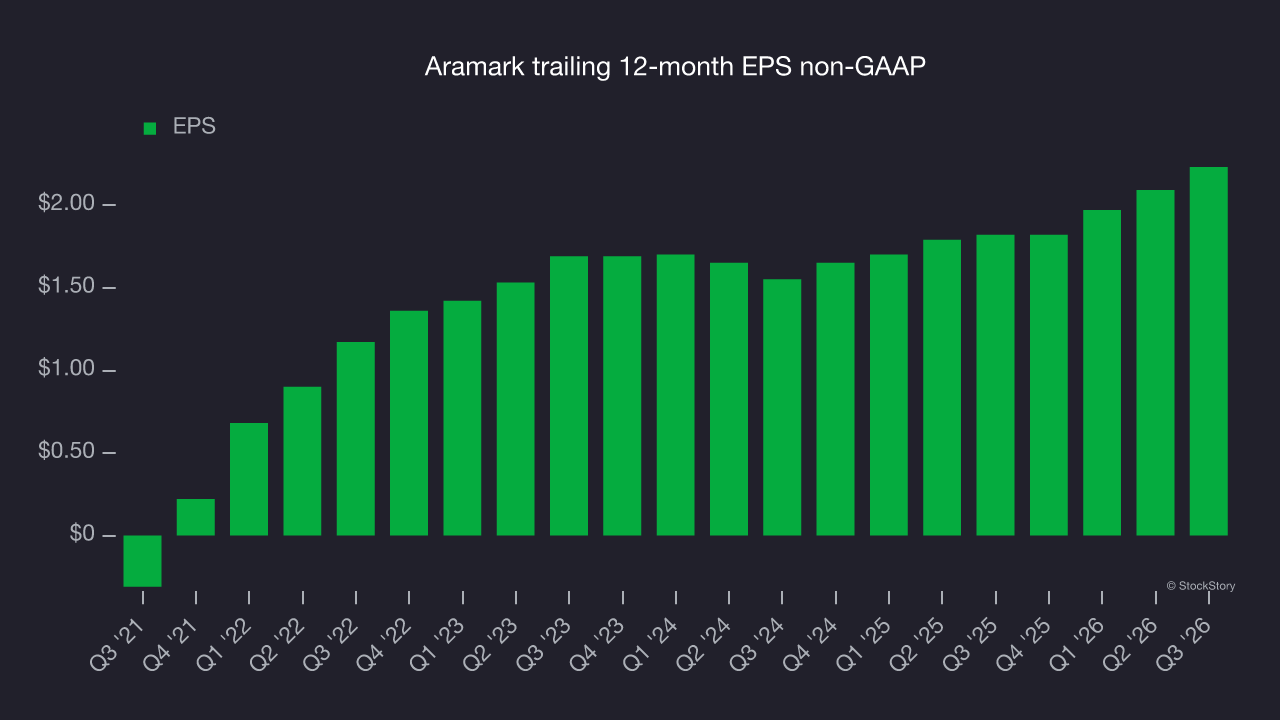
Like with revenue, we analyze EPS over a more recent period because it can provide insight into an emerging theme or development for the business.
Aramark’s EPS grew at a strong 19.9% compounded annual growth rate over the last two years, higher than its 7.5% annualized revenue growth. This indicates the company became more profitable on a per-share basis as it expanded.
In Q3, Aramark reported adjusted EPS of $0.71, up from $0.57 in the same quarter last year. Despite growing year on year, EPS missed analysts’ consensus estimates, but long-term adjusted EPS growth matters more than short-term movements. Over the next 12 months, Wall Street expects Aramark’s full-year EPS to grow 25.9% from $2.23 to $2.81, according to S&P.
Key takeaways from Aramark’s Q3 results
An EPS miss and revenue in line with Wall Street’s consensus estimates left few positives in Aramark’s softer quarter. Shares fell 3.8% to $51.88 immediately after the results.
Aramark’s latest quarter was underwhelming. One earnings report doesn’t define a company’s quality, though, so assessing whether the stock is a buy at the current price requires considering its valuation and business quality alongside the latest results. For more on these factors, read our full research report here (it’s free).