
What you think of diversifying your positions is actually betting on AI? Wall Street begins penetrating AI risks to find cash flow winners
The most important change in market sentiment right now in the stock market investment frenzy surrounding AI can be described as investors beginning to ask: How many potential returns and benefits does the entire investment portfolio actually have, and is heavily dependent on the same trillion-dollar AI computing power infrastructure spending expected to continue to expand? More importantly, some important research reports revealed that AI risk allocation exposure has far surpassed the classification of technology stocks.
After the rebound, the Philadelphia Semiconductor Index still retreated about 31% from its historical closing high. Combined with the intensive reduction in Nvidia's target price and forecasted contraction of forward computing power purchases, the market began to penetrate stocks, bonds, and private equity investments to investigate the extent to which they all depended on AI capital expenditure to continue to expand. GPU, storage, optical interconnection, and power equipment companies rely on customer procurement, computing power project loans rely on lease payments, and some municipal bonds are linked to fiscal revenue from data centers; once financing becomes tight and park delivery is delayed, order fulfillment, profit growth, and solvency may simultaneously be under pressure.
The Zhitong Finance App learned that MSCI statistics show that the largest companies most directly related to AI involved an investment of at least US$25.3 trillion; in the group of large pensions studied by Equable, 52 AI-related listed companies accounted for their public stock holdings, rising from 20.7% in early 2010 to 38.5% in June 2026, equivalent to 9% to 11% of the fund's total assets, and not yet included in bonds, venture capital and other private equity assets. What really needs to be penetrated is the actual source of return on investment — whether different securities rely on the same AI spending, customer credit, and project delivery assumptions.
PGIM's two-tier screening of nearly $1 trillion in fixed income investments is a reflection of this change: it not only analyzes how AI changes the business model and credit quality of enterprises, but also examines how a slowdown in capital expenditure or market crises are transmitted to indirect positions. Municipal bonds may rely on additional taxes from data centers, industrial enterprises may rely on park equipment orders, and loans may rely on computing power to repay rent debts.
Nomura asset management strategist Andy Goldberg warned that investors who hold a wide range of AI-related assets may jointly increase sales pressure even if they only cut allocations slightly; BlackRock's Jay Jacobs pointed out that index concentration has made diversification more difficult than it seems on the surface.
Peter Berezin, chief economist at BCA, emphasized that increased productivity does not necessarily lead to increased profits: efficiency gains may be transferred to customers through competition and price cuts, and easing supply bottlenecks may also weaken equipment manufacturers' excess profits. Powell Industries fell from a high of $328 to $146 during the year and retraced about 55.5%, reflecting the market's repricing of the scarcity premium. Corresponding to this, the reduction in computing power costs may also improve the unit economy of application companies.
Risk assessments can also uncover major investment opportunities that have been overlooked by the market. Rob Arnott, founder of Syzygy Asset Management, believes that investors are overfocusing on popular AI assets with crowded valuations and may ignore companies that can use AI to create value but have not yet received sufficient pricing. Looking at the operating mechanism, the decline in computing power costs and the spread of AI tools are expected to reduce the R&D, customer service, and operating costs of some enterprises, but whether these efficiency benefits remain in the profit statement still depends on the company's pricing power, competitive pattern, and organizational execution ability.
This also echoes BCA's chief economist Peter Berezin's latest judgment — that increased productivity does not necessarily lead to increased profits. Therefore, the investment value of penetrating AI exposure lies not only in identifying positions that focus on capital expenditure expansion, but also in finding companies that can continuously transform AI efficiency gains into profit and free cash flow, and valuations have yet to fully reflect this improvement. The value of AI theme allocation in the next investment stage will probably depend more on whether enterprises can maintain cash flow growth after construction growth slows down, and whether AI users can turn efficiency improvements into real retained profits.
Fee has rebounded but still hasn't broken out of the bear market trajectory, and the market has begun to recalculate AI risk accounts
Previously, after a sharp decline on November 5, semiconductors and broad technology stocks in the global stock market counterattacked on the 6th, 9th, and 11th, but on the 13th, the Philadelphia Semiconductor Index and NASDAQ 100 fell by 3.43% and 1.22%, respectively. Although the week was still up 8.05% and 3.53%, respectively. By the close of the 13th, the Philadelphia Semiconductor Index was still 30.67% lower than its historical closing high on June 22, and the NASDAQ 100 was about 10.5% lower than its peak on October 6. The Philadelphia Semiconductor Index can be described as having fallen into a technical bear market. The retracement reached 38.43% on November 5. The recent strong rebound has yet to recover this decline, while the NASDAQ 100 is in the adjustment range of more than 10%.
Nvidia's leadership changes have further increased the risk compensation required by the market. The company disclosed that the board of directors accepted the resignation of Hwang In-hoon on November 11, and that Chief Financial Officer Colette Kress also served as interim CEO. Subsequently, Goldman Sachs lowered its target price from $300 to $220, Citi from $285 to $225, and Morgan Stanley from $300 to $267, but retained the “buy”, “buy” and “overrated” ratings, respectively.
Based on the Nvidia stock closing price of $162.85 on the 13th, these Wall Street financial giants still implied an upward margin of about 35.1%, 38.2%, and 64.0% after Nvidia founder Wong In-hoon was forced to resign as CEO. The differences focus on how much profit existing orders can support, and how much leadership uncertainty should weigh down valuations: Goldman Sachs believes that long-term orders limit the direct impact on earnings in the next 12-18 months, but the valuation multiples are under more obvious pressure.
The AI computing power theme and intense selling pressure on the semiconductor sector, sparked by Hwang In-hoon's resignation, spread further to Asia on November 16: the Taiwan Weighted Index closed down 6.03%, a cumulative retracement of about 17.63% from the historical closing high on October 6; South Korea's KOSPI index fell 3.59%, and Nikkei 225 fell 2.42%. The Asian stock market has huge chip design, wafer manufacturing and memory chip leaders, as well as cutting-edge 3D advanced packaging systems and chip testing systems, which are divided into different semiconductor market segments, yet they share the procurement budgets and guaranteed financing conditions of Nvidia and many large AI cloud computing-related customers. When the market simultaneously re-evaluates customer expenses, management continuity, and capital costs, geographical fragmentation makes it difficult to fully offset the impact of common sources of demand.
Based on the closing price of the day, the Taiwan Stock Market Benchmark Index retracted by about 17.6% from the closing high on October 6; SK Hynix and Samsung Electronics retraced their intraday highs on June 25 and June 19, respectively, by about 62.5% and 47.4%, respectively. These declines over various time spans show that hardware deals related to AI infrastructure have experienced significant valuation contractions brought about by the “delay in the AI data center construction process” argument after the Democratic Party won the election, and Monday's sell-off further deepened the adjustments. Changes in Nvidia's leadership, particularly Wong In-hoon's resignation as Nvidia CEO due to a series of negative events, have caused global investors to re-evaluate the continuity of their customer financing support and industry chain cooperation arrangements.
The AI sell-off frenzy has investors rushing to measure their true risk exposure
Until recently, investors viewed artificial intelligence as one of the biggest investment bets Wall Street has ever made. Today, many portfolio managers are taking a more cautious approach to this area, trying to assess how much AI risk their portfolios actually contain.
This is a big deal. According to the MSCI Global Intelligence Index, at least $25.3 trillion has been invested in the world's largest companies most directly related to AI. Additionally, as AI reshapes industries, investors also have additional exposure that is difficult to quantify for companies that may benefit or suffer from it.
The recent sharp sell-off of AI-related stocks, including Wednesday's decline triggered by the resignation of Nvidia CEO Hwang In-hoon, brought back into focus how much AI exposure investors actually have.
For Andy Goldberg, chief investment strategist at Nomura Asset Management, he felt the scale of the problem firsthand when he saw last month that wedding retailer David's Bridal was planning to spin off its AI wedding planning business next year and push for the market.
“Since when have bridal shops been the target of AI investment?” Goldberg said. He added that the problem is that even in the most unexpected corners of the economy, there are AI exposures. David's Bridal CEO Kelly Cook said the company “has been a pioneer in applying AI to retail for many years.”
Goldberg said that from freight companies that use AI tools to solve logistics problems, to municipal bonds where credit ratings may depend on revenue from building new data centers, AI affects both risk and return.
“No one knows exactly how much AI exposure they actually have; by this stage, it's actually turned into a huge mutual deal.” Goldberg said. He added that if investors decide to cut AI-related asset allocations by even 1% or 2%, the market reaction could “look like a collapse.”
A reconnaissance investigation task
For investors trying to clarify these exposures, this process is becoming more and more like a reconnaissance investigation.
Analysts and portfolio managers managing close to $1 trillion in fixed income investments at PGIM, an investment management agency under Prudential Insurance, began two AI-based screenings for every bond, loan, and structured securities this year. One assesses the impact of AI on a company's business model and credit status; the other examines risk exposure brought about by events ranging from the slowdown in AI-related capital expenditure to market crises in the most unexpected companies.
“We know how to assess direct exposure, such as having a data center or a chip in the portfolio.” Brian Barnhurst, PGIM's head of global credit research, said, “But what about indirect effects? It's important to understand that.”
Barnhurst said that this approach helps analysts clarify one by one: “What does AI mean for this healthcare company, this industrial company, or this telecommunications company?”
Is the real risk exposure too high?
Needless to say, global institutional or retail investors are investing in AI themes and the actual market capitalization of AI themes is huge. The Equable Institute, a non-partisan pension think tank, estimates that as of June 2026, a basket of shares composed of 52 AI-related listed companies accounted for 38.5% of a group of large pension public stock holdings, up from 20.7% in early 2010.
Equable estimates that 9% to 11% of the total assets of these funds are invested in AI-focused companies. This figure doesn't include debt holdings, venture capital, and other private equity investments, so it almost certainly underestimates their wider exposure.
Jay Jacobs, head of BlackRock's US equity ETF business, said that at this stage of the AI cycle, “understanding the true exposure of investment portfolios is becoming more important.” So many AI core holdings now dominate large indices, forming a certain degree of concentration, making “achieving diversification more difficult than investors may realize.”
Continued news of major AI companies such as Nvidia, Anthropic's upcoming initial public offering, and concerns about CoreWeave have further increased uncertainty.
Some fund managers are responding by raising stock selection standards.
Peter Berezin, chief economist at BCA Research, a market, economic and geopolitical research institute, said that the market's relentless crackdown on companies involved in AI transactions “can be seen as an early warning sign that all of us need to be more picky when reviewing the AI promotion process.”
“AI is likely to eventually make companies more productive, but it won't necessarily make them more profitable.”
Powell Industries' share price fluctuations are an example. The company's power management system is a critical component of the data center. Its stock price was only $8 four years ago; it once rose to $328 this year, but has since dropped to $146.
Powell Industries did not respond to requests for comment.
Berezin said that bottlenecks in data center construction will eventually be mitigated, thereby weakening the excess profits obtained by Powell and other AI beneficiaries. But it's also unknown when this will happen.
Adding fuel to the fire
Wall Street institutional investors and analysts almost agree that these factors together form the conditions for continued market fluctuations.
Junley Henderson technology analyst Shawn Bucky said that since AI valuations peaked in June, “we have seen a long list of concerns continue to accumulate.” He said the US midterm election results were “almost like adding fuel to the fire,” and the Democratic Party's expansion of seats raised concerns about the future growth of AI. He said that this made investors “increasingly want to discern good and bad from it.”
Liz Ann Sanders, chief investment strategist at Carson Wealth Management and Finance Research Center, said that even after detailed research, “the quantitative relationships behind all of these AI exposures” make such a highly concentrated market extremely difficult to manage.
However, Rob Arnott, founder of Syzygy Asset Management, said that a calm and pragmatic assessment of AI concentration in an investment portfolio can reveal both risks and opportunities.
“There's some kind of visual limitation here.” he said. When investors “take huge risks in one area of the market where the bubble is stronger, they are ignoring the opportunity to invest in other companies in advance — AI will create value for these companies, but this value has not been recognized by the market until now.”
The market reassesses AI risks! SemiAnalysis predicts that AI computing power will be drastically cut: 2028 capital expenditure forecast will be reduced by nearly 30%, and silicon shipping area will drop 17%
According to a research report recently released by the well-known market research agency SemiAnalysis, global AI accelerator capital expenditure forecasts for 2027-2030 will be reduced by about 19%, 28%, 41%, and 40%, respectively. The new forecasts are 627 billion, 758 billion, 796 billion, and 923 billion US dollars. These are cuts compared to the old forecast, not a year-on-year decline; the new path still means that the scale of investment will increase from US$392 billion in 2026 to US$923 billion in 2030, with a compound annual increase of about 24%.
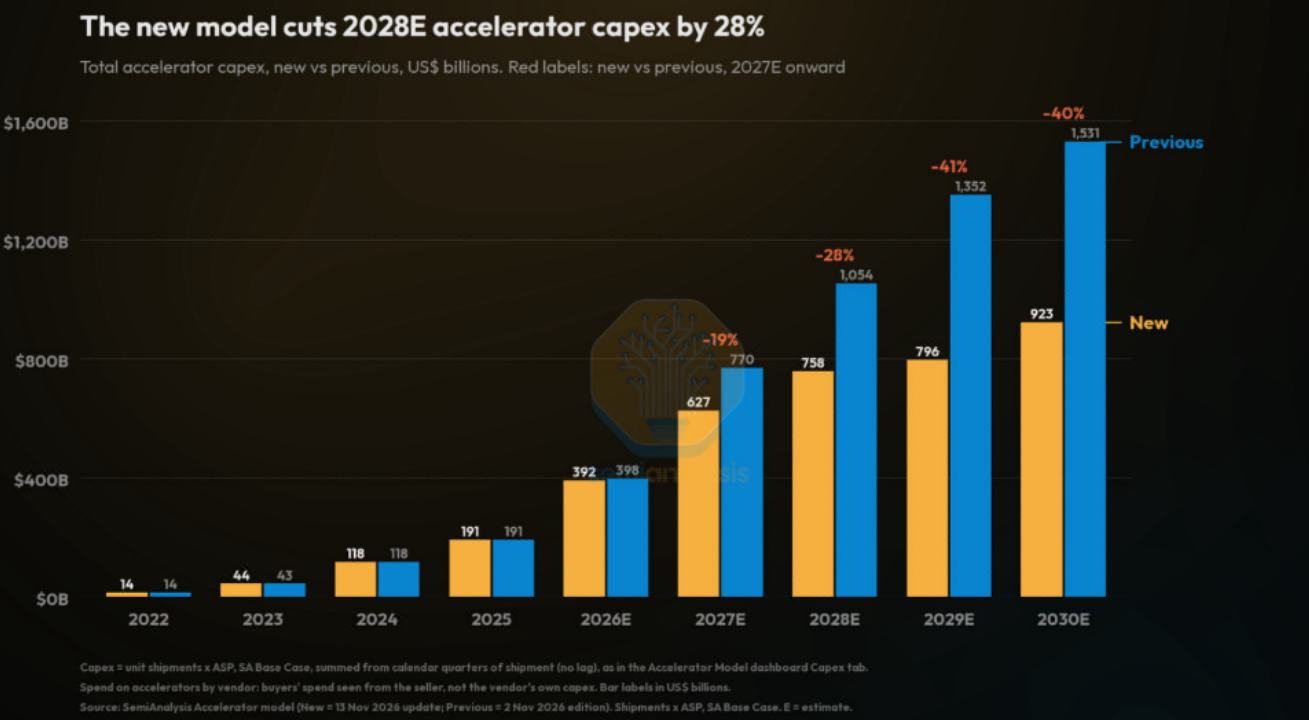
The SemiAnalysis analyst team said that the main reason for the adjustment is that the growth of new revenue growth of cutting-edge model companies is slowing, financing is being tightened, and the ability to cover computing power costs is being examined. Delayed delivery of 5.8 gigawatts of US data center capacity is expected to further increase the pressure. The core change is that after the Democratic Party took control of the US Congress, the AI data center construction process slowed down, revenue cashing and financing capacity began to restrict procurement, and computing requirements associated with non-AI workloads suddenly disappeared.
On the hardware side, there are also double adjustments in quantity and price: the cumulative forecast for accelerator logic silicon wafers was reduced by 17% from 2026 to 2030, especially Nvidia accounting for 66% of the reduced area; HBM capacity demand fell from 9.0 EB to 6.4 EB in 2028, a drop of nearly 30%; and accelerator power requirements dropped from 122.8 gigawatts to 80.7 gigawatts in 2030. However, the area, storage capacity, and power of the logic silicon individually measure different requirements and are not interchangeable as the number of chips.
Lower HBM costs and lower sales prices and price increases for new products will also cause nominal purchase amounts to drop faster than physical demand. As far as the profit prospects of AI computing power supply chain leaders are concerned, it is necessary to simultaneously observe delivery quantities, product portfolios, and pricing rights.
As a result, the degree of pressure between companies is significantly divided. SemiAnalysis believes that Nvidia faces financing risks from new cloud customers, competition for alternative computing platforms, and narrowing space for hardware price increases; Broadcom's five-year ASIC revenue forecast is reduced by 11%, mainly including the transmission of HBM cost decline to sales price; AMD's near-end deployment is relatively steady, but long-term forecasts are still being cut, and some MediaTek custom chip projects have also been adjusted; Amazon Trainium's 2027-2028 shipping forecast remains unchanged. Furthermore, it is worth noting that this round of model revisions in SemiAnalysis did not take into account the impact of Hwang In-hoon's departure.
The research agency also said that GPU/TPU/ASIC, CPU, storage, optical interconnection, power equipment, and even project loans may all rely on scheduled financing, commissioning, and payments from the same group of customers; holding more links in the industry chain does not automatically reduce this common risk.
Based on Goldman Sachs and Morgan Stanley's investment strategy outlook for the 2027 global and Asian stock markets, AI-related investment opportunities can be selected from three main lines: infrastructure providers that can convert orders into revenue on schedule and maintain profit margins; cloud platforms with sound balance sheets, financing capabilities and commercialization advantages; and companies that can increase productivity, improve profits and cash flow through AI applications. The investment criteria that run through these three main lines are whether growth can be realized and whether current valuations reasonably reflect future returns.