
Intelligent organizations bring continuous AI rewards, and it is time to revalue Baidu-W (09888), where cloud services have become a growth engine
Since this year, the overall capital expenditure of the global AI industry has increased sharply, but financial returns on the enterprise side have lagged behind, creating a fault between the two. In order to clarify the root cause of this gap, McKinsey and Boston Consulting conducted separate empirical studies on large samples. The two came to similar conclusions.
The key reason for the gap between investment expenses and corporate returns is not model ability, but rather poor organizational restructuring. The vast majority of enterprises only use AI as an “upgrade tool”; they do not redivide tasks, accumulate knowledge, or rearrange human-robot collaboration around AI. Although personal efficiency has improved, there has been no significant improvement in the organization's profit and loss statement.
In this context, as the first full-stack AI company in China to publicly propose the “intelligent organization” concept and systematically implement it, Baidu's financial report for the third quarter of 2026 provided a key verification window for the market: that is, can Baidu take the lead in transforming organizational restructuring into verifiable commercial returns and operational quality improvements on the necessary track of AI implementation?
AI accounts for 53% of revenue, and the profit margin of the cloud business has increased dramatically to become a growth engine
To understand Baidu's latest financial report, you need to have a clear understanding of the shift in the focus of market attention. As the market gradually desensitizes large model competition and iteration, industry competition has moved from “model capability competition” to “cost performance ratio and implementation efficiency competition”. After all, at a time of rapid model iteration, it is difficult to maintain a single-point performance advantage, and the window period may only be several months.
More importantly, what the customer actually pays for is not the “model itself,” but the “business results,” and the customer needs to solve actual problems in sales, R&D, operation and maintenance, and customer service. Therefore, evaluating the value of Baidu's AI should not be based on the position of a model on the list; it should be based on whether its AI capabilities can penetrate business scenarios, settle into reusable organizational assets, and ultimately transform into sustainable operating returns.
And data is the least likely to lie. In the third quarter of 2026, Baidu's new core AI business revenue was 13.2 billion yuan, up 37% year on year, and 6% month on month, accounting for 53% of Baidu's general business, up 14 percentage points year on year and 3 percentage points month on month. This has already accounted for more than half of this indicator for three consecutive quarters.
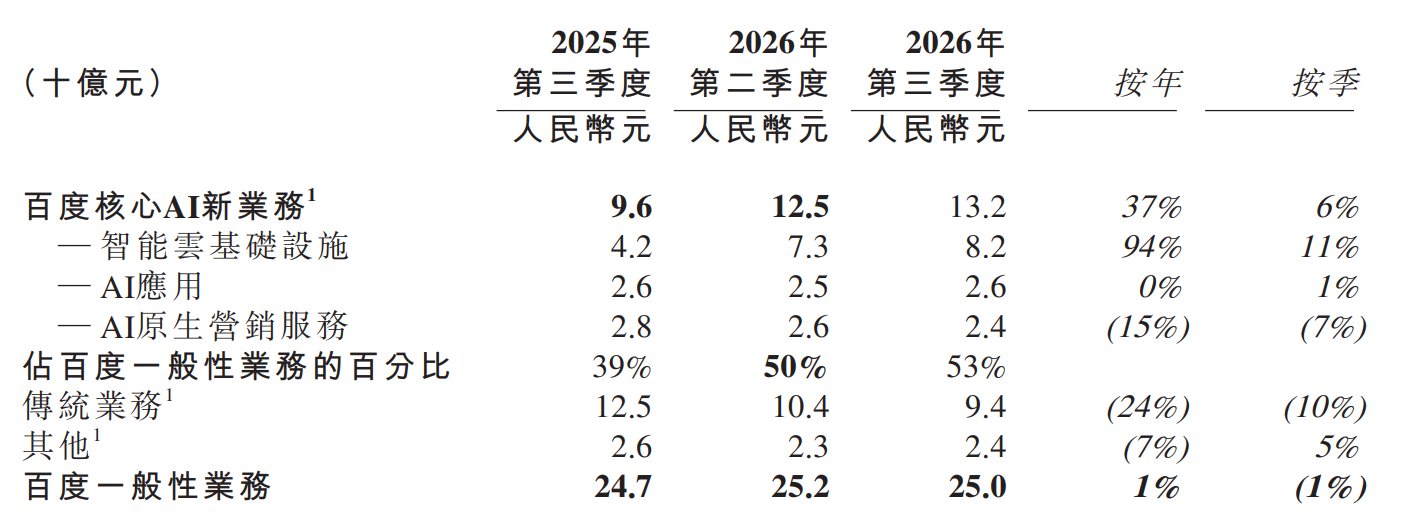
The point is that after accounting for more than half, the AI business did not fall into the inertia of “the base becomes larger and the growth rate slows down”. Instead, it achieved both the same and month-on-month growth, which is enough to show the strong strength of Baidu's AI business in terms of implementation efficiency. Among them, the smart cloud business, which grew 94% year on year and 11% month on month, has become a key force driving the rapid growth of Baidu's new core AI business.
At the Q3 earnings conference call, Baidu management further disclosed the operating details of the smart cloud business. The profit and profit margin of the smart cloud business increased year-on-year and month-on-month, contributing significantly to overall profit. Thanks to the strong drive of GPU Cloud, Kunlun Core, and MaaS, these three businesses together account for more than half of AI cloud infrastructure revenue.
Among them, GPU cloud revenue surged 191% year-on-year and 43% month-on-month during the reporting period. The growth rate far exceeded that of traditional cloud computing, indicating that the driving engine had switched from “resource leasing” to “AI business deployment.” Furthermore, the three major GPU cloud customers renewed their contracts this year and extended them for a maximum period of 6 years, which significantly shortened the company's AI cloud infrastructure payback cycle.
At the same time, token call revenue from external customers on the Qianfan MaaS platform surged 1159% year over year, indicating that customers were not idle after purchasing, but instead continued to embed AI into business processes to generate call consumption. Furthermore, mass production of the Kunlun Core M100, which is optimized for large-scale AI inference, is expected to begin at the end of 2026, and large-scale deployment in 2027 is already a definite event.
The strong growth of the three major businesses, GPU Cloud, Kunlun Core, and MaaS, shows that Baidu's smart cloud revenue is being delivered from a project system to an accelerated shift to a “deployment-invocation-renewal” reusable subscription model. This is the most direct reflection of “customers pay for business results” on the financial reporting side.
If data from the smart cloud verifies that Baidu's AI capabilities have passed the closed commercial loop of “deployment, call, and renewal,” then Radish Run proves that this set of AI capabilities can be reused and scaled in asset-heavy physical scenarios.
In the third quarter of 2026, Radish Express expanded to 30 cities worldwide, with an autonomous driving mileage of about 34 million kilometers in a single season, with a cumulative total of over 390 million kilometers; unmanned orders in Shenzhen increased by about 170% month-on-month, and the size of the Dubai fleet doubled.
What is behind this is not a single-point model ability, but a continuous closed loop of perception, decision-making, scheduling, and operation in real road conditions. The vehicle itself becomes a “physical intelligence” operating on an open road, refining the unit economy and verifying the possibility of large-scale replication every time an order is taken and driven.
However, the reason why Smart Cloud and Radish Run can accelerate the export of Baidu's AI capabilities to the outside world is that Baidu's own intelligent organizational restructuring has achieved initial results. In the past year, Baidu's internal daily active intelligence (DAA) increased from an average of 50,000 to 37,000 (more than 6 times), and the number of effective weekly tasks completed increased from 84,000 to over 1 million (over 11 times). 4,300 workspaces have been built, and more than 20,000 organizational skills have been accumulated.
When “human+agent” collaboration became the norm for tens of thousands of employees, Baidu no longer only sold AI to technical vendors, but first transformed itself into a test field for “intelligent organizations” and verified it for personal use, which is the strongest endorsement for external export.
Demand side and supply side are coupled in both directions, and the three paths bite to accelerate the “flywheel effect”
From the above analysis of financial reports, it is easy to see that Baidu, which has promoted the “intelligent organization” from the concept to its own implementation, has verified the company's AI capabilities to achieve sustainable management returns through smart clouds and radish sprint. Achieving this result is essentially a two-way coupling between “paying for results” on the demand side and “full stack closed loop” on the supply side.
Currently, market demand is undergoing a structural shift: the standard for enterprises to procure AI has changed from “whether the inference effect is good enough” to “whether it can be continuously used and output stabilized in the daily business flow”. Whether the computing power can withstand the peak, whether the model can be applied to the scenario, whether the solution can be embedded in the ERP/CRM/production line system, and whether the service can be procured and managed for a long time. Of these four things, the single-point model supplier was unable to deliver on any of these four matters.
This is the underlying logic behind Baidu's definition of an “intelligent organization” as the next scene: when AI changes from personal efficiency improvement tools to organization-level infrastructure, companies are no longer buying the model itself, but a closed loop of tasks delivered as a “core, cloud, model, and body”.
However, Baidu's full-stack layout on the supply side is in line with this demand. The company focuses on an iterative application model, uses terms to lower the enterprise call threshold, and uses an intelligent matrix to go deep into the business backbone. Through these three interlocking paths, the requirement to “pay for results” is translated into a product structure that can be delivered on a large scale.
In terms of model iteration, Baidu sticks to the “scene definition model.” The company's Wenxin Lightning deep thinking model was born out of searching for massive inference requirements. Using BSA sparse attention+Kunlun Core collaboration, inference ROI was increased by 50% and calling costs were reduced by more than 30%. At the same time, Wenxin Yigyo specializes in digital people, reducing video costs by 50%, and the high-speed version becomes a 1:1 real-time film.
This kind of model core collaboration runs the “scenario force - model backfeed” in a closed loop, not only meeting the real needs of the enterprise, but also suppressing unit inference costs, and preventing AI investment from falling into the trap of “only burning money and not producing”.
In terms of lowering the call threshold, the “Etymology Center” published by Baidu targets the trust and threshold issues of enterprises “using AI for the first time”. How to select models, unreliable sources, and how much does it cost to connect? These are all real pain points for companies.
“Word Source Institute” uses a “verification+credit reporting” mechanism as a “big model exchange”, and achieved outstanding results: on the first day of release, more than 100 suppliers and 1,000 customers accessed, the average number of test runs exceeded 50 million times per day, and more than 40 models were launched, covering mainstream and self-developed series.
In the short term, the launch of the “Word Element Institute” allows enterprises to “run first” at a low threshold, turning trials into continuous use; in the long term, they establish measurable supply management methods through verification, price comparison, and continuous monitoring. Qianfan MaaS Token's revenue surged 1159% during the reporting period, which verified the strong cashout potential of the “Word Element Institute” in the “low threshold entry → continuous use” path from the commercial side.
Meanwhile, while the “etymology office” solves “entry points,” Baidu uses an intelligent matrix to solve “retention and deepening,” and it incorporates smart devices into the backbone of customer business according to industry know-how. For example, as a unified task portal for enterprises to call agents, the task completion rate exceeds 99%. The deeper the business is embedded, the more skills and workspaces are settled, and the higher the migration cost.
Bemou 3.0 targets production schedules and management decisions, and is directly responsible for final indicators such as GMV, construction period, and costs. It already covers 25 major industrial categories, and has strong customer stickiness; at first sight, 6.0 uses visual intelligence to sink stores and production lines, moving Yuanyuan Group's 10,000 store inspections from “annual coverage” to “full daily coverage”. The former optimizes business decisions, and the latter solidifies on-site standards. As a result, professional intelligence is reduced from a “trial tool” to an enterprise's regular production system.
These agents are not “try it out” tools, but rather special systems that connect with enterprise ERP, CRM, and OA and are responsible for business KPIs. Once the core process is on top, companies will continue to consume tokens, continue to pay, and continue to deposit data. AI expenses will shift from project-based CAPEX to recurring revenue that can be anticipated and repurchased. This is the strongest undertone of Baidu's “intelligent organization” on the commercial side: retention is revenue, and deepening is a barrier.
However, the above three interlocking paths form a flywheel effect: cheaper models → more corporate procurement → smart devices go deep into the business → continuous use and renewal → revenue feed back, model iteration and expansion of computing power → models are cheaper and more capable.
Every turn of the flywheel changes barriers from “product advantage” to “system advantage”. This is the internal mechanism of “paying for results” from narrative to Baidu's earnings numbers. A single path doesn't necessarily work; instead, three paths link requirements, entry, and retention into an unbreakable delivery chain. Baidu's lead in the AI field is not how fast a certain model runs, but rather the accelerated operation of this system based on AI's full-stack capabilities.
Epilogue:
The next scene of AI does not belong to those who run the model the fastest, but to those who sink the model into the deepest organization. Intelligent organizational transformation of enterprises is already a necessary path for the development of the AI industry.
Baidu took the lead in running through internal samples and then exported this system to the outside world. Under the flywheel effect, barriers are no longer parameters, but organizational productivity.
This financial report also proved to the market that Baidu's “smart organization” is no longer an internal narrative, but has realized verifiable continuous returns through smart clouds and Radish Run.
In this process, Baidu's AI transformation has crossed an inflection point. After accounting for more than half of the revenue from the new AI business for three consecutive quarters, the high-growth smart cloud business has replaced online marketing as the core growth engine for general businesses.
As the revenue structure fades away, Baidu's valuation anchor will accelerate the switch from “advertising cash flow” to “AI recurring revenue,” and this opens a value revaluation window. This is already reflected in the seller's attitude.
Recently, institutions such as UBS, Citibank, Jefferies, and New Street all maintained Baidu's “buy” rating. Among them, Citi emphasized that Baidu's “core - cloud - model - body” is forming a deliverable productivity system; Jefferies values the strategic value of its long-term AI investment.
The four institutions' target prices for Baidu's US stock are concentrated in the 140-155 US dollar range, and there is significant room to rise from the current stock price around $73. This shows that the market's pricing for Baidu's “AI return delivery” has not been sufficient, and this may be a good time for investors to obtain excess profits on a long-term basis.