
Xiantong Pharmaceutical-B (09941) issued at a 39.2% discount: a revaluation game integrating scarcity funding, valuation inversion, and diagnosis and treatment integration
Xiantong Pharmaceutical-B (09941, hereinafter referred to as Xiantong Pharmaceutical), which is in the prospecting window, is rapidly heating up in popularity. The company is currently offering 656.1 million H shares globally. The sale price range is HK$52.00 to HK$68.00 per share, and the entry fee is approximately HK$3434.29 per lot. It is expected to be listed on November 24.
As of the evening of the first day of November 16, the brokerage firm had loaned about HK$2,018 billion, which was more than 45.23 times overbought in response to the public sale; as of 10:14 on November 17, the margin amount had further increased to HK$4.273 billion, and the margin ratio had risen to about 96 times. If subsequent capital continues to pour in, part of the public sale is likely to trigger significant overpurchases, and in the end, there is still room for upside in subscription popularity. This subscription intensity reflects the market's concern about the scarcity of the “first nuclear drug stock.”
The discount rate compared to the primary market valuation is as high as 39.2%
According to the Zhitong Finance App's historical financing details, in the last two rounds of pre-IPO sprints (capital increase in January 2025, share transfer in May 2025), the company's post-investment valuation has been boosted to about 87.86 yuan/share, with a converted RMB valuation of about RMB 5.188 billion. The final capital entered (Wuxi Shangxing and Maotai Jinshi Fund) was highly uniform in the primary market with a comprehensive shareholding cost of 70.29 yuan/share.
However, it is worth noting that when the Maotai Jinshi Fund transferred shares in May 2025, there was a “different price for the same share” situation. Among them, the transfer prices of Qiming Rongxin and Qiming Sunac were both RMB 70.29 per share, which is consistent with the initial share transfer price in May 2025; while the transfer price of Huaqing Materia Medica was RMB 65.90 per share. The difference between the two was RMB 4.39 per share, with a price difference of about 6.25%. As can be seen from the calculation, the overall weighted cost of the Maotai Jinshi Fund is about 69.70 yuan/share.
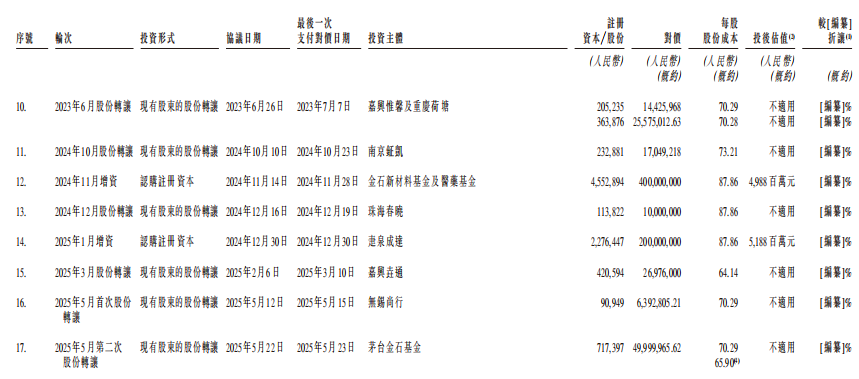
If the primary market data is valued at RMB 5.188 billion (approximately HK$5.6 billion) and compared, the inversion of the valuation is quite obvious. Even though the company applied the fixed price of HK$52.00, the discount rate was as high as 39.2% compared to the primary market valuation. The price is capped at HK$68, and the discount rate is still as high as 20.7% compared to the primary market valuation. Even when issued at the highest price, Wuxi Shangxing, which entered the market in the last round, still faced a book loss of about 11.2%, and state-owned assets (Maotai Jinshi) also had a loss of 9.67%.
In addition to pricing, whether Xiantong Pharmaceutical can get through after it is marketed has also become the biggest concern in the market. According to public information, Xiantong Pharmaceutical-B sold only 65.61 million shares globally. According to the median estimate, the net capital raised was about HK$329 million. The total market value after issuance was about HK$3.4 billion to HK$4.5 billion, and the market value of H shares was about HK$2.1 billion to HK$2.8 billion. Since there is no foundation, only 15% green shoes, a low share of public sales, a thin chip base in the early stages of listing, and inverted valuations of old pre-IPO shareholders, it is difficult to naturally enter Hong Kong Stock Connect in the short term. If the main capital wants to drive access, it is natural to find ways to raise the market capitalization level. In particular, it is necessary to maintain transaction activity around events such as TR008 approval, BD milestones, and commercialization volume.
Explosive increase in active hematopoietic revenue
According to the prospectus, Xiantong Pharmaceutical is deeply involved in the field of nuclear medicine and has built 13 pipelines, covering the three major fields of tumors, neurodegenerative diseases, and cardiovascular disease. Its core products include: the NDA-stage neuroendocrine tumor treatment drug XTR008, which is expected to be approved in December 2026; and the PET myocardial perfusion imaging diagnostic agent XTR004, the myocardial fatty acid metabolism imaging agent XTR003, and the AD diagnostic agent XTR006.
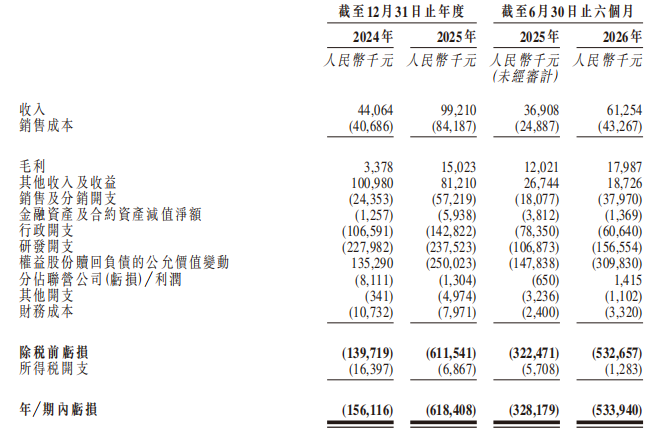
On the revenue side, the company's core diagnostic products are in the accelerated phase. Revenue was 44.64 million yuan in 2024, a sharp year-on-year increase of 125% to 99.210 million yuan in 2025, and recorded a further 61.254 million yuan (+66% year over year) in the first half of 2026, showing strong commercial hematopoietic capacity. Net losses for the same period were $156 million, $618 million, and $534 million respectively. The increase in losses needs to be disaggregated: Of the 534 million yuan loss in the first half of 2026, about 310 million yuan came from changes in the fair value of equity share redemption liabilities, which are treated as non-cash accounting. After listing, this debt will be transferred to equity and will no longer affect the income statement. After excluding this factor, losses at the operating level were mainly due to pre-R&D investment (R&D expenditure of 157 million yuan in the first half of the year) and sales team building.
Looking at the core business structure, CRO/CDMO services have long played a role as the cornerstone of the company's cash flow. In 2024 and 2025, this business revenue accounted for 61.6% and 43.2% of total revenue, respectively, providing stable financial support for early company operations and pipeline research and development. At the same time, the high-margin goods sales business achieved a leapfrog structural explosion. Product sales revenue soared from 3.742 million yuan in 2024 to 380.09 million yuan in 2025 (an increase of more than 9 times), and further soared to 398.25 million yuan in the first half of 2026. It has completely replaced CRO/CDMO services and became the core engine driving the company's total revenue growth.
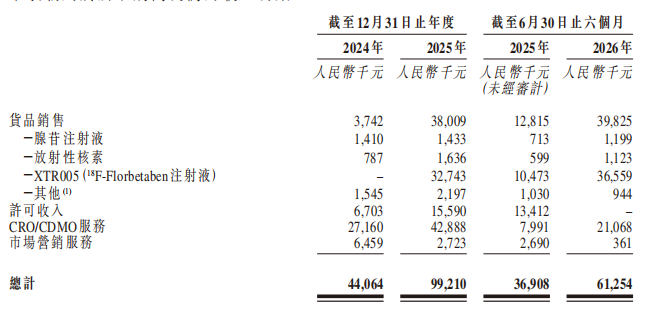
In terms of diagnostic product matrices, the core single product XTR005 (19F-Florbetaben injection) has shown strong commercial potential. As a breakthrough product in the field of Alzheimer's disease (AD) diagnosis, its sales reached 32.743 million yuan in 2025 and rapidly climbed to 36.559 million yuan in the first half of 2026. A single product contributed more than 90% of the sales revenue of goods during the same period, and has officially entered the large-scale deployment period. Furthermore, traditional radionuclides such as adenosine injections have maintained a steady increase of more than 10% per year, forming a steady base for basic business. In contrast, licensing revenue showed significant fluctuations. After recording 15.59 million yuan in 2025, there were no new accounts in the first half of 2026, indicating that the company is switching from a passive income model that relies on BD milestone payments to an active hematopoietic model centered on terminal drug sales.
It is worth noting that with the overall acceleration of the commercialization process, the company's marketing strategy and resource allocation are undergoing marginal changes. Market service and distribution expenses increased sharply to 572.19 million yuan in 2025, but market service revenue declined sharply to 2,723 million yuan during the same period. This gap in scissors reveals a complete shift in the company's current strategic focus, that is, from exporting marketing services to concentrating internal resources and capital, and making every effort to build an independent sales network to cope with the upcoming commercialization volume and terminal coverage of the core product XTR005 and subsequent pipelines (such as XTR008).
XTR008 Domestic SSR Targeted Nuclear Drug First Imitation Catalytic Diagnosis and Treatment Integrated Valuation Revaluation
Xiantong Pharmaceutical's core pipeline is showing a deep strategy of “two-wheel drive for diagnosis and treatment”. The diagnostic side has already been commercialized, and the core product XTR008 on the treatment side has significant investment flexibility in terms of advantages and market space.
The core advantage of XTR008 is the triple superposition of clinical progress, efficacy data and indication expansion. First, as a generic of Lutathera, XTR008 is the first candidate product of its kind to be submitted to the NDA in category 3. The NDA has been accepted by the State Drug Administration and is expected to be approved in December 2026. It is expected to become the first therapeutic radioligand targeting SSR in China. Second, phase III data showed that PFS was not achieved in the XTR008 treatment group, and the control group was 5.8 months; ORR reached 43.4%, which was significantly superior to 1.0% of the control group. Third, the company did not stop at the first imitation, but further expanded new indications such as G3 GEP-NET, PPGL, and meningioma. Among them, phase III of the new indications was launched in June 2026, and the meningioma phase II clinical plan was launched in March 2027, forming a double-layer growth curve of “first imitation dose+extension of new indications”.
After the core barriers are established, XTR008's market space is quite optimistic. Overseas, it has been proven that SSTR targeted radioactive ligands have the potential to be a major single product. Novartis Lutathera's global sales in 2025 reached US$816 million, up 13% year over year. No similar therapeutic radioligands have been approved in this field in China before. The penetration rate is close to zero in 2025, while the base of advanced SSTR positive G1/G2 GEP-NET patients in China is expected to increase from 184,000 in 2025 to 22,100 in 2036, and the penetration rate is expected to increase to about 40% in 2036. Insight Consulting predicts that the global market for radioligands for targeted SSTR treatment will reach US$4.30 billion in 2036, and the relevant market size in China is expected to reach US$800 million.
In the longer term, the core significance of XTR008 is to push the company to reevaluate from a “diagnostic nuclear drug company” to an “integrated platform for diagnosis and treatment.” The diagnostic side has proven commercialization capabilities, and once approved, the treatment side will significantly raise the value and revenue ceiling for a single patient. Considering that the company has set up three production bases and 21 commercial production lines in Wuxi, Zhongshan, and Mianyang, and has end-to-end capabilities for nuclide production, preparation and distribution, XTR008 release is expected to be converted into revenue relatively quickly. The speed of commercialization of XTR008 will be a key anchor point for the market to give a valuation premium.
Taken together, Xiantong Pharmaceutical Margin surpassed the subscription intensity by more than 96 times, reflecting the scarcity of “the first nuclear drug stock.” However, discounts of up to 39.2% in the primary market, book losses from old shareholders, and uncertainty about access due to lack of foundation and weak chips all formed a valuation game in the early stages of listing.