
The semiconductor equipment spending cycle is not over yet! Bernstein raised the 2026-2028 WFE forecast and expects continued growth in 2029
The Zhitong Finance App learned that in a global semiconductor equipment research report called “Global Semiconductor Equipment: No Significant Revision in Sight Yet,” Bernstein raised the 2026-2028 global wafer manufacturing equipment (WFE) capital expenditure forecast, pointing out that the risk that the current market is worried that the industry's capital expenditure will be lowered has not been realized. The 2027 equipment capital expenditure is basically locked in, and the outlook for 2028 is also stable Furthermore, the potential increase brought about by Terafab and Intel's expansion of production has not been taken into account. Even without considering Terafab's upward space, the global WFE market is expected to continue to grow in 2029.
Bernstein said in the report that the global WFE scale will be raised from US$148 billion to US$156 billion, with a year-on-year growth rate of 28.0%; in 2027, WFE will be raised from US$204 billion to US$217 billion, with a year-on-year growth rate of 39.3%; and in 2028, WFE will be raised from US$259 billion to US$279 billion, up 28.4% year over year.
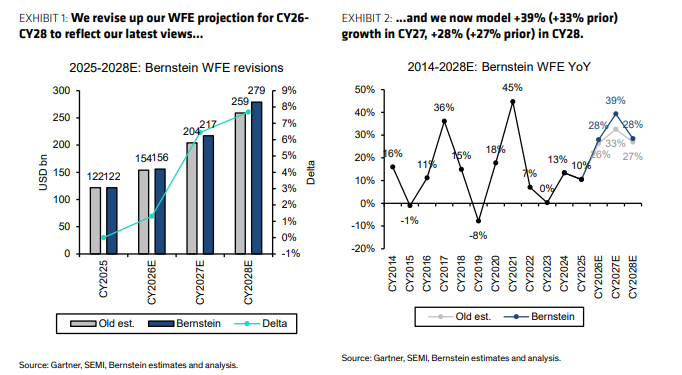
The bank pointed out that this increase comes from a further increase in capital expenses of logic/foundries and DRAM storage vendors in China and overseas regions, while demand for wafer-level packaging (WLP) equipment has also been improved. In terms of application, the agency predicts the year-on-year growth rate of DRAM WFE expenditure from 2027-2028 to be 57%, 39%, NAND 58%, 42%, and logic/foundry 27% and 19%, respectively. Storage devices will be the main driving force in this upward cycle.
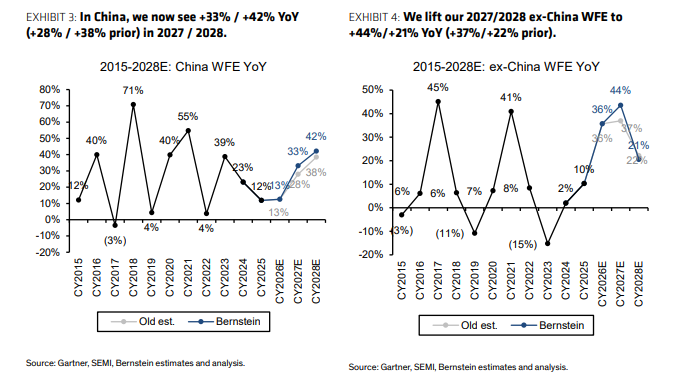
By region, WFE in the non-Chinese market is expected to increase 44% year-on-year in 2027 and 21% in 2028. Among them, non-Chinese WFE increased by US$5.8 billion in 2027, US$4 billion from logic/foundry, and US$1.8 billion from DRAM; non-Chinese WFE increased by US$5.1 billion in 2028, US$3.8 billion from logic foundry, and US$1.3 billion from DRAM. In addition to front-end manufacturing equipment, the bank also raised WLP equipment expectations, increasing WLP by $2 billion in 2026 and $4.4 billion and $7.9 billion respectively in 2027 and 2028.
In the Chinese market, the agency maintained its judgment that WFE would require US$57 billion in 2026, raising the 2027 forecast by US$2.9 billion to US$76 billion, and by 2028 by US$6.7 billion to US$108 billion. The clarification of production expansion plans of leading domestic storage manufacturers is the core reason for the increase. Domestic storage-related WFE expenses are expected to increase by 84%, 78%, and 68% year-on-year respectively from 2026 to 2028. A series of technological breakthroughs such as advanced logic terminals, Huawei logic folding, and AI networks support the demand for advanced logic devices; in mature manufacturing fields, AI infrastructure construction, and localization of industrial and automotive chips will bring strong demand, which may cause mature logic production capacity to be tight, driving domestic fabs to accelerate production expansion from 2027 to 2028.
Views and rankings of overseas equipment companies
Bernstein raised the profit models of LRC X.US (LRC X.US) and KLAC.US (KLAC.US) slightly, and the Applied Materials (AMAT.US) model was not adjusted.
The bank pointed out that in the context of high capital expenditure in data centers, all three companies gave “outperforming the market” rating, and the target price remained unchanged. The recommended ranking was applied materials first, followed by Ke Lei, and finally, Fanlin. The bank believes that applied materials have the most complete layout in the fields of advanced logic, DRAM, and packaging, and the valuation is relatively lower; Ke Lei's year-on-year growth base is friendly, and the performance in 2027 is highly flexible after the release of clean room production capacity; and Fanlin has excellent execution capabilities and profit margin levels.
In terms of Japanese semiconductor equipment, benefiting from rising storage capital expenditure, Kokusai Electric and Tokyo Electronics are recommended as priority, and the ratings are “outperforming the market.” Since the increase in DRAM is greater than that of the logic OEM, companies with a higher share of the target internal preferred storage business are ranked as Kokusai Electric > Tokyo Electronics > Screen.
The bank said that Kokusai has a leading edge in batch ALD atomic layer deposition technology and is profoundly benefiting from the iteration of advanced NAND and GAA nodes; for the Chinese market, the DRAM expansion dividend will benefit Kokusai Electric to the greatest extent, followed by Tokyo Electronics. Screen maintains a holding rating. Although the valuation is low, growth drivers are weak, and the decline in China's share of revenue is putting pressure on profit margins. We can only focus on the potential opportunities brought about by panel-level packaging.
For European semiconductor equipment, the bank listed ASML.US (ASML.US) as the first choice and gave it a “outperforming market” rating, with a target price of 2,500 euros. Revenue is expected to grow at a compound rate of 34% from 2025 to 2028, driven by the expansion of capital expenditure from advanced logic and DRAM, and an increase in the intensity of the use of lithography processes.
The bank expects both EUV and DUV devices to achieve high growth, with shipments of EUV devices increasing from 48 to 118 units in 2025-2028; DUV will also benefit from DRAM expansion, and the bank estimates that each EUV device will be equipped with approximately two ArFi DUV. Although China's share of revenue fell back to 20% of total sales, domestic demand for DUV equipment is strong, and there is still significant potential for growth.
Chinese semiconductor equipment: pullback brings layout window
Bernstein maintained that Northern Huachuang (002371.SZ), China Micro (688012.SH), and Tuojing Technology (688072.SH) outperformed the market ratings. According to the report, delivery delays and phased performance fluctuations due to the shortage of parts will gradually ease over the next 1-2 quarters. Continued strong demand for downstream terminals will support orders from domestic equipment manufacturers. The recent stock price correction provides a better layout point. It is expected that domestic equipment companies will usher in profit recovery in 2027, and there is a possibility of an increase in performance.
The internal ranking is Northern Huachuang > Zhongwei Company > Tuojing Technology. Beifang Huachuang has the most complete product matrix, covering etching, deposition, heat treatment, and cleaning. Customers cover logic, DRAM, and NAND, and benefit the most from the wave of mature and advanced logic expansion; China and Micro companies excel in dry etching, while expanding deposition equipment, and their technical strength is widely recognized by the industry; Tuojing Technology focuses on film deposition and lays out advanced hybrid bonding and packaging equipment, with outstanding product innovation capabilities. The bank also mentioned that the market is concerned about NAND's capital expenditure, but judged that NAND production expansion will not slow down. After the Changjiang Storage IPO is restarted, China Micro and Tuojing are expected to experience a rebound in performance in the first quarter of 2027.