
Prediction: This Growth Stock Will Double by the End of 2027
Key Points
Lemonade is using artificial intelligence (AI) write insurance quotes, pay claims, calculate premiums, and run its operations.
Lemonade now serves over 3.5 million customers, and its in-force premium has grown at an accelerating pace for 12 straight quarters.
Lemonade's attractive valuation sets the stage for significant potential returns over the next year and beyond.
Dealing with an insurance company is rarely a pleasant experience, particularly when it's time to make a claim. Receiving a payout can involve several phone calls and a long waiting period, adding to the claimant's stress. Lemonade (NYSE:LMND) is using artificial intelligence (AI) to overhaul the customer experience, and it's succeeding in a big way.
Lemonade operates in the renters, homeowners, life, pet, and car insurance segments. Its in-force premium (IFP), which is the value of premiums from all active policies, is growing at an accelerating rate, which is fueling a surge in the company's revenue.
Missed AI’s "Act 1"? Act 2 Could Be 15x Bigger. Most investors think they missed the AI boat because they didn't buy Nvidia in 2005. But according to our analysts, we’re only at the end of "Act 1"—the R&D phase. "Act 2" is the global rollout. Continue »
Lemonade stock continues to trade at an attractive valuation; here's why I predict it will double by the end of 2027.

Image source: The Motley Fool.
Lemonade's AI-powered approach is proving very popular
Lemonade developed an AI chatbot named Maya that is capable of writing an insurance quote in under 90 seconds via the company's website. It also created AI Jim, which can pay out claims in just a few seconds without any human intervention.
But Lemonade also uses AI to calculate premiums, assess risk, and run its operations, creating efficiencies that ultimately reduce prices for policyholders. In fact, during the third quarter of 2026, Lemonade's loss adjustment ratio (LAE) remained at a record low of 5%, which is nearly half the industry average of 9%. The LAE ratio measures the percentage of premiums an insurer spends on processing claims, and 5% is very low.
Furthering that point, Lemonade's IFP has grown by 155% over the last four years, while its employee headcount declined over the same period, so AI is unlocking an incredible amount of operating leverage. IFP was $1.55 billion at the end of the third quarter, and its year-over-year growth rate accelerated for the 12th consecutive quarter to 34%.
Lemonade had over 3.5 million policyholders as of Sept. 30, which was up 23% from the year-ago period, so its AI-driven approach is clearly resonating with consumers.
Lemonade's revenue is soaring
The gross loss ratio is another important metric in the insurance industry, because it measures the proportion of premiums paid out as claims. In the past, Lemonade said a gross loss ratio of 75% was the sweet spot for a thriving insurance business, but the lower the better, and it was 65% in the third quarter.
When IFP grows alongside a low gross loss ratio, Lemonade makes more money. That's why the company's revenue soared by 73% year over year to $336.1 million in the third quarter. The strong result prompted management to raise its full-year revenue forecast for 2026 to $1.233 billion (at the midpoint of the guidance range) from $1.217 billion.
Lemonade is still very much a growth company, so its main focus is acquiring as many customers as possible and expanding its business, even if it leads to short-term losses. As a result, it generated a generally accepted accounting principles (GAAP) net loss of $43.7 million in the third quarter. But excluding one-off and noncash expenses like stock-based compensation, its loss on an adjusted (non-GAAP) earnings before interest, taxes, depreciation, and amortization (EBITDA) basis was much smaller at $20.4 million.
Lemonade had $1.2 billion in cash and cash equivalents on hand as of Sept. 30, so it can comfortably afford to sustain its losses for the foreseeable future. However, management thinks profitability will come in the years ahead.
Lemonade stock could double by the end of 2027
Based on Lemonade's trailing-12-month revenue of $1.1 billion, its stock is trading at a price-to-sales (P/S) ratio of 3.3, which is a steep discount to its three-year average of 5.3. But Wall Street believes the company will grow its revenue to almost $1.7 billion in 2027 (according to Yahoo! Finance), placing its stock at a forward P/S ratio of just 2.1.
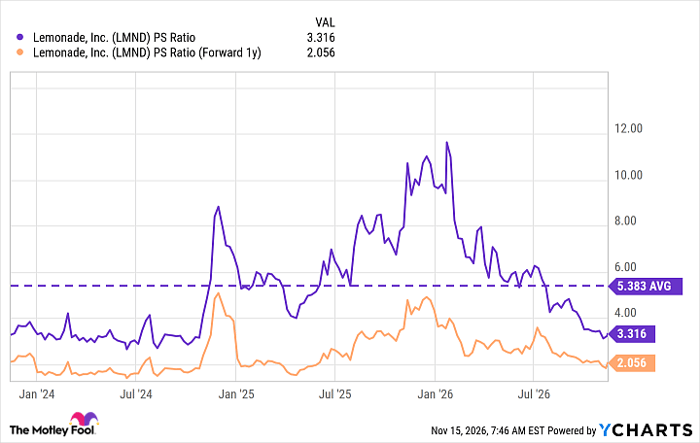
LMND PS Ratio data by YCharts
Assuming Wall Street's estimate turns out to be accurate, Lemonade stock would have to soar by 162% by the end of next year to trade in line with its three-year average P/S ratio. Therefore, I think there is plenty of room for the stock to at least double before 2027 is over.
But investors could earn even bigger returns over the long term, because Lemonade believes it can grow its IFP by 545% to $10 billion by 2034. If we assume a proportionate increase in revenue, then its stock might also soar by a similar amount.
Simply put, I think Lemonade stock could be a great buy at the current price.
Anthony Di Pizio has no position in any of the stocks mentioned. The Motley Fool has positions in and recommends Lemonade. The Motley Fool has a disclosure policy.