
Nike (NKE.US) proposed a “full speed ahead” strategy! The sword points to a return to revenue growth in fiscal year 2029
The Zhitong Finance App learned that Nike (NKE.US) said at an Investor Day event held at the US headquarters on Tuesday that it expects to resume revenue growth in the 2029 fiscal year. CEO Elliott Hill is trying to accelerate its business recovery plans by betting on professional sports performance and further strengthening the company's focus on athletes.
Nike announced the “Full Stride Ahead” (Full Stride Ahead) strategy and development plan for the 2031 fiscal year on Tuesday. The company will focus on the five major sports and sports lifestyle businesses of running, training, soccer, basketball, and outdoor activities, which are expected to contribute approximately 95% of revenue growth in the 2028-2031 fiscal year. In addition to the guidelines for revenue to resume growth in FY2029, the strategy also sets a goal of increasing revenue by an additional $5 billion by fiscal year 2031, and plans to increase the operating margin to 12% to 14%.
Hill said, “We're focusing our resources on the areas where we have the best chance of winning. At the same time, we're also changing the way we operate to capture market demand by creating breakthrough products, deepening local connectivity, and acting faster. This series of initiatives will jointly push Nike back to a sustainable and profitable growth path.”
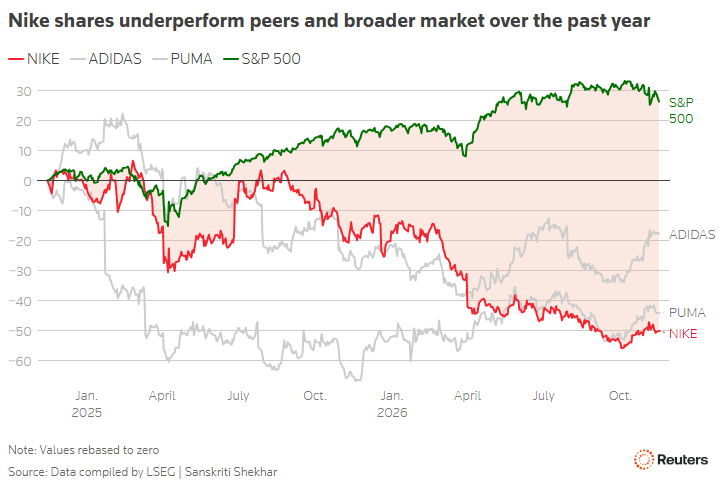
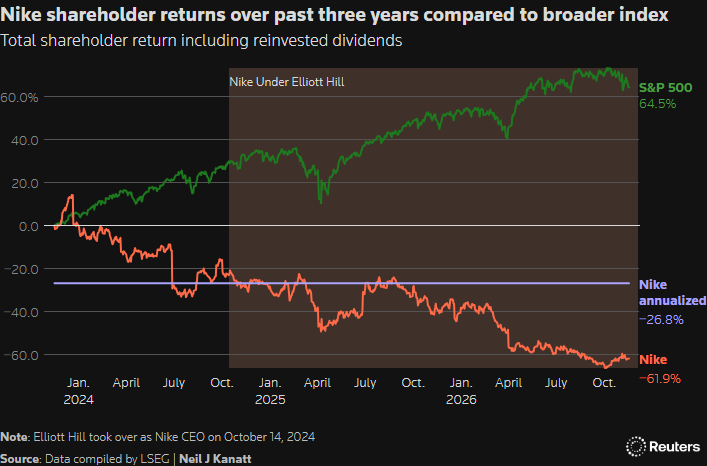
This financial roadmap is the latest round of strategic adjustments introduced by Elliot Hill since returning to Nike in October 2024 and becoming CEO. Since then, Nike's stock price has fallen by more than half. The reason is that demand for sportswear continues to be sluggish, and sales in the Chinese market, which used to be an important profit engine, have also continued to decline.
Despite Nike's attempt to appease investors with the goal of resuming revenue growth in the 2029 fiscal year, the stock price remained lower on Tuesday. Simon Siegel, an analyst at Guggenheim Securities, said, “Nike's proposed goals are higher than the expectations previously announced by the market. Now they need to deliver on those goals. Investors are currently unconvinced that these goals can be achieved.”
Hill has been working to repair partnerships with wholesalers and retailers, refocus product development on core sports, and streamline company operations. Hill told investors: “The market we are in is constantly expanding — we have more ways to serve athletes, and we have the competitive advantage we have built up over decades.” However, he also acknowledged, “We still have more work to do in terms of inventory management, regular price sales, and profitability.”
This week, Nike showcased some of its latest innovations, including the new Vaporfly and Vomero running shoes, an expanded Mind series designed to improve athletes' mental focus, and an inflatable, temperature-adjustable jacket. Hill said that by the end of fiscal year 2031, Nike plans to double the number of products with a development cycle of less than 14 months.
The road to recovery is not easy
Nike anticipates that profits will continue to be under pressure in the short term. The company reiterated its previous earnings forecast that revenue for the 2027 fiscal year would decline by a high single-digit percentage, and then gradually stabilized in the 2028 fiscal year.
Nike currently anticipates that by the 2029 fiscal year, its revenue will resume growth, and the growth rate is roughly the same as the overall sneaker and sportswear market. Thereafter, the company's revenue growth rate will further accelerate in FY2030 and FY2031, and exceed the overall growth level of the market.
Mary Shore, senior stock analyst at Columbia Threadneedle, who owns Nike shares, said, “This financial guidance seems quite aggressive.”
In the Chinese market, where sales have been declining for nine consecutive quarters, Nike expects that business revenue in China will remain roughly flat during the 2027-2031 fiscal year. The company expects the Jordan product line to grow “slightly” starting in 2029. Chief Financial Officer Dave Denton said, “We have no unrealistically optimistic assumptions about the growth of the Chinese market.”
Bet on the field of professional sports
Under the new strategy called “Full Speed Forward,” Nike will focus resources on five major sports fields and 23 key countries and regions. The company expects these sectors and markets to contribute more than 90% of its revenue growth by fiscal year 2031.
Nike said the company is continuing to adjust operations in Greater China and accelerate growth in other key markets; it is expected that by 2031, its Indian business will more than triple its current size.
Nike said that the professional sports sector — including running, training, global soccer, basketball, and outdoor sports — will contribute about $4 billion of its $5 billion target in additional revenue, while the sportswear business will contribute another $1 billion. Competitor Adidas has adopted a similar strategy in recent years and is committed to developing footwear and apparel products for more types of sports.
Nike is relying on cost cuts to help restore profitability. The company expects its cost optimization program called “Pace” to achieve annual cost savings of approximately $2.5 billion by fiscal year 2031. Relevant earnings will be visible starting in FY2027 and gradually increasing in FY2029 and FY2030. Nike expects to incur approximately $1.3 billion in pre-tax expenses during the implementation of the plan up to fiscal year 2031.