
The auction of Japan's 20-year treasury bonds is getting cold! The bid multiplier plummeted to 3.64, and demand was the weakest in the year
The Zhitong Finance App noticed that demand for Japanese 20-year treasury bonds was lower than the 12-month average on Wednesday, and investors are still wary of further increases in yield as market fluctuations intensify.
The bid multiplier dropped to 3.64 from 5.84 the previous time, compared to a 12-month average of 3.92. As another sign of weak demand, the margin (that is, the gap between the average winning bid price and the lowest bid price) widened from 0.07 last month to 0.29, the widest level in a year.
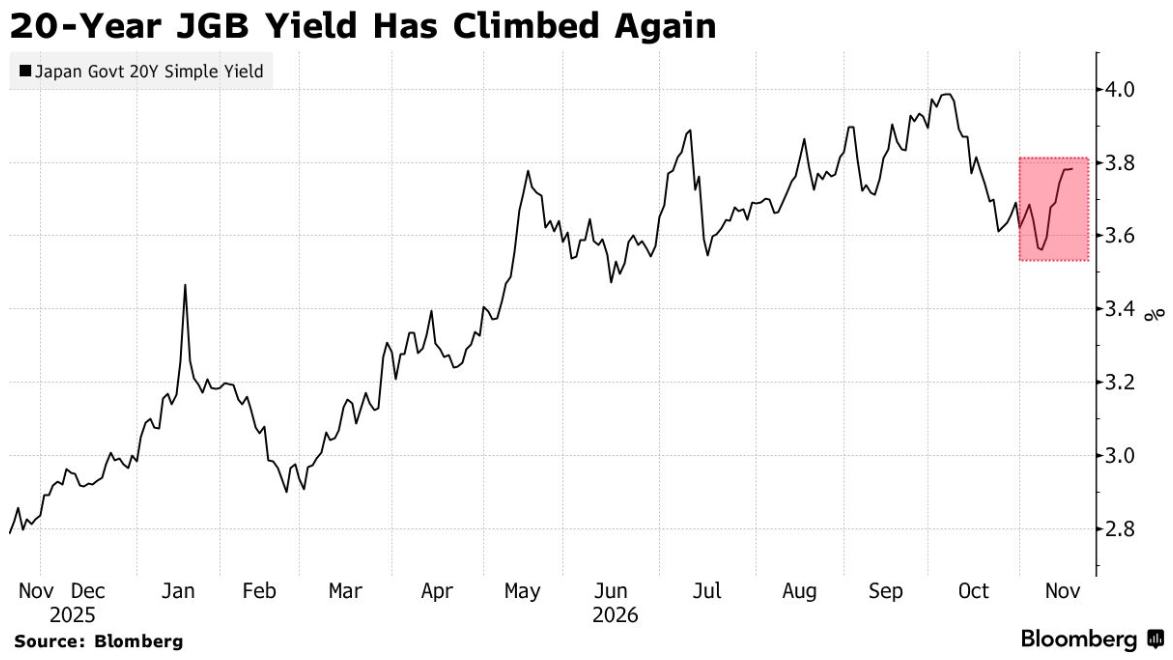
At the time of this auction, the yield on Japanese treasury bonds has risen again — in the context of the recent sell-off of US bonds, investors are taking into account the greater possibility that the Federal Reserve will further tighten monetary policy to contain inflation. A new round of unease surrounding AI stock trading has also intensified overall market volatility.
Ryutaro Kimura, senior asset management bond strategist at BNP Paribas, said, “Delays about ultra-long-term Japanese treasury bonds are likely to reflect recent heightened global risk aversion and rising interest rate volatility, leading to a decline in investors' risk appetite.”
The 20-year Treasury yield fell 3 basis points to 3.74% on Wednesday, compared to a high of 3.995% in early October. So far this month, the yield has risen by more than 20 basis points.
This result is in stark contrast to last month's auction, which recorded the strongest demand on record, with the help of a 3.8% coupon interest rate (the highest in 30 years). Furthermore, a significant percentage of allotments were attributed to unidentified buyers, triggering market speculation that institutions such as public pension funds and banks were involved.
Since then, as the Japanese Government Pension Investment Fund (GPIF) kept its asset allocation largely unchanged in the last quarter, such speculation has cooled down somewhat.
Japan's 2027 budget is another source of uncertainty in the bond market. Investors are watching how the government led by Prime Minister Takaichi Sanae is raising funds for higher defense spending and consumption tax cuts, and whether this requires an increase in the issuance of treasury bonds.
Kimura said that investors may have to wait until the Takaichi government announces the budget in December before they can clearly see the outline of the scale of treasury bonds issued for the next fiscal year. He added that until then, it may be difficult for ultra-long-term Japanese treasury bonds to outperform.