
Gap reports Q3 2026 in line with expectations but quarterly revenue guidance misses expectations

Clothing and accessories retailer Gap (NYSE:GAP) met Wall Street’s revenue expectations in Q3 2026, with revenue increasing 1.8% year on year to $4.01 billion. On the other hand, next quarter’s revenue guidance of $4.21 billion was less impressive, coming in 3.5% below analysts’ consensus estimates. Its GAAP profit of $0.86 per share was 11.7% above analysts’ consensus estimates.
For more on Gap, read our free full research report.
Gap Q3 2026 highlights:
- Revenue $4.01 billion vs S&P analysts’ consensus estimates of $4.01 billion (1.8% year-on-year growth, in line)
- EPS (GAAP) $0.86 vs analysts’ consensus estimates of $0.77 (11.7% beat)
- Revenue guidance $4.21 billion at the midpoint for Q4 2026, below analysts’ consensus estimates of $4.37 billion
- Operating margin 9.9%, up from 8.5% in the same quarter last year
- Free cash flow margin 13.8%, up from 3.9% in the same quarter last year
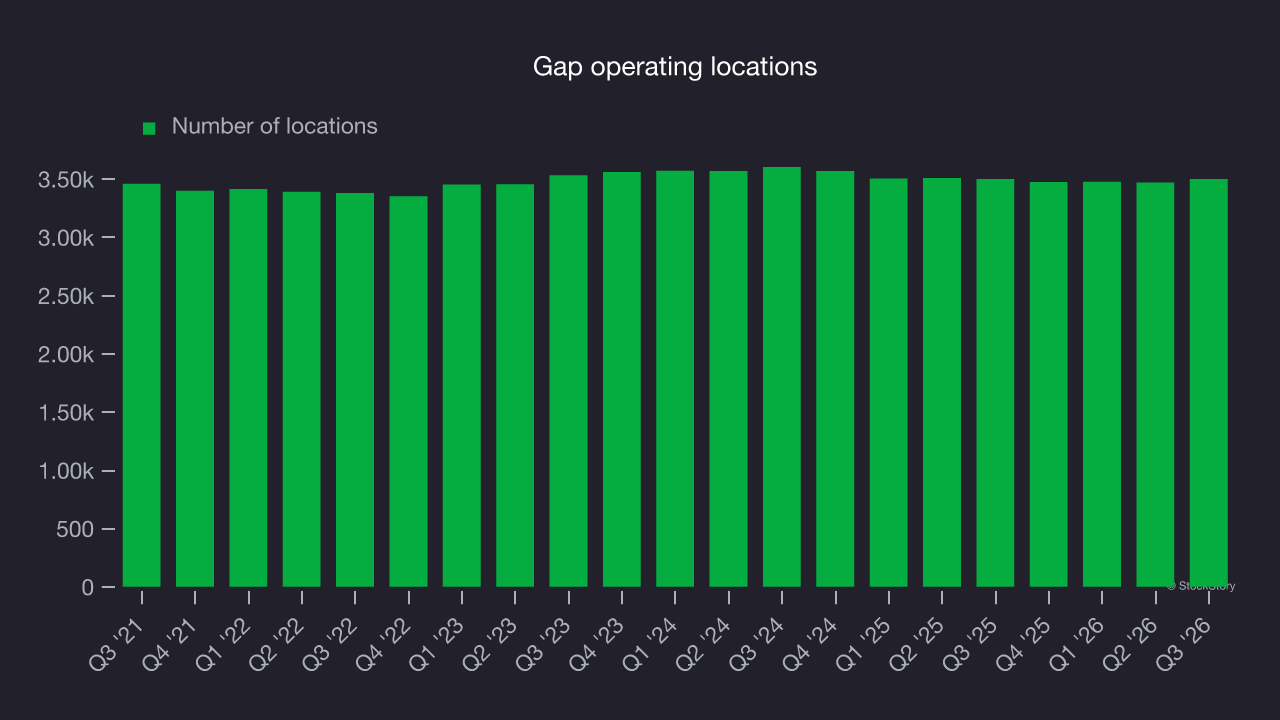
- Locations 3,500 at quarter end, up from 3,499 in the same quarter last year
- Same-store sales were flat year on year (5% in the same quarter last year)
- Market capitalization $6.97 billion
Dickson continued, "While demand softened in October and early November, amidst warmer weather, we are encouraged by the more recent improvement in trends as temperatures have cooled. As we move through the holiday season, we remain focused on delivering compelling product assortments and culturally relevant marketing across our brands, supported by a strong value proposition for our customers. We continue to operate with rigor and discipline, with the strength of our balance sheet giving us the flexibility to continue investing in the capabilities and growth opportunities that we believe will create long-term value, while returning cash to shareholders."
Revenue growth
A company’s long-term performance is an indicator of its overall quality. Any business can report a good quarter or two, but the best consistently grow over the long term.
With $15.4 billion in revenue over the past 12 months, Gap is one of the larger companies in the consumer retail industry and benefits from a well-known brand that influences purchasing decisions. However, its scale is a double-edged sword because there is only so much real estate to build new stores, placing a ceiling on its growth. To accelerate revenue growth, Gap likely needs to optimize its pricing or pursue international expansion.
Gap’s 1.2% annualized revenue growth over the last three years was sluggish as it closed stores and barely increased revenue at existing, established locations.
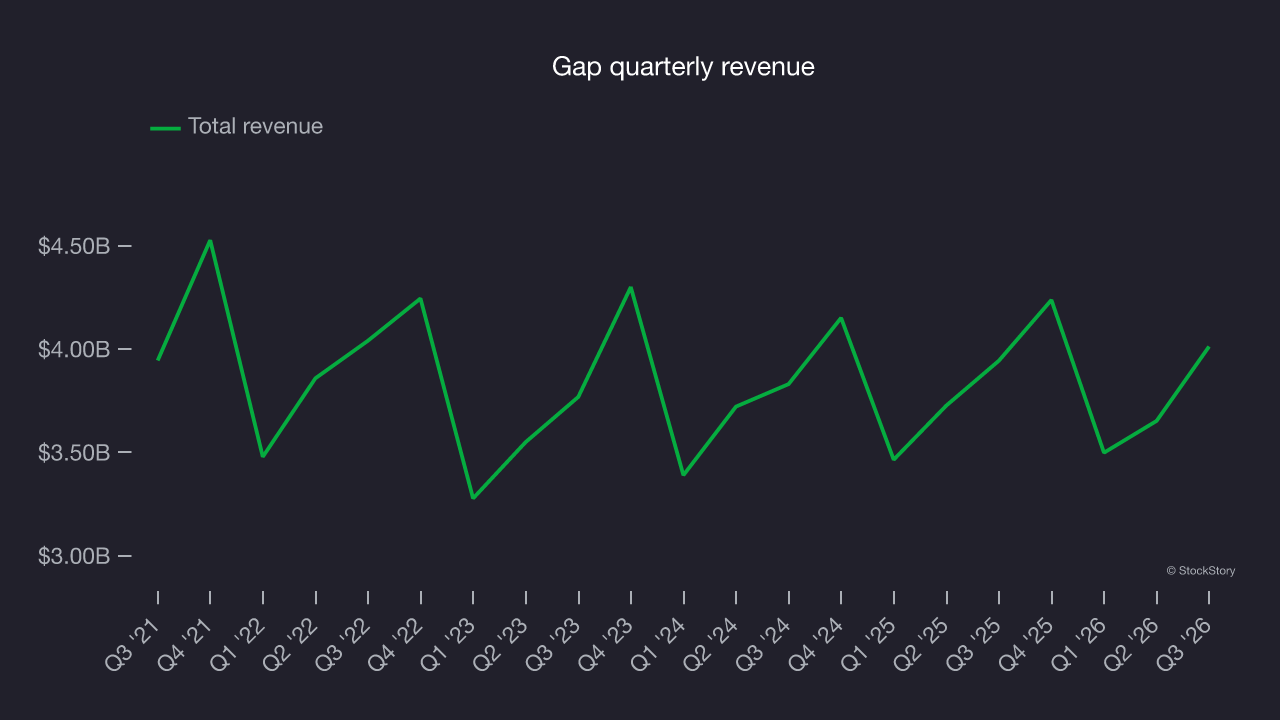
This quarter, Gap grew its revenue by 1.8% year on year, and its $4.01 billion in revenue was in line with Wall Street’s consensus estimates. Management is currently guiding for flat revenue next quarter.
Looking further ahead, sell-side analysts expect revenue to grow 2.9% over the next 12 months, according to S&P. Although this projection indicates its newer products will drive better revenue growth, it is still below average for the sector.
Store performance
Number of stores
Gap operated 3,500 locations in the latest quarter. Over the last two years, the company has generally reduced its store count, averaging 1.3% annual declines.
When a retailer shutters stores, it usually means that brick-and-mortar demand is less than supply, and it is responding by closing underperforming locations to improve profitability.
Same-store sales
The change in a company’s store base only tells one side of the story. The other is the performance of its existing locations and e-commerce revenue, which informs management teams whether they should expand or downsize their physical footprints. Same-store sales is an industry measure of whether revenue is growing at those existing stores and is driven by customer visits (often called traffic) and the average spending per customer (ticket).
Demand at Gap’s existing locations has been relatively stable over the last two years but trailed that of most retailers. On average, the company’s same-store sales have grown by 1.9% per year. Given its declining store base over the same period, this performance stems from a mixture of higher e-commerce revenue and increased foot traffic at existing locations (closing stores can sometimes boost same-store sales).
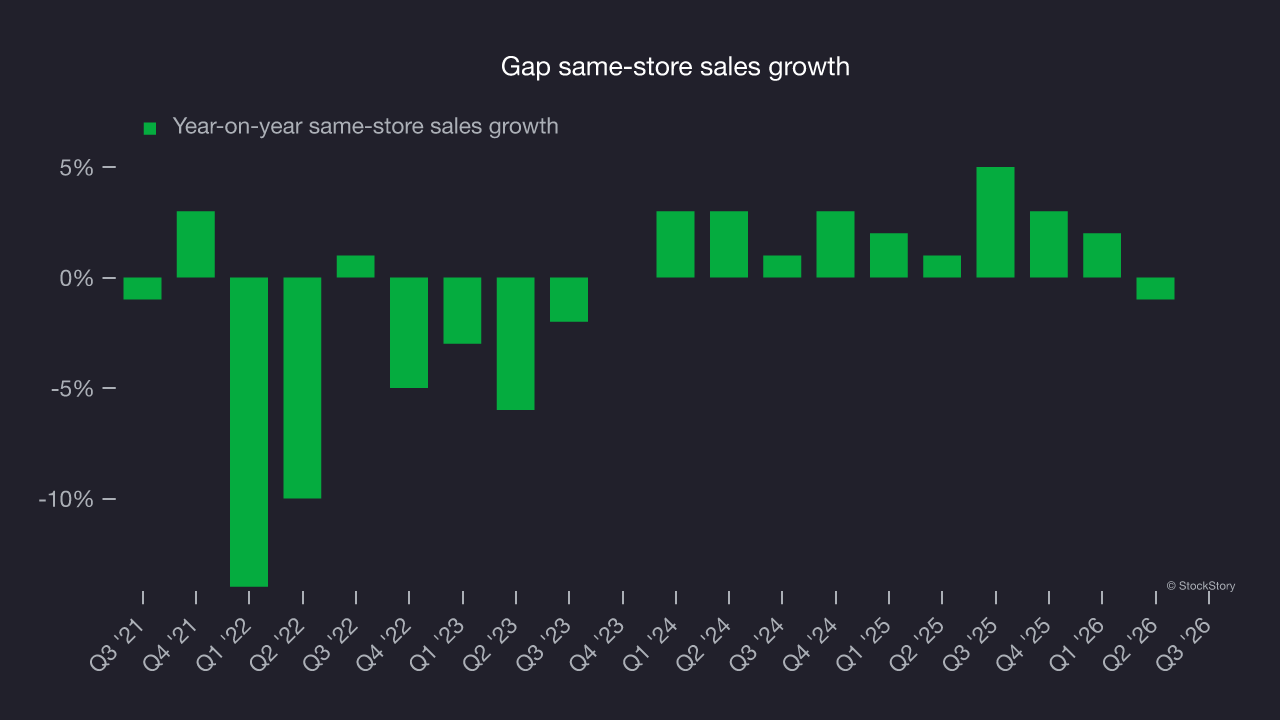
In the latest quarter, Gap’s same-store sales were flat year over year. This was a meaningful deceleration from its historical levels. The question is whether Gap can reaccelerate growth.
Key takeaways from Gap’s Q3 results
Gap’s EPS beat was a bright spot in an otherwise softer quarter: revenue guidance for next quarter missed expectations, and gross margin fell slightly short of Wall Street’s consensus estimates. Shares rose 3.5% to $19.52 immediately after the release.
Is Gap an attractive buy at its current price? When making that decision, it’s important to consider its valuation, business quality and latest quarterly results. Read our full research report here (it’s free).