
How Investors May Respond To Lennar (LEN) Misleading Disclosure Lawsuit
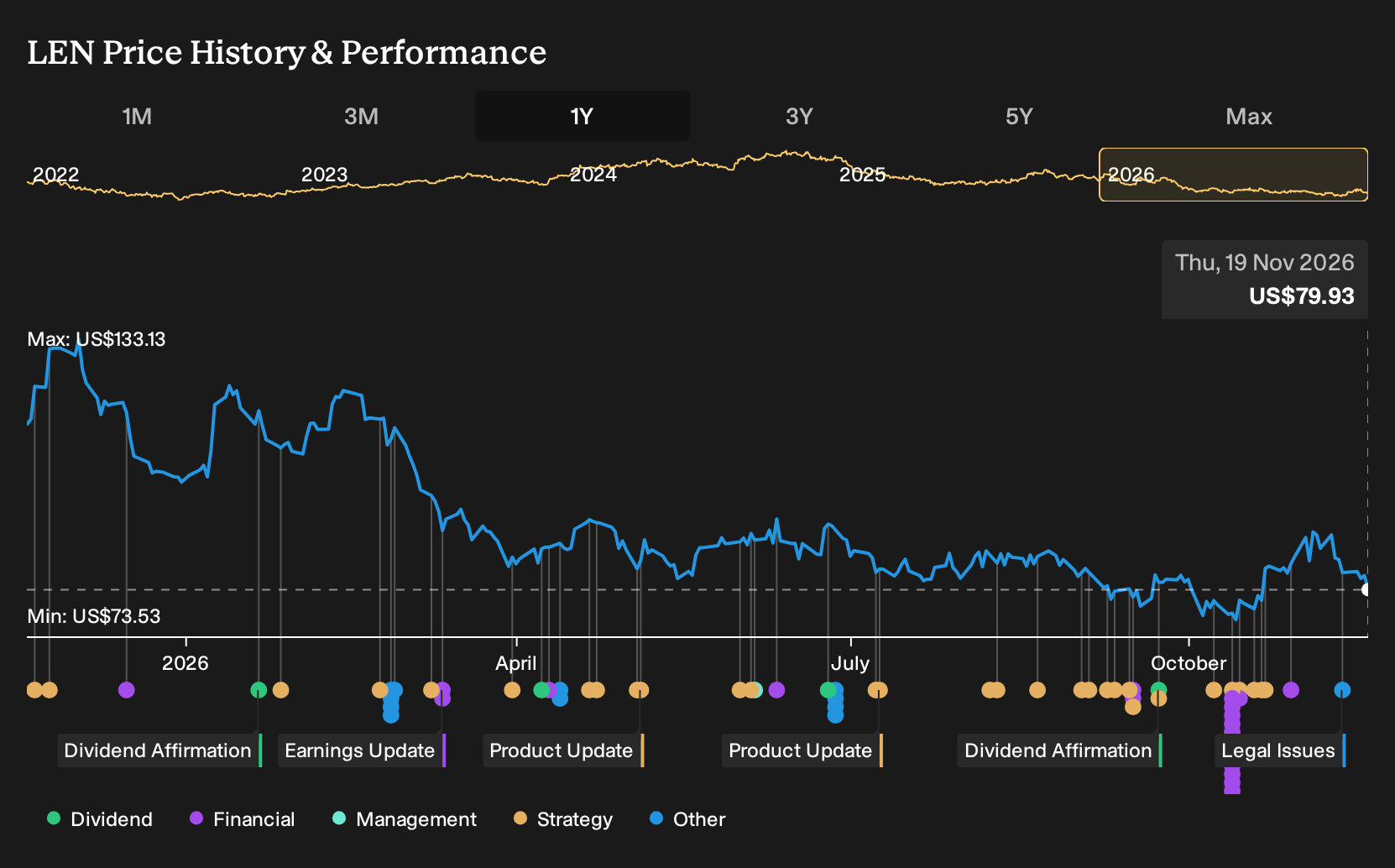
- Lennar is facing a class action lawsuit filed in November 2026 that claims the company misled investors about its operating approach and the true purpose of the Millrose spin off, including how expenses were recorded and how affiliated transactions affected reported demand.
- The complaint highlights an alleged use of Millrose to buy Lennar homes at above market prices and rent them at below market levels. If accurate, these practices would raise fundamental questions about how the homebuilder’s asset light model and demand trends were presented to shareholders.
- This article examines how Lennar's investment narrative is challenged by alleged Millrose related home purchases used to support reported demand.
Lennar Investment Narrative Recap
To own Lennar, an investor needs to be comfortable with a homebuilder that relies heavily on an asset light model, tight build cycles and controlled homesites rather than a large land bank. The class action and Millrose allegations cut across that story because they question how land option costs and affiliated transactions intersect with the reported asset mix and demand.
In the short term, the key swing factor remains housing demand under high mortgage rates and Lennar’s ability to keep volumes moving with incentives while protecting already compressed 4.1% profit margins. The biggest risk now is that legal and regulatory scrutiny around Millrose raises compliance costs or constrains use of similar structures at a time when affordability pressure is already weighing on deliveries.
The lawsuit itself is the central development to focus on. Robbins LLP alleges Lennar capitalized expenses tied to land bank option agreements, rather than expensing them, and used Millrose to purchase homes above market prices while renting them below market levels. That critique goes directly to the analyst consensus narrative on Simply Wall St, which was built around the benefits of an asset and land light approach.
If the court process leads to tighter limits on affiliated land bank activity, the homebuilder may have less flexibility in how it balances reported margins, demand optics and land access. For you, the operational questions are whether Lennar can still sustain its volume focused production model, keep construction costs around US$80 per square foot under control and manage higher land and option fees without further pressure on earnings.
Lennar's analyst narrative points to revenues of US$40.6b and earnings of US$2.7b by 2029, based on assumed annual revenue growth of 8.3% and an earnings increase of about US$1.4b from US$1.3b today.
Uncover why Lennar's fair value indicates a 3% potential downside to its current price, highlighting a valuation premium investors cannot ignore.
Exploring Other Perspectives
You are now seeing how sharply views on Lennar diverge. The lowest analysts were already building in flat revenue around US$31.7b and earnings of only US$1.0b by 2029, well below the consensus path. Their bigger worry is demand, not accounting, so this lawsuit could push those already cautious forecasts even lower or be reassessed entirely.
Explore 4 other Lennar fair value estimates, including one that suggests as much as 31% downside from the current price!
The Verdict Is Yours
Don't just follow the ticker. Dig into the data and build a conviction that's truly your own.
- A great starting point for your Lennar research is our analysis highlighting 3 key rewards and 1 important warning sign that could impact your investment decision.
- See our latest analysis for Lennar. The report includes a comprehensive fundamental analysis summarized in a single visual, the Snowflake, making it easy to evaluate Lennar's overall financial health at a glance.
Looking for more ideas beyond Lennar?
If Lennar's situation has you rethinking concentration risk, it can help to line it up against other companies with simpler stories and cleaner balance sheets. The Simply Wall St Screener lets you quickly filter for businesses that better match your comfort level on leverage, earnings quality and dividend reliability.
- If capital preservation is your priority, start with resilient businesses that score well on financial strength through the 30 resilient stocks with low risk scores.
- For investors hunting for mispriced opportunities with solid fundamentals, sort through the 36 high quality undervalued stocks to see which stocks align with your criteria.
- If reliable income matters most, focus on companies offering higher yields that still look financially robust by scanning the 8 dividend fortresses.
Have feedback on this article? Concerned about the content? Get in touch with us directly. Alternatively, email editorial-team@simplywallst.com