
Capitulation sell-offs have all arrived. How far are AI technology stocks from bottoming out?
The Zhitong Finance App learned that the sharp decline in technology stock valuations, especially the main target of artificial intelligence (AI) trading, is sparking a debate about whether the current market has fully absorbed pessimistic expectations.
The Nasdaq 100 Index, the S&P Information Technology Sector, and the Philadelphia Semiconductor Index have all been undervalued for many years compared to earnings expectations. AI upstream targets such as semiconductors have fallen the most, and companies that have invested heavily in data centers have also experienced a pullback. Surrender sell-off signals appeared one after another this week, making it more difficult to determine when the bottom is. However, Nvidia (NVDA.US) handed over impressive financial reports, and Anthropic (ANT.US) made a big debut. The overall holdings of the superposition technology sector are already extremely light, and some investors are beginning to see a layout window.
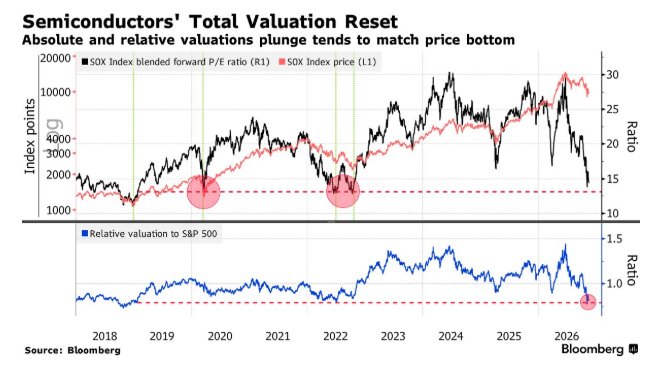
Louis Navellier, founder of Navellier & Associates, said: “I think the AI sector will see a good rebound. Earnings fundamentals are still strong, but current valuations are surprisingly cheap.”
He mentioned that the forward price-earnings ratio of individual stocks such as Micron Technology (MU.US) and Ultra Micro Computer (SMCI.US) is less than 4 times, which is an “excellent buying opportunity.”
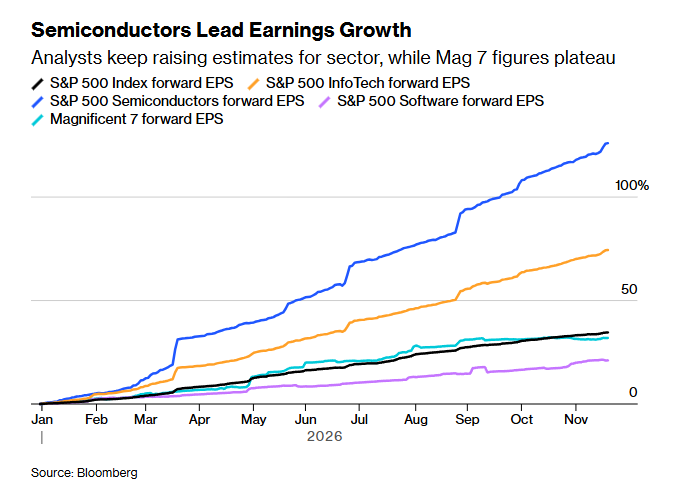
In fact, the divergence between current stock prices and earnings expectations is already quite prominent. Analysts are still raising profit forecasts after the latest earnings season. Whether the company can finally deliver on its results remains to be seen, but it is still unknown how long investors will continue to wait and see if profit cuts are not implemented.
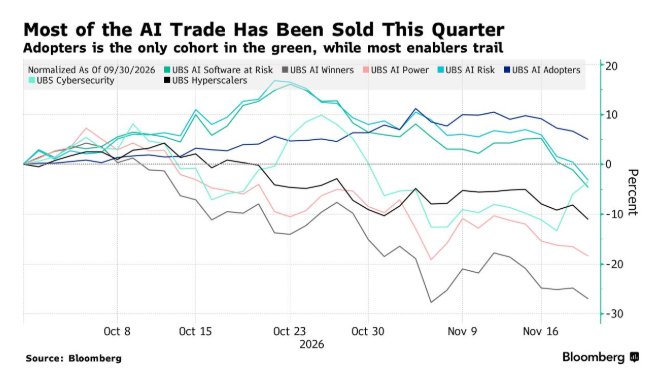
Hyperscale cloud vendors cut capital expenses, which may be a trigger for a new round of decline; however, at present, their investment plans remain stable. The Democratic Party's big victory in the US midterm elections has once again sparked discussions in the market about the pace of AI construction; however, the change of power is likely not to stop AI expansion; it may only slow down. Since this year, the increase in earnings expectations for technology stocks has significantly outperformed the market, with the semiconductor and hardware sectors being particularly prominent.
“Despite many uncertainties, recent financial reports show that demand for cloud services and AI computing power is very resilient,” said Johan Van der Biest, Candriam's global equity co-head.
“Investments are turning into revenue growth, and semiconductor and equipment manufacturers are optimistic about their 2027 guidance. Therefore, even if investors have doubts about long-term returns, the current profit fundamentals are still supported.”
It's not just about valuations that are attractive. According to Societe Generale's estimates, the popular leveraged ETF used to bet on the AI market this year has almost all of the surplus accumulated previously.
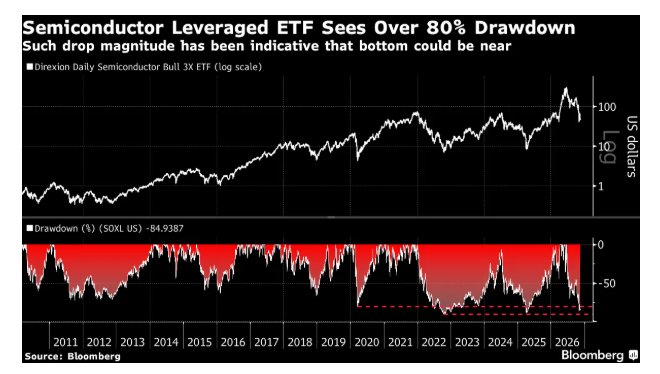
Derivatives strategist Jitesh Kumar looked at tripling the semiconductor ETF-Direxion (SOXL.US) and triple-doubling the NASDAQ ETF-ProShares (TQQQ.US). He pointed out that at the end of July, the total investment capital of Korea's leveraged single-share ETF began to turn into losses, and it was later proved that this point corresponds to a partial bottom of the underlying stock.
Although the anchored index still recorded positive returns, the two leveraged ETFs had almost zero returns during the year. Looking at SOXL alone, this 84% retracement is already comparable to several of the biggest declines in the past ten years, and after such sharp falls in history, it often ushered in a rapid rebound.
Admittedly, the risk in tech stocks has not disappeared. If the Federal Reserve implements a sharp rate hike in December, it is likely to interrupt the rebound; the market expects to raise interest rates three more times in the next seven months. However, US crude oil fell by more than 20% in November. Even if the geographical conflict escalates again, it will be difficult for oil prices to rise effectively.
Low valuations, solid fundamentals, the global economy is expected to accelerate in 2027, and the December interest rate hike has basically been priced. Under multiple factors, investors may be worried about going short. Furthermore, November and December are traditionally strong months for the stock market, and seasonal benefits are also worth considering.
According to J.P. Morgan's market intelligence team led by Andrew Tyler, “Current positions are more fully cleared, and entry is more cost-effective. We think the probability that the Fed will raise interest rates by 50 basis points in December is very low. Although AI transactions have brought more division to the market, demand is still strong, but the pace of construction may slow down; this is not necessarily a bad thing; commercialization and productivity growth will advance along with it.”