
Winners and losers of Q3: BWX vs the rest of the defense contractors stocks

As the craze of earnings season draws to a close, here’s a look back at some of the most exciting (and some less so) results from Q3. Today, we are looking at defense contractors stocks, starting with BWX NYSE:BWXT.
Defense contractors typically require technical expertise and government clearance. Companies in this sector can also enjoy long-term contracts with government bodies, leading to more predictable revenues. Combined, these factors create high barriers to entry and can lead to limited competition. Lately, geopolitical tensions–whether it be Russia’s invasion of Ukraine or China’s aggression towards Taiwan–highlight the need for defense spending. On the other hand, demand for these products can ebb and flow with defense budgets and even who is president, as different administrations can have vastly different ideas of how to allocate federal funds.
The 13 defense contractors stocks we track reported a favorable Q3. As a group, revenues beat analysts’ consensus estimates by 1.3% while next quarter’s revenue guidance was 1.4% above.
Amidst this news, share prices of the companies have had a rough stretch. On average, they are down 5% since the latest earnings results.
BWX NYSE:BWXT
Contributing components and materials to the famous Manhattan Project in the 1940s, BWX (NYSE:BWXT) is a manufacturer and service provider of nuclear components and fuel for government and commercial industries.
BWX reported revenues of $953 million, up 10% year on year. This print fell short of analysts’ expectations by 2.1%. Overall, it was a mixed quarter for the company with a solid beat of analysts’ EBITDA estimates but full-year revenue guidance meeting analysts’ expectations.
"As we look to the remainder of 2026 and into 2027, we expect continued demand momentum for nuclear solutions and increased conversion of our robust bid pipeline into firm awards," said Geveden. "Our preliminary outlook for 2027 points to another year of solid earnings and cash flow growth, which combined with robust demand, a strong balance sheet, and a disciplined capital allocation strategy, positions us well to continue compounding growth and shareholder value in 2027 and beyond."
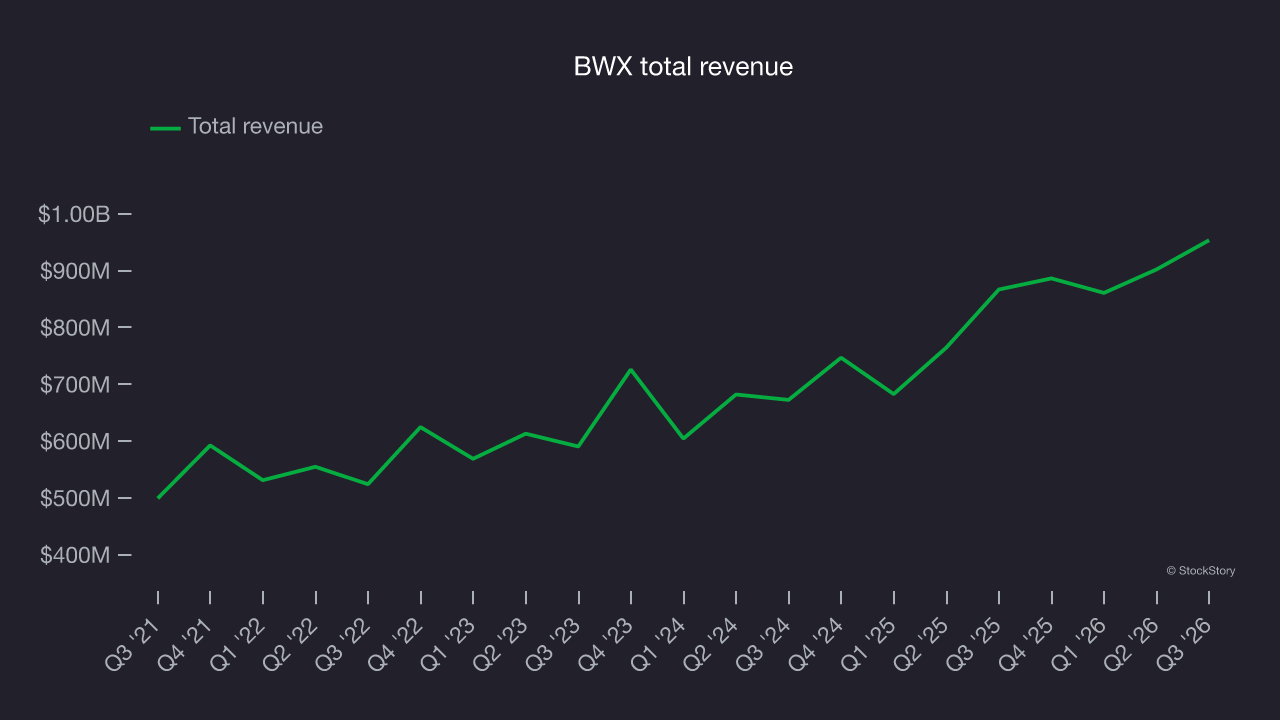
The market seems disappointed with the results as the stock is down 12.3% since reporting and currently trades at $114.45.
Is now the time to buy BWX? Access our full analysis of the earnings results here, it’s free.
Best Q3: Mercury Systems (NASDAQ:MRCY)
Founded in 1981, Mercury Systems (NASDAQ:MRCY) specializes in providing processing subsystems and components for primarily defense applications.
Mercury Systems reported revenues of $253.2 million, up 12.4% year on year, outperforming analysts’ expectations by 3.4%. The business had an exceptional quarter with a beat of analysts’ EPS estimates and a solid beat of analysts’ EBITDA estimates.
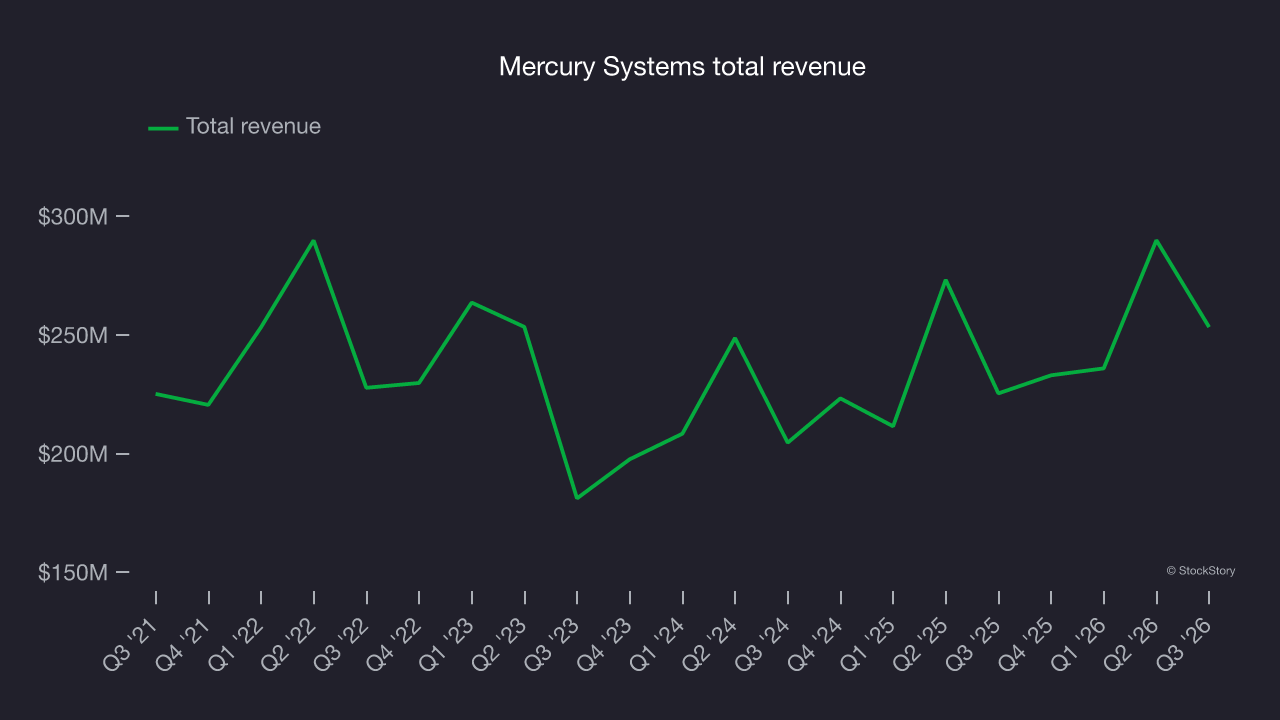
Although it had a fine quarter compared to its peers, the market seems unhappy with the results as the stock is down 7.6% since reporting. It currently trades at $77.24.
Is now the time to buy Mercury Systems? Access our full analysis of the earnings results here, it’s free.
Kratos (NASDAQ:KTOS)
Established with a commitment to supporting national security, Kratos (NASDAQ:KTOS) is a provider of advanced engineering, technology, and security solutions tailored for critical national security applications.
Kratos reported revenues of $471.8 million, up 35.7% year on year, in line with analysts’ expectations. It was a mixed quarter as it posted a solid beat of analysts’ EBITDA estimates but EBITDA guidance for next quarter missing analysts’ expectations significantly.
As expected, the stock is down 11.7% since the results and currently trades at $29.49.
Read our full analysis of Kratos’s results here.
Lockheed Martin (NYSE:LMT)
Headquartered in Maryland, Famous for the F-35 aircraft, Lockheed Martin (NYSE:LMT) specializes in defense, space, homeland security, and information technology products.
Lockheed Martin reported revenues of $20.71 billion, up 11.3% year on year. This result topped analysts’ expectations by 1.3%. Overall, it was a satisfactory quarter as it also put up a beat of analysts’ EPS estimates.
The stock is up 3.8% since reporting and currently trades at $572.25.
Read our full, actionable report on Lockheed Martin here, it’s free.
CACI (NYSE:CACI)
Founded to commercialize SIMSCRIPT, CACI International (NYSE:CACI) offers defense, intelligence, and IT solutions to support national security and government transformation efforts.
CACI reported revenues of $2.47 billion, up 8.2% year on year. This print missed analysts’ expectations by 1.4%. Zooming out, it was actually a solid quarter as it recorded a solid beat of analysts’ EBITDA estimates and a beat of analysts’ EPS estimates.
The stock is down 2.9% since reporting and currently trades at $605.47.
Read our full, actionable report on CACI here, it’s free.
Market update
Over the past year, investors have been forced to repeatedly answer the same question: What is the market’s biggest risk? The answer has changed several times, and each shift has reshaped market leadership.
Late in 2025 and early 2026, artificial intelligence became the market’s primary uncertainty. Investors questioned whether AI would erode software pricing power and weaken competitive moats as AI made it easier to replicate once-differentiated products.
By the spring, technology took a back seat to geopolitics. The U.S. conflict with Iran briefly became the market’s dominant narrative, raising concerns about oil prices, inflation, and global growth. But as energy markets remained orderly and fears of a prolonged supply disruption faded, investors quickly turned their focus back to fundamentals.
Want to invest in winners with rock-solid fundamentals? Check out our Top 6 Stocks and add them to your watchlist. These companies are poised for growth regardless of the political or macroeconomic climate.