
Q3 earnings highlights: Wintrust Financial vs the rest of the regional banks stocks

Looking back on regional banks stocks’ Q3 earnings, we examine this quarter’s best and worst performers, including Wintrust Financial NASDAQ:WTFC and its peers.
Regional banks, financial institutions operating within specific geographic areas, serve as intermediaries between local depositors and borrowers. They benefit from rising interest rates that improve net interest margins (the difference between loan yields and deposit costs), digital transformation reducing operational expenses, and local economic growth driving loan demand. However, these banks face headwinds from fintech competition, deposit outflows to higher-yielding alternatives, credit deterioration (increasing loan defaults) during economic slowdowns, and regulatory compliance costs. Recent concerns about regional bank stability following high-profile failures and significant commercial real estate exposure present additional challenges.
The 86 regional banks stocks we track reported a softer Q3. As a group, revenues were in line with analysts’ consensus estimates.
While some regional banks stocks have fared somewhat better than others, they have collectively declined. On average, share prices are down 2.8% since the latest earnings results.
Wintrust Financial NASDAQ:WTFC
Founded in 1991 as a community-focused alternative to big banks in the Chicago area, Wintrust Financial (NASDAQGS:WTFC) operates community banks in the Chicago area and provides specialty finance services including insurance premium financing and wealth management.
Wintrust Financial reported revenues of $762.2 million, up 9.3% year on year. This print exceeded analysts’ expectations by 0.9%. Despite the top-line beat, it was still a softer quarter for the company with a significant miss of analysts’ tangible book value per share estimates and a narrow beat of analysts’ EPS estimates.
“We are encouraged by our strong third quarter performance and record results year-to-date. We believe we are well-positioned to build on our strong momentum and deliver further revenue growth as we close out the year. Our unique market position and strong customer relationships continue to create long-term franchise value in the markets we serve. We are proud of our latest deposit market share gains in Illinois and remain committed to expanding our market presence in Wisconsin and west Michigan. Our focus remains on delivering consistent balance sheet growth, expanding net interest income while maintaining a disciplined approach to expense management, which should generate positive operating leverage for the year”, Mr. Crane concluded.
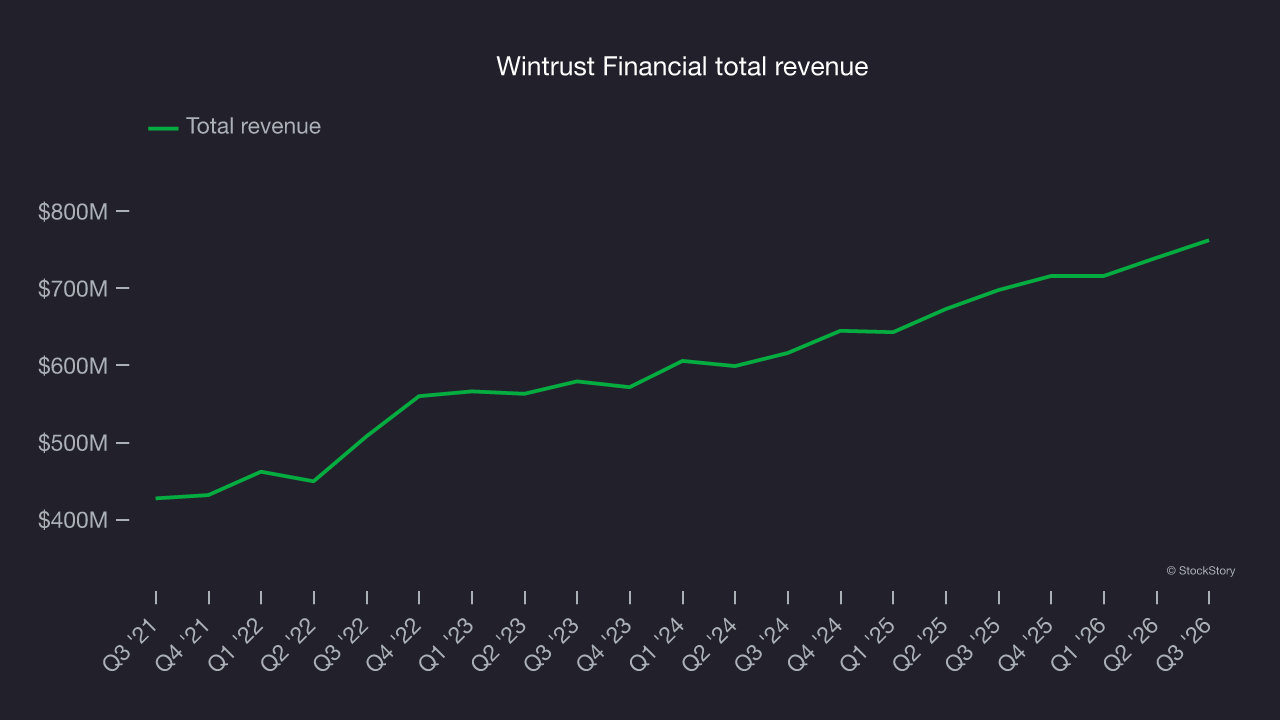
Interestingly, the stock is up 3.5% since reporting and currently trades at $147.50.
Read our full report on Wintrust Financial here, it’s free.
Best Q3: Merchants Bancorp (NASDAQ:MBIN)
With a strategic focus on low-risk, government-backed lending programs, Merchants Bancorp (NASDAQCM:MBIN) is an Indiana-based bank holding company specializing in multi-family mortgage banking, mortgage warehousing, and traditional banking services.
Merchants Bancorp reported revenues of $224.9 million, up 31.5% year on year, outperforming analysts’ expectations by 22.3%. The business had a favorable quarter with a beat of analysts’ EPS estimates and a narrow beat of analysts’ tangible book value per share estimates.
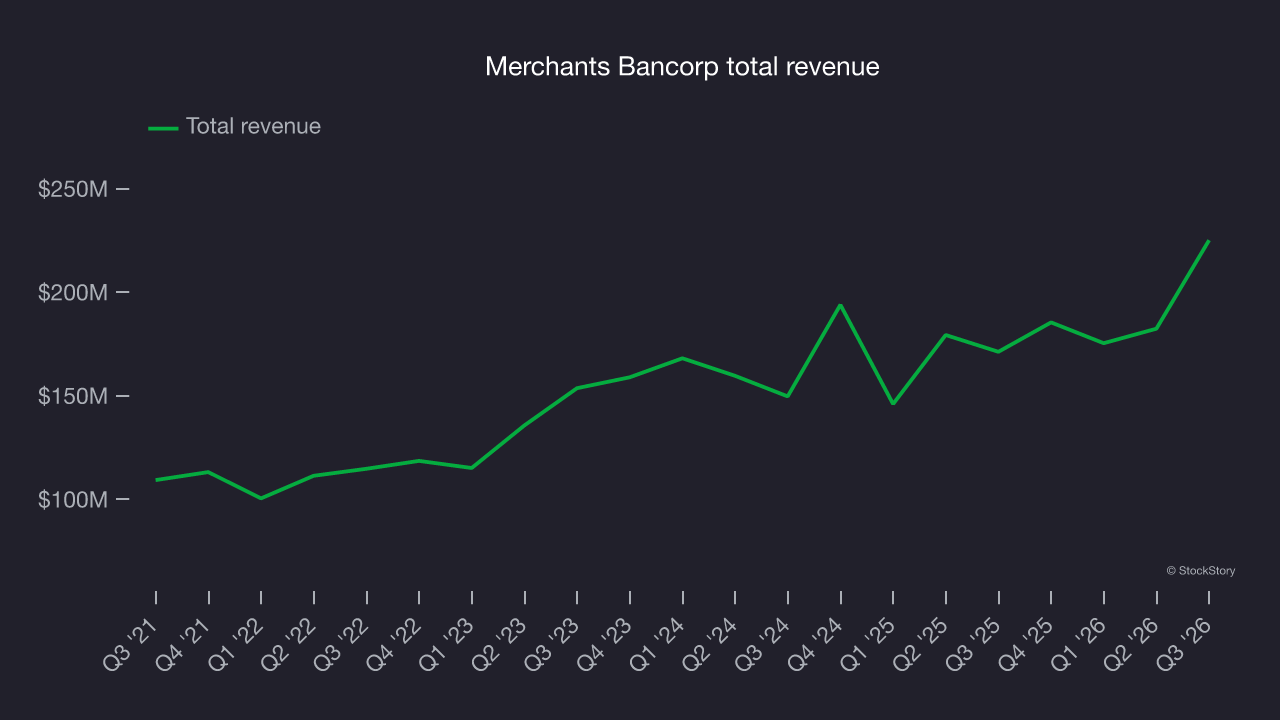
Merchants Bancorp delivered the biggest analyst estimate beat among its peers. The market seems content with the results as the stock is up 1.8% since reporting. It currently trades at $50.00.
Is now the time to buy Merchants Bancorp? Access our full analysis of the earnings results here, it’s free.
Weakest Q3: National Bank Holdings (NYSE:NBHC)
Operating under familiar local brands like Community Banks of Colorado, Bank Midwest, and Bank of Jackson Hole, National Bank Holdings (NYSE:NBHC) operates regional banks across Colorado, Kansas, Missouri, Wyoming, Texas, and other western states, offering commercial, business, and consumer banking services.
National Bank Holdings reported revenues of $128.5 million, up 21.8% year on year, falling short of analysts’ expectations by 2.1%. It was an underwhelming quarter as it posted a significant miss of analysts’ net interest income estimates and a significant miss of analysts’ EPS estimates.
As expected, the stock is down 5.5% since the results and currently trades at $36.84.
Read our full analysis of National Bank Holdings’s results here.
Fifth Third Bancorp (NASDAQ:FITB)
Named after the merger of Third National Bank and Fifth National Bank in 1908, Fifth Third Bancorp (NASDAQ:FITB) is a financial services company that provides banking, lending, wealth management, and investment services to individuals and businesses across the Midwest and Southeast.
Fifth Third Bancorp reported revenues of $3.33 billion, up 43.8% year on year. This result was in line with analysts’ expectations. Aside from that, it was a softer quarter as it produced a significant miss of analysts’ tangible book value per share estimates and net interest income in line with analysts’ estimates.
The stock is up 1.3% since reporting and currently trades at $51.01.
Read our full, actionable report on Fifth Third Bancorp here, it’s free.
United Bankshares (NASDAQ:UBSI)
With roots dating back to 1982 and a strong presence in the Mid-Atlantic region, United Bankshares (NASDAQ:UBSI) is a bank holding company that provides commercial and retail banking services through its United Bank subsidiary across multiple states.
United Bankshares reported revenues of $326.2 million, up 4% year on year. This print met analysts’ expectations. Taking a step back, it was a softer quarter as it recorded a miss of analysts’ tangible book value per share estimates and EPS in line with analysts’ estimates.
The stock is down 1.9% since reporting and currently trades at $46.27.
Read our full, actionable report on United Bankshares here, it’s free.
Market update
Over the past year, investors have been forced to repeatedly answer the same question: What is the market’s biggest risk? The answer has changed several times, and each shift has reshaped market leadership.
Late in 2025 and early 2026, artificial intelligence became the market’s primary uncertainty. Investors questioned whether AI would erode software pricing power and weaken competitive moats as AI made it easier to replicate once-differentiated products.
By the spring, technology took a back seat to geopolitics. The U.S. conflict with Iran briefly became the market’s dominant narrative, raising concerns about oil prices, inflation, and global growth. But as energy markets remained orderly and fears of a prolonged supply disruption faded, investors quickly turned their focus back to fundamentals.
Want to invest in winners with rock-solid fundamentals? Check out our Strong Momentum Stocks and add them to your watchlist. These companies are poised for growth regardless of the political or macroeconomic climate.