
Should Breakup Plan Require Action From CVS Health (CVS) Investors?
- CVS Health has approved a plan to separate into two independent, publicly traded companies, one centered on healthcare services and the other on retail pharmacy, reshaping how its insurance, pharmacy benefit and store operations are organized.
- The breakup highlights a push to make CVS Health’s insurance, pharmacy benefit management and retail pharmacy activities easier for investors to assess as distinct businesses. Some critics question whether the move addresses on-the-ground patient care and pharmacist working conditions.
- We will look at how CVS Health’s investment narrative shifts as management pursues a two-company split focused on healthcare services specialization.
CVS Health Investment Narrative Recap
To own CVS Health through this plan, you need to believe the split can preserve the benefits of integration while giving each arm clearer priorities. According to Andrei_Niculescu, an investor in the Simply Wall St Community, the key swing factor is still Aetna keeping its medical benefit ratio in a workable range and retail pharmacy earnings staying relatively steady. The separation announcement does not change that in the near term. The main operational risk remains medical cost trend and any squeeze on pharmacy benefit management margins.
The more mechanical short term catalyst remains execution on existing guidance and cash generation rather than the breakup itself. Investors also need to watch debt, since the group carries a high level of borrowing that must be allocated between two future balance sheets. If pharmacy or PBM profitability becomes less predictable while leverage remains elevated, the split could simply make those pressures more visible rather than easing them.
The Aetna For You & Baby initiative looks most relevant when thinking about CVS Health after the separation. Management is leaning on the health insurance, Caremark and retail footprint to support maternal and infant care, testing whether this integrated model can keep members engaged and stickier inside the ecosystem. That is where the long term earnings story could either hold or fade.
If programs like Aetna For You & Baby build more stable member relationships, they may help offset regulatory or reimbursement pressure on the PBM and retail units that critics worry the breakup does not directly address. Execution risk is real, since these offerings rely on coordination across systems, benefits and local touchpoints. For a shareholder, the question is whether this kind of coordinated care program can stay intact and effective even after CVS Health is formally split into two listed companies.
On those figures, Andrei_Niculescu’s narrative points to fair value of US$124.00 for CVS Health by applying assumed revenue growth of 16.1% a year and a future profit margin of 1.2%, which together support a mid-teens P/E multiple on the business’s projected earnings power.
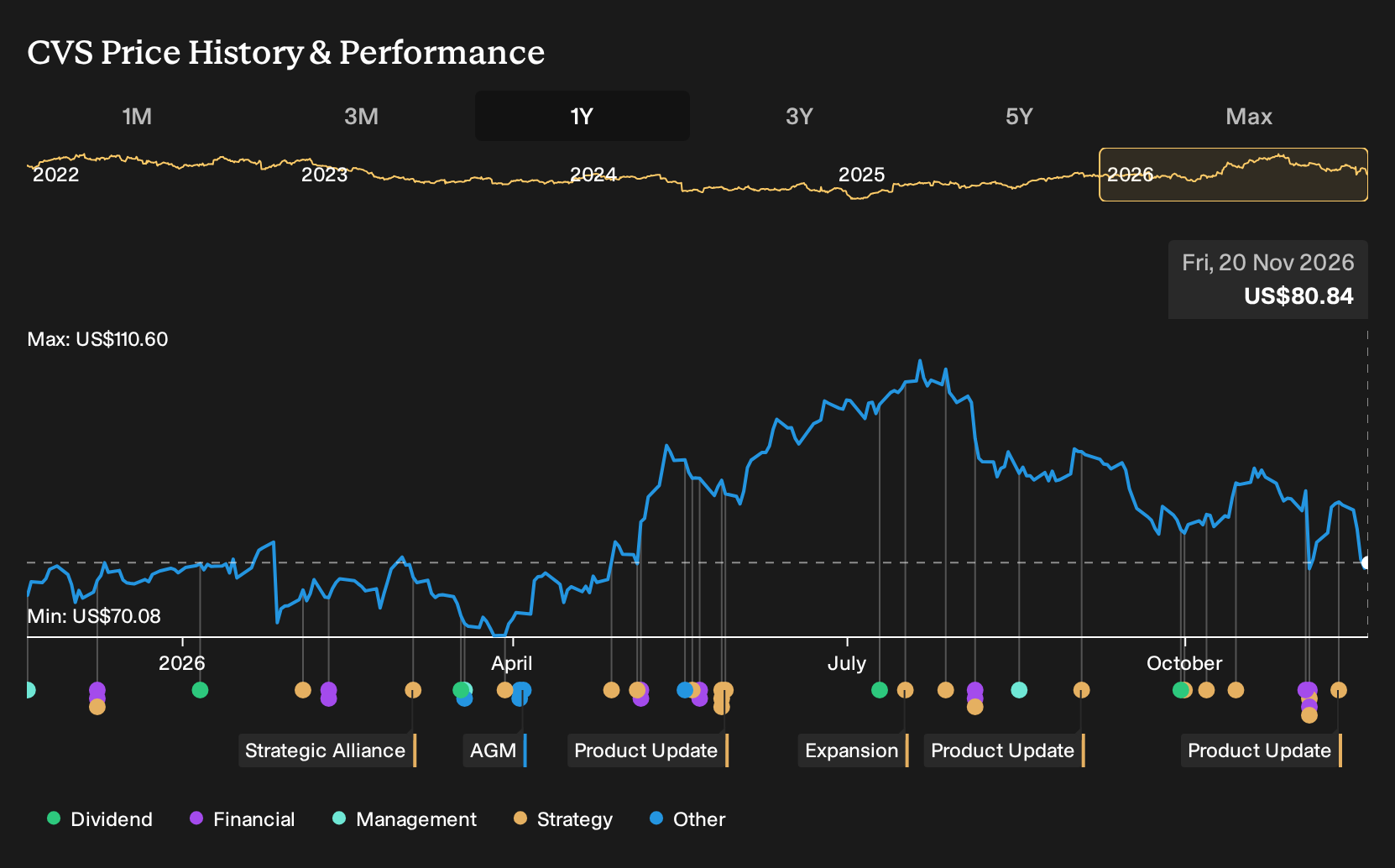
Uncover why CVS Health's fair value indicates a 53% potential upside to its current price, which could narrow quickly.
Exploring Other Perspectives
Five fair value views from the Simply Wall St Community span roughly US$104 at the low end to about US$278 at the top, so you are looking at wide disagreement. That spread sits beside CVS Health’s pending breakup and retail initiatives, which could influence how future Community members frame their estimates.
Explore 4 other CVS Health fair value estimates, including one that suggests it could be worth just $104.01!
Decide For Yourself
Disagree with existing narratives? Extraordinary investment returns rarely come from following the herd, so go with your instincts.
- A great starting point for your CVS Health research is our analysis highlighting 5 key rewards and 1 important warning sign that could impact your investment decision.
- See our latest analysis for CVS Health. The report includes a comprehensive fundamental analysis summarized in a single visual, the Snowflake, making it easy to evaluate CVS Health's overall financial health at a glance.
Looking for more investment ideas beyond CVS Health?
Once you are comfortable with how CVS Health fits into your portfolio, it often helps to compare it with a wider set of opportunities that share similar qualities or offer something very different. The Simply Wall St Screener can help you quickly sort through thousands of companies based on balance sheet strength, income potential or future growth profiles so you can build a watchlist that closely matches your goals.
- For investors who want income that feels more predictable, review companies with higher yields and resilient payouts through our 8 dividend fortresses.
- If capital preservation and steadier business profiles matter most to you, filter for businesses that show lower risk scores and sturdy fundamentals using the 32 resilient stocks with low risk scores.
- When you are searching for quality that is not yet widely followed, scan a focused shortlist of under-the-radar opportunities with strong fundamentals via the 18 high quality undiscovered gems.
Have feedback on this article? Concerned about the content? Get in touch with us directly. Alternatively, email editorial-team@simplywallst.com