
Fair Isaac (FICO) Draws Attention On S&P 500 Talk As Valuation Questions Linger
Fair Isaac (FICO) has been in focus after speculation about a potential S&P 500 inclusion coincided with fresh news on its mortgage scoring partnerships, giving investors new angles to assess the stock.
Recent headlines around Fair Isaac, from speculation about S&P 500 inclusion to the Xactus mortgage scoring deal and leadership changes in its B2B Scores unit, have arrived after a sharp reset in the share price. The stock has fallen year to date, with a share price return down 57.75% and a 1 year total shareholder return down 61.17%, even though the 5 year total shareholder return remains up 100.89%. This suggests long term holders have still seen gains, but recent momentum has clearly faded.
Scan beyond Fair Isaac by lining up how it compares on quality, value and resilience against our curated list of 31 resilient stocks with low risk scores in similar markets.
Fair Isaac still appears to be a high quality scoring franchise, yet the share price has been hit hard this year. Is a strong business now available at a reasonable valuation, or is it still priced for perfection?
Most Popular Narrative: 10% Overvalued
Fair Isaac closed at $694.31, while the most followed narrative places fair value closer to $632.72. This sets up a measured, slightly cautious view on the stock according to andre_santos, an investor in the Simply Wall St Community who built a full cash flow and earnings based valuation framework.
The stock fell from about $1,660 a year ago to $711, mostly because of VantageScore, FICO's rival. FHFA, the regulator of Fannie Mae and Freddie Mac, said on September 28, 2026 that both will price loans on a single grid for FICO and VantageScore 4.0 (HousingWire; Motley Fool, September 29, 2026).
See why 2 investors see Fair Isaac as 10% overvalued.
That narrative fair value of $632.72 uses a 9.78% discount rate and blends a DCF outcome of $630.51 with an EPS based estimate of $701.82, with more weight on the cash flow work than on the earnings scenarios.
The valuation work hinges on three linked ideas. Fair Isaac has very high margins today, it carries a sizeable debt load after buybacks, and the mortgage score pricing debate introduces a clear spread between upside and downside paths. In the DCF, the analyst starts from trailing revenue of $2.53b and an overall operating margin of about 51.5%, then lets margins drift toward 50% while revenue growth slows to mid single digits.
On that setup, Fair Isaac screens as a high quality but fully priced asset in the narrative. The DCF Monte Carlo simulation clusters many outcomes below the recent share price because the model gives more room for margin pressure in weaker scenarios than for further expansion in stronger ones. The EPS based view lands closer to the current market level, which is why the blended fair value ends up only around 10% below the last close.
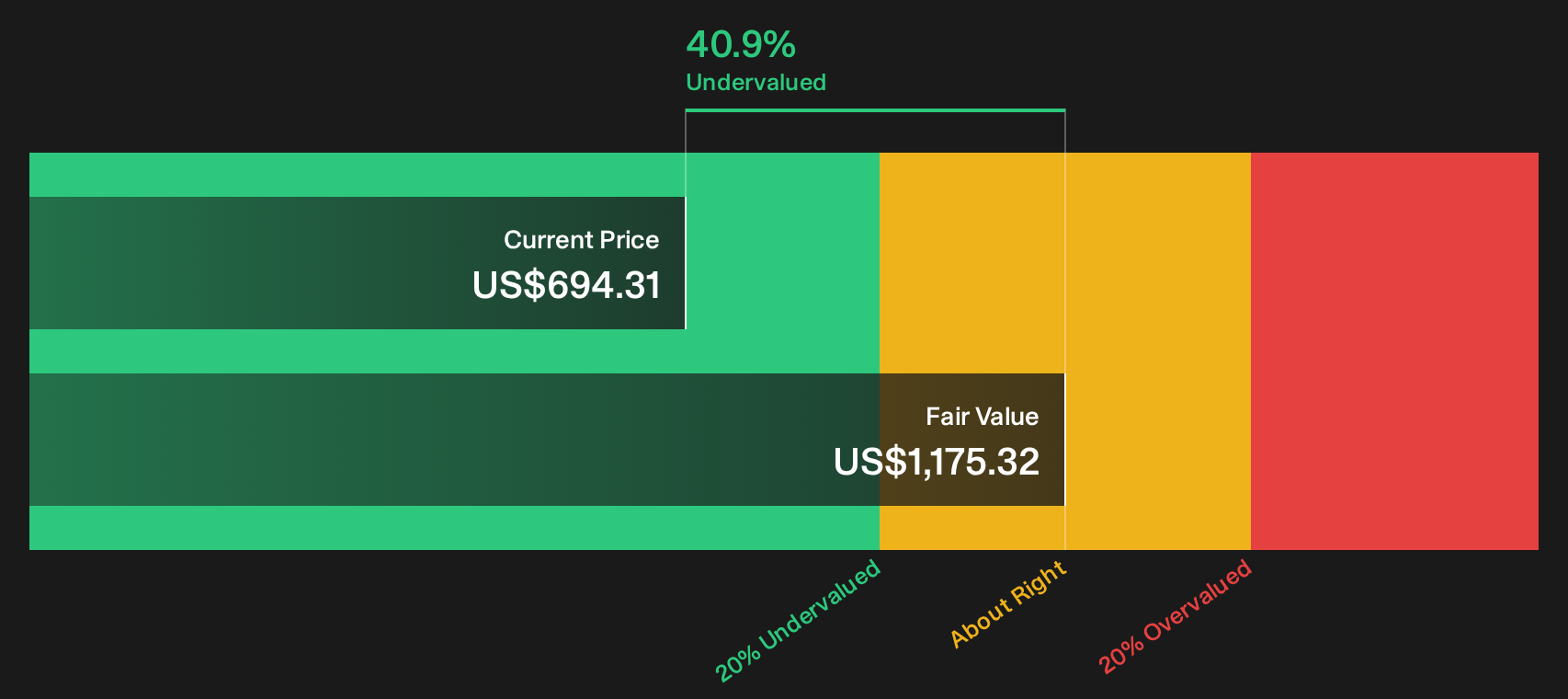
For investors weighing this against analyst models such as the SWS DCF, the gap between $632.72 and the SWS future cash flow value of $1,175.32 highlights how sensitive valuation is to assumptions about long term pricing power, leverage and growth.
Result: Fair Value of $632.72 (OVERVALUED)
Still, Fair Isaac’s story could change quickly if mortgage score pricing is reset more aggressively or if debt-funded buybacks limit flexibility when conditions tighten.
Find out about the key risks to this Fair Isaac narrative.
Another View On Fair Isaac’s Valuation
The community narrative pegs Fair Isaac at about 10% above its fair value, yet the SWS DCF model presents a different perspective. On that approach, FICO at $694.31 is described as trading around 41% below an estimated future cash flow value of $1,175.32, which implies a very different risk and reward profile.
For anyone considering which perspective to use, it helps to see exactly how the cash flow model is built and what would need to change for the gap to close. Look into how the SWS DCF model arrives at its fair value.
Here is how that future cash flow value currently compares with the share price.
Next Steps
The mixed signals around Fair Isaac might leave you curious rather than convinced, so consider taking the time now to stress test the story against your own framework using the 4 key rewards and 2 important warning signs
Looking for more Fair Isaac sized opportunities?
If Fair Isaac has sharpened your thinking, this is the moment to widen your net and pressure test other ideas before the next wave of opportunities moves on.
- Target resilient compounding potential by filtering for strong cash generation and valuation support using the 40 high quality undervalued stocks.
- Lock in potential income ideas by scanning companies with consistent payouts through the 8 dividend fortresses.
- Spot sturdier balance sheets by zeroing in on financially robust businesses with the list of solid balance sheet and fundamentals (24 results).
Have feedback on this article? Concerned about the content? Get in touch with us directly. Alternatively, email editorial-team@simplywallst.com