
Broadcom Stock Faces Google Order Cuts And AI Customer Concentration Risk
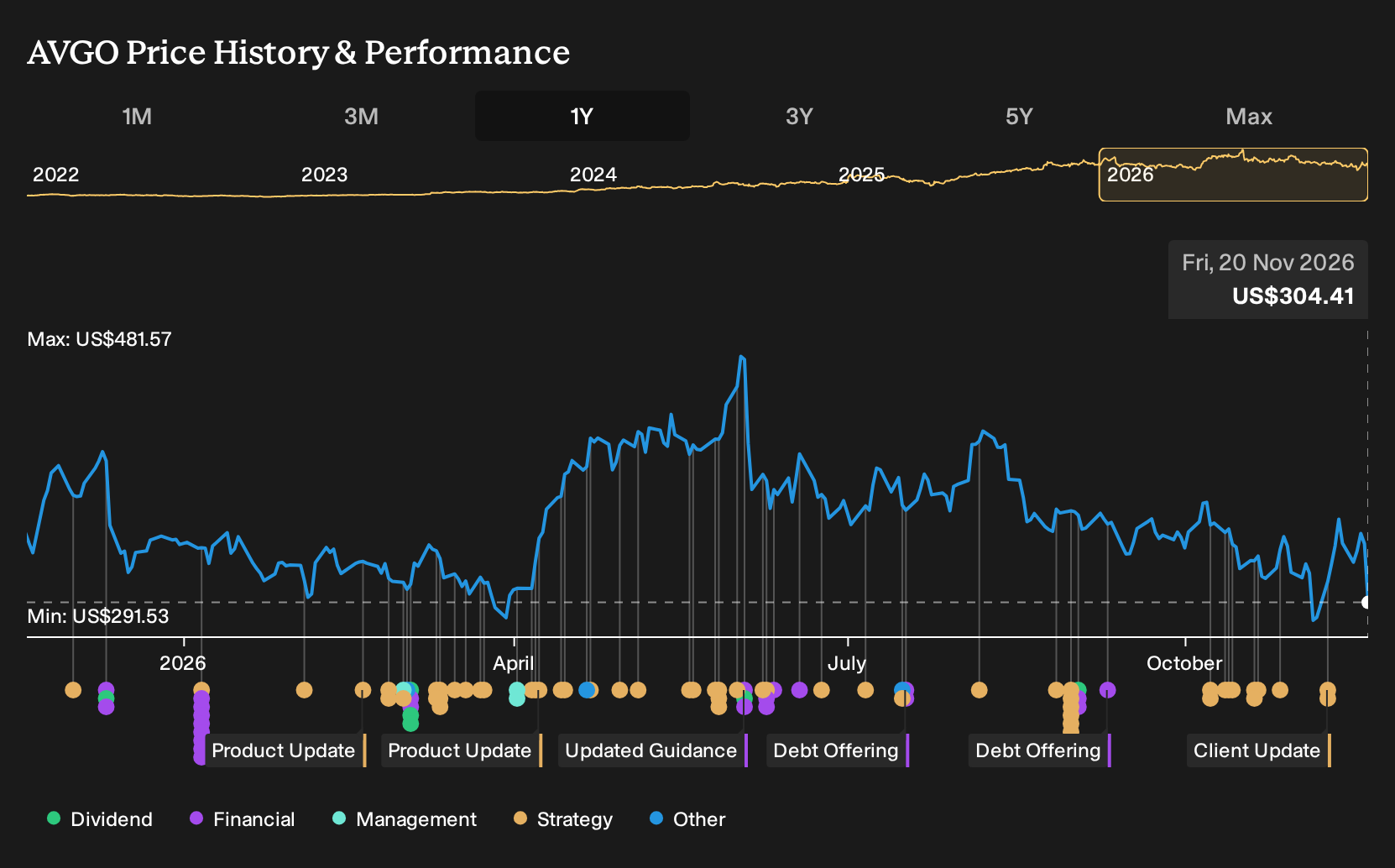
- Recent reports indicate that Google has reduced planned 2027 shipments of Broadcom designed TPU 8i AI chips, raising questions about how lower hyperscaler orders may affect Broadcom's AI semiconductor pipeline and long term custom accelerator plans.
- This shift spotlights how much Broadcom's AI story depends on a handful of very large cloud customers, with investor focus now squarely on concentration risk, contract structure, and whether other workloads or clients can fill any gap in demand.
- The investment narrative around Broadcom as a digital infrastructure provider now needs to be weighed against reduced Google AI chip orders and related concentration risk.
Broadcom Investment Narrative Recap
To own Broadcom, you need to believe, as niteco, a Simply Wall St Community investor who wrote the narrative argues, that this is a long term digital infrastructure platform, not just an AI chip pure play. The current operating story hinges on custom accelerators, networking and VMware Cloud Foundation pulling together into one integrated stack. The near term catalyst remains AI semiconductor demand and execution against management’s AI revenue ambitions, while the biggest risk right now is clearly customer concentration in hyperscalers and AI labs.
Google’s 2027 TPU shipment reset directly presses on that risk, but it does not by itself rewrite the whole Broadcom thesis. Investors will be watching whether Anthropic, OpenAI and other AI customers actually take up the chip capacity Broadcom is lining up and whether VMware driven software cash flows keep smoothing chip cycle swings. If AI customers stagger orders or stretch ramps, the short term growth cadence could slow even if the long term digital infrastructure need that niteco highlights remains intact.
The VM API project moving into the Cloud Native Computing Foundation and Broadcom co chairing the new Kubernetes Workload Conformance Working Group is one of the most relevant developments to watch alongside the Google reset. It ties Broadcom’s VMware Cloud Foundation platform more tightly into open source standards for running both virtual machines and AI workloads under a single Kubernetes control plane. That matters because it speaks directly to how Broadcom aims to stay central as customers blend VMs, containers and AI agents across multi vendor clouds.
If VM API and VKS gain broad adoption, Broadcom’s role could become more about defining how workloads are run and managed than about any single chip program. That would give the group another operational lever on top of custom accelerators when AI buyers rebalance suppliers. For you as an investor, the key question is whether this open ecosystem push, with more than 20 partner solutions already validated for VMware vSphere Kubernetes Service, can offset swings from any one AI chip contract while keeping Broadcom’s digital infrastructure story intact.
Using niteco’s own framework, the fair value of Broadcom lands at $651.05 based on revenue rising 22.0% a year and a future profit margin of 39.9%. Together, these factors support a higher earnings base and justify the valuation the narrative sets out.
Uncover why Broadcom's fair value indicates a 114% potential upside to its current price that could narrow quickly.
Exploring Other Perspectives
You also see a very different angle in the lowest Broadcom analyst forecasts. These sceptics zoom in on the AI XPV financing exposure, where up to about US$29b of residual value guarantees sit against a US$35b tranche. They were already baking in heavy caution despite projecting revenue of US$318.1b and earnings of US$160.8b by 2029. As a result, Google’s reset could push their narrative even further apart from the baseline. That wide gap in opinion is exactly why you should explore several viewpoints before deciding how this AI infrastructure story fits your own portfolio.
Explore 13 other Broadcom fair value estimates, including one that suggests it could be worth just $401.32!
Form Your Own Verdict
Disagree with existing narratives? Extraordinary investment returns rarely come from following the herd, so go with your instincts.
- A great starting point for your Broadcom research is our analysis highlighting 4 key rewards that could impact your investment decision.
- See our latest analysis for Broadcom. The report includes a comprehensive fundamental analysis summarized in a single visual, the Snowflake, making it easy to evaluate Broadcom's overall financial health at a glance.
Looking For More Ideas Beyond Broadcom?
If the Broadcom story leaves you wanting a broader mix of AI infrastructure and cash flow profiles, it can help to widen the search using the Simply Wall St Screener and line up a few contrasting candidates side by side.
- For investors hunting for quality at a measured price, scan a curated 40 high quality undervalued stocks that may offer more conservative entry points relative to their fundamentals.
- If resilience matters most to you, focus on balance sheets that look built to handle shocks by starting with a list of solid balance sheet and fundamentals (24 results) and stress testing how each business might hold up under pressure.
- When you want to back durable businesses that the crowd is not already fixated on, broaden your watchlist with a 18 high quality undiscovered gems that combines strong numbers with lower market attention.
Have feedback on this article? Concerned about the content? Get in touch with us directly. Alternatively, email editorial-team@simplywallst.com