
How Operating Reorganization Will Impact General Mills (GIS) Investors
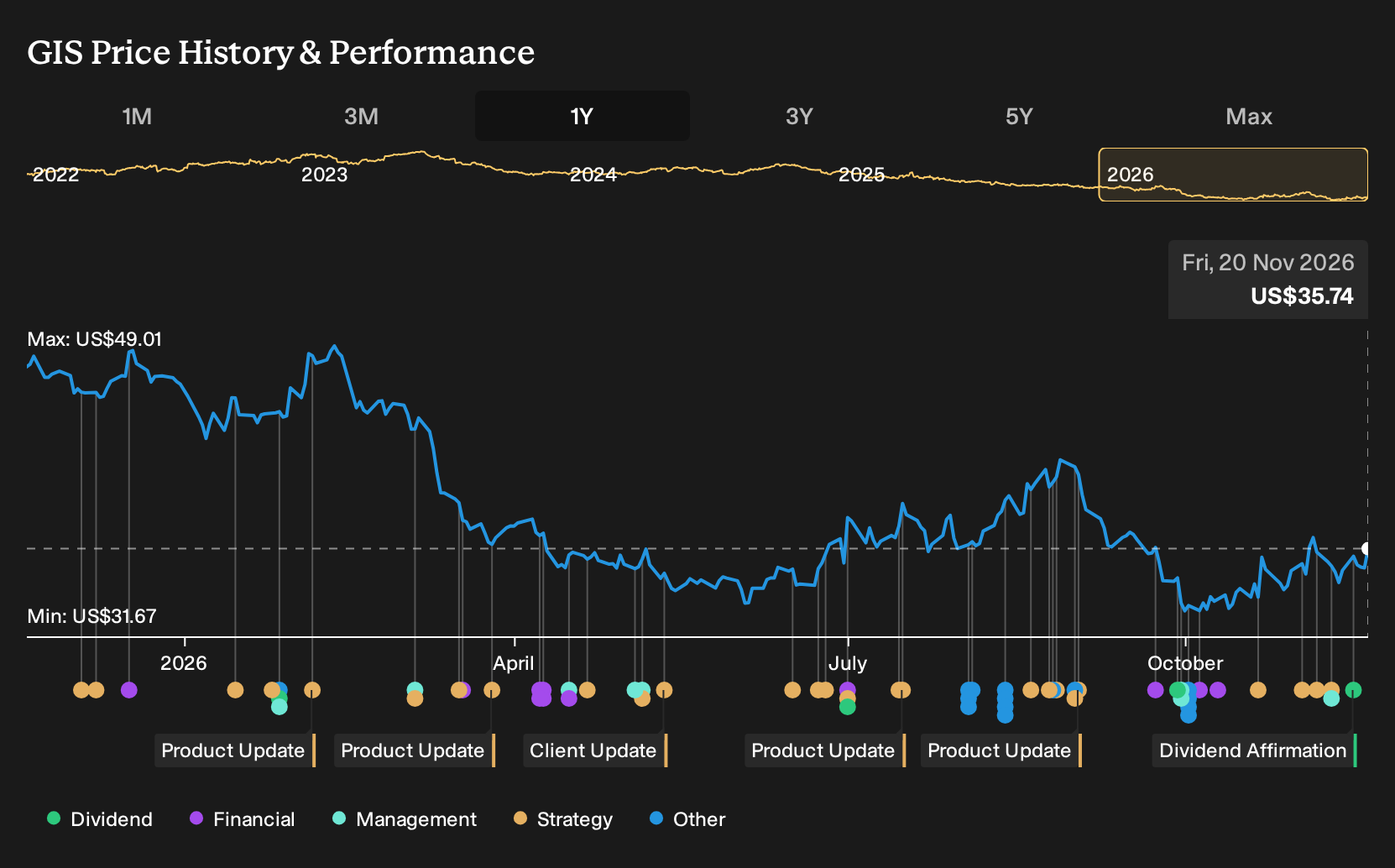
- General Mills has approved a quarterly dividend of $0.61 per share payable on February 1, 2027, and has outlined a new operating model effective January 1, 2027 that consolidates its businesses into three segments and creates a Commercial function that unites marketing, sales and consumer insights.
- The reorganization places Cereal, Snacks & International under Ricardo Fernandez, Meals & Baking Solutions under Brett White and keeps Pet with Liz Mascolo, while a newly promoted Chief Commercial Officer, Josh Yates, is tasked with tightening omnichannel execution around these refocused units.
- We will now examine how General Mills' new three segment structure and Commercial function could reshape the existing investment narrative.
Scan beyond General Mills and see how other packaged food and consumer staples players are repositioning for the next few years with our hand picked 31 resilient stocks with low risk scores.
General Mills Investment Narrative Recap
The big picture for a General Mills shareholder, based on the analyst consensus Narrative on Simply Wall St, is belief in a slow repair job. Cost savings, product refreshes and pet platforms are expected to support earnings over time even while revenue forecasts are flat and the business is currently loss making. The new three segment structure and Commercial function look more like execution plumbing than a direct fix for near term profit pressure.
Right now the key catalyst is whether US$750 million of planned fiscal 2027 savings and volume repair efforts actually show up in margins and earnings. The biggest risk remains that recent organic sales and profit declines persist, especially if operational missteps, promotional dependence or product quality issues resurface. The reorganization helps only if it tightens day to day execution across those problem pockets.
The most relevant fresh announcement here is the operating model change that groups General Mills into Cereal, Snacks & International, Meals & Baking Solutions and Pet, while creating a single Commercial function. This reshuffle links directly to the core catalyst in the analyst consensus Narrative on Simply Wall St, which is cleaner execution on cost programs and brand work rather than a big revenue upswing.
Investors can watch how leaders like Ricardo Fernandez, Brett White and Liz Mascolo run these new segments and how Josh Yates, as Chief Commercial Officer, coordinates pricing, promotions and e-commerce across them. Evidence of smoother omnichannel execution, fewer problem brands and more disciplined spending would support the cost saving and margin repair story. A messy transition would lean into the existing risk of earnings compression lasting longer than expected.
General Mills' current narrative points to forecast revenue of US$17.9b and expected earnings of US$1.8b by 2029, with analysts assuming fairly flat revenue trends over the next 3 years and an earnings swing of about US$2.7b, from a loss of US$894.8m today to those projected profits.
Uncover why General Mills' fair value indicates a 3% potential upside to its current price. This reflects a discount that could close faster than many investors expect.
Exploring Other Perspectives
One bearish twist on General Mills focuses on dividend strain. The most pessimistic analysts already saw leverage near 3.8x EBITDA and payout ratios around 70% to 85% as fragile, even while forecasting roughly US$17.4b of revenue and US$1.9b of earnings by 2029. With a new dividend affirmation and reorganization on the table, those views could shift. You can use that spread in expectations as a reminder that reasonable investors can read the same numbers very differently, and it is worth exploring several narratives before making your own call.
Explore 7 other General Mills fair value estimates, including one that suggests as much as 16% downside from the current price.
Decide For Yourself
Disagree with existing narratives? Extraordinary investment results rarely come from following the herd, so go with your instincts.
- A great starting point for your General Mills research is our analysis highlighting 2 key rewards and 3 important warning signs that could impact your investment decision.
- See our latest analysis for General Mills. The report includes a comprehensive fundamental analysis summarized in a single visual, the Snowflake, making it easy to evaluate General Mills' overall financial health at a glance.
Looking For More Investment Ideas Beyond General Mills?
If General Mills' reorganization has you rethinking how you spread risk and opportunity across your portfolio, it can help to scan for other stocks that fit clear criteria on quality, balance sheet strength or income potential using the Simply Wall St Screener.
- For investors who care most about capital preservation and stability, consider starting with a curated set of resilient companies via the 31 resilient stocks with low risk scores.
- If you are hunting for quality at a sensible price, use the dedicated screener featuring 40 high quality undervalued stocks that combine solid fundamentals with attractive pricing signals.
- Income focused investors can zero in on reliable cash returns by scanning a hand-picked group of 8 dividend fortresses that may align with long term payout goals.
Have feedback on this article? Concerned about the content? Get in touch with us directly. Alternatively, email editorial-team@simplywallst.com