
From technical stabilization to Wulianyang, what has driven the stock price coaster of Federal Pharmaceuticals (03933) since November?
Since the Chinese core compound patent for simeglutide officially expired in March of last year, at least 10 domestic companies have started marketing applications for biosimilar drugs or generic drugs, targeting a broad market for weight loss indications. Federal Pharmaceuticals (03933) is one of them.
As early as January 2025, this company was the first in China to submit a marketing registration application for simeglutide injections for type 2 diabetes and was accepted. The weight loss indication market is undoubtedly the next door that needs to be opened.
The Zhitong Finance App observed that on November 4 of this year, Federal Pharmaceuticals issued a voluntary announcement announcing the heavy management indications for simeglutide injections declared by its wholly-owned subsidiary, Zhuhai Federal Biomedical, which was officially accepted by the State Drug Administration (NDA).
According to official information from November 3, Federal Pharmaceuticals submitted a total of five acceptance numbers from CXSS2600179 to CXSS2600183 at once, completing the full specification declaration from initial titration to maintaining high doses, directly targeting the complete medication plan for the original product.
The secondary market gave positive feedback on this. From November 3 to November 9, the stock price of Federal Pharmaceuticals broke out of a round of obvious upward trend. The cumulative increase reached 14.50%, while the largest share price fluctuation during the period reached 18.90%.
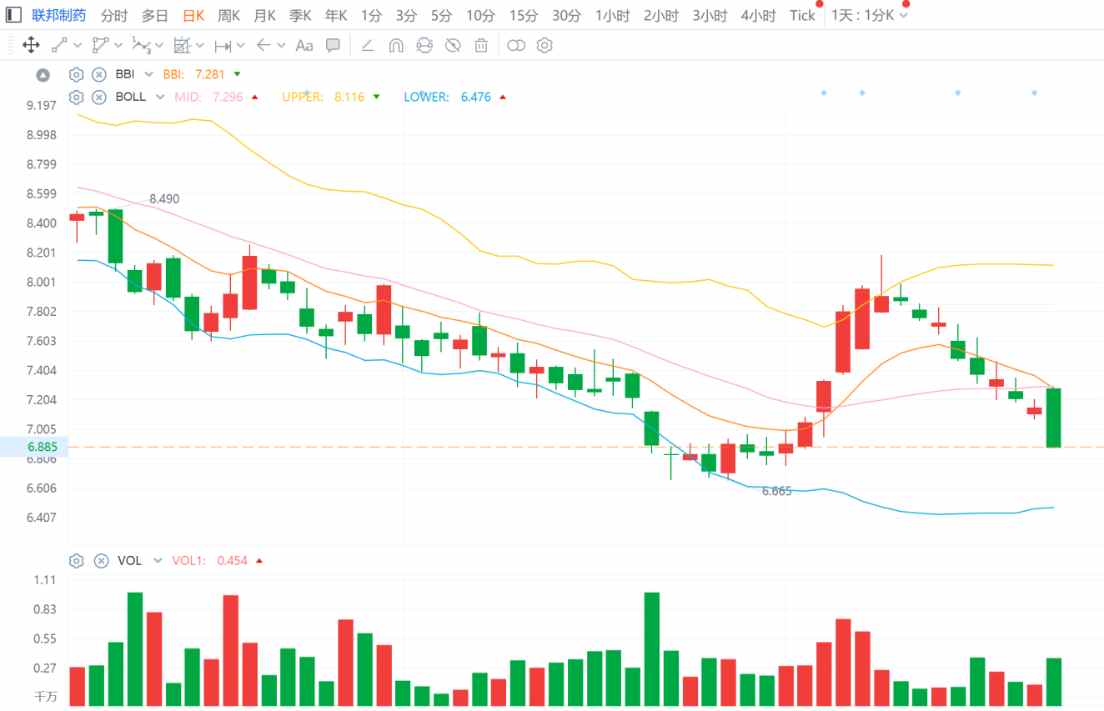
From technical stabilization to “Five Lianyang” of stock prices
Looking at the long-term timeline, after the intraday stock price peaked at HK$9.75 in stages on July 7 this year, the stock price of Federal Pharmaceuticals broke out of a clear downward range, driven by the impact of its own performance and the peripheral turbulence of innovative drugs in Hong Kong stocks. The company's stock price once fell to HK$6.66 in the intraday session on October 28, which means it has almost taken back all of its gains since July 2024.
And this period of decline has also accumulated an extreme pattern of overselling in terms of technology for federal pharmaceuticals. The Zhitong Finance App observed that on October 22, the company's stock price once again hit BOLL offline and operated until October 27.
During this period, the extreme value of Federal Pharmaceuticals' RSI14 index was as low as 10.2, approaching the historical extreme low of the company's stock price since listing; the KDJ-J range low fell to 9.1, which is in the extreme oversold zone; its CCI index fell below -100 to about -108, showing a clear signal of freezing in market sentiment; at the same time, its BIAS12 index showed that the extreme value of the company's stock price deviation from October 22 to 27 had exceeded 6%, showing a relatively extreme share price divergence rate.
Simply put, after a round of 3-month stock price declines, extreme technical overselling indicators within the federal pharmaceutical market have all gathered, and a large amount of pressure has accumulated to return to the average stock price.
After volume closed down 4.43% on October 22 and achieved a single-day trading volume of 10.7629 million shares, the company's stock price basically contracted sideways in the range of HK$6.67-6.90 during the five trading days from October 23 to October 30. During this period, its single-day volume shrank to less than half of the previous period. The corresponding OBV index showed that after falling to -17.4 million on October 27, it rebounded to -15.1 million during the stabilization phase, indicating a positive marginal weakening of its in-market selling pressure.
However, the recovery of the industry and institutional research reports are undoubtedly important drivers for stabilizing federal pharmaceutical stock prices.
The hosting of the ESMO 2026 conference once drove the China Securities Hong Kong Stock Connect Innovative Drug Index to rise by 3.37% in a single day, and the beta recovery in the industry provided a window of emotional recovery for stocks that had surpassed the decline; in addition, three investment banks recently gave purchase ratings to Federal Pharmaceuticals, and the target average price reached HK$12.3, which is more than 70% room for improvement compared to the company's stabilized price of about HK$6.9 at the time. Among them, some research reports mentioned that the company's 2026H1 adjusted profit increased 79.6% month-on-month, and the operating recovery trend is clear. The current valuation already reflects the biggest pessimistic expectation that traditional business is under pressure.
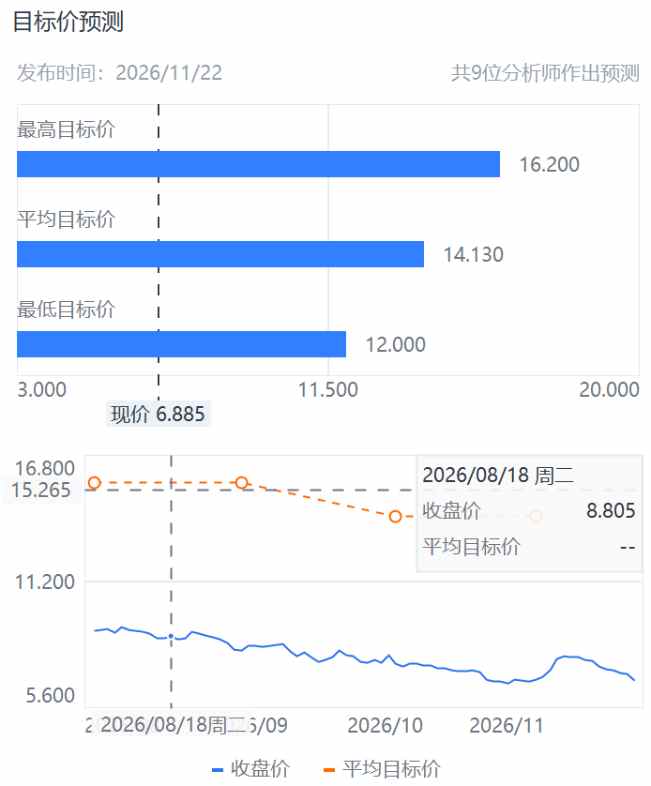
When external factors were “ignited,” a rebound in the federal pharmaceutical farm, which was driven by substantial catalysis of the company's GLP-1 pipeline, began on November 3, and eventually broke out of the “Wulianyang” market.
Commercialization becomes the key to catalyzing stock prices in the post-GLP-1 era
With the gradual expiration of original research patents, centralized declarations of domestic generic drugs, and advanced development of oral GLP-1 and multi-target agonists, the current domestic weight loss drug market has apparently gradually entered the “post-GLP-1 era” from the previous “budd-outbreak” stage.
In this market context, the stock price trend of Federal Pharmaceuticals from November 3 to 9 and November 10 to the present shows the basic trading logic of investors “buy expectations and sell facts.”
As an established domestic manufacturer of recombinant insulin and biofermentation, the company's design production capacity of 6-APA and penicillin G potassium industrial salt has reached 20,500 tons, and the capacity utilization rate has remained high at 100% for a long time. Based on this, the company is also the only domestic company that uses genetically-engineered yeast expression technology to produce insulin. It is also the first company to have both second-generation and third-generation insulin production capacity. Its Zhuhai base has an annual production capacity of 3 tons of insulin raw materials and about 300 million formulations. Since simeglutide is a polypeptide, the production process is the same fermentation and purification system as insulin. Therefore, the yeast expression platform, large-scale fermentation experience and formulation filling capacity accumulated by the company on insulin can be directly transferred to the production of simeglutide and generic drugs.
It has a 10,000-ton biological industrialization base and a complete independent supply capacity for APIs. The ability to vertically integrate the entire industry chain as a result means that the company can not only guarantee a continuous and stable supply of production capacity during the commercialization phase, but is also expected to have stronger pricing penetration in future terminal collection and out-of-hospital retail at its own expense. This is undoubtedly a huge advantage in the post-GLP-1 era of competitive supply chains and cost advantages.
However, the company turned its own advantages into an important step to commercialize expectations. This time, it has received 5 acceptance numbers for domestic weight loss indications in a single place.
The Zhitong Finance App learned that unlike a single maintenance dose for hypoglycemic indications, weight loss indications clinically require strict stepped titration of 0.25 mg, 0.5 mg, 1.0 mg, 1.7 mg to 2.4 mg. The simultaneous implementation of the five acceptance numbers means that the company has completed the full specification declaration from initial titration to high dose maintenance, directly targeting the complete medication plan of the original research drug, and laying a solid foundation for subsequent commercialization.
However, on the other hand, the agency predicts that the global weight loss drug market is expected to exceed 130 billion US dollars in 2030, of which GLP-1 drugs will account for more than 90%; in the Chinese market, the GLP-1 weight loss drug market is expected to exceed 20 billion yuan in 2030. If all indications are considered (sugar reduction+weight loss), the overall market size of GLP-1 receptor agonists (GLP-1RA) in China is expected to reach 71.7 billion yuan in 2029.
Specifically, at present, companies including Renhui Biology and Huadong Pharmaceutical have obtained approval for obesity/overweight indications to seize the first-mover window in the domestic weight loss market. Since then, dozens of companies, including Borui Pharmaceutical, Jiuyuan Gene, and Hanyu Pharmaceutical, have promoted their various innovative drugs and biosimilars to NDA or phase III clinical trials, covering single targets, GLP-1/GIP dual targets, and GLP-1/GCG three targets. According to IQVIA data, over 10 GLP-1 products are expected to be launched intensively in the next 2-3 years.
In the current context where the “first simulation” of simeglutide has not been achieved in China, the secondary market has apparently responded quickly to its “rush” expectations. However, after the “Five Lianyang” stock prices, overbought technical performance and market competition expectations in the post-GLP-1 era became important driving factors for market fundraisers to “sell facts.”