
After the tech stock battle royale, the bottom of the money went to the bottom! But Wall Street warns: the volatility is not over
The Zhitong Finance App learned that US stock futures experienced a rebound after bottoming out of funds entered the market. Previously, the market experienced a round of sharp sell-off, and capital escaped from the technology sector on a large scale, indicating a significant increase in the volatility of the artificial intelligence (AI) trading market.
According to the data, S&P 500 futures rose 2%, while Nasdaq 100 futures had the highest increase of nearly 3%. Prior to that, the NASDAQ recorded its worst weekly performance since 2020; the much-publicized chip index plummeted 11%. The S&P 500 and the Dow Jones Industrial Average both entered a pullback range last Friday — a pullback defined as a retracement of at least 10% from an all-time high.
Josh Gilbert (Josh Gilbert), chief analyst at eToro Asia Pacific and Middle East in Sydney, said, “After seven consecutive trading days, a rebound is likely to occur. This rise in futures reflects that the technology sector is already deeply oversold. The fundamentals haven't changed much, which is why investors are willing to enter the market layout at the current price.”
The Nasdaq 100 expected volatility indicator has risen to its highest level since April 2020. Two major shocks in a row — the departure of Nvidia (NVDA.US) Hwang In-hoon and the Democratic Party's victory in the midterm elections brought the technology weight index to the brink of a bear market.
Liquidity in the US is already weak this week due to shortened trading hours during the Thanksgiving holiday, which may further amplify market fluctuations. Currently, the market is already facing two major fundamental risks: the future of AI's main market and the Federal Reserve's interest rate path. US stocks closed early on Thursday due to Thanksgiving Day.
Amy Wu Silverman (Amy Wu Silverman), head of derivatives strategy at RBC's capital markets, said: “Judging from seasonal patterns, VIX usually falls back in November, and this is especially true during the Thanksgiving holiday. Therefore, VIX has surged more than 85% so far this month, which is very abnormal. Unfortunately, the investigation into Nvidia's accounting issues is still ongoing, and the probability of this round of volatility shock is not over yet.”
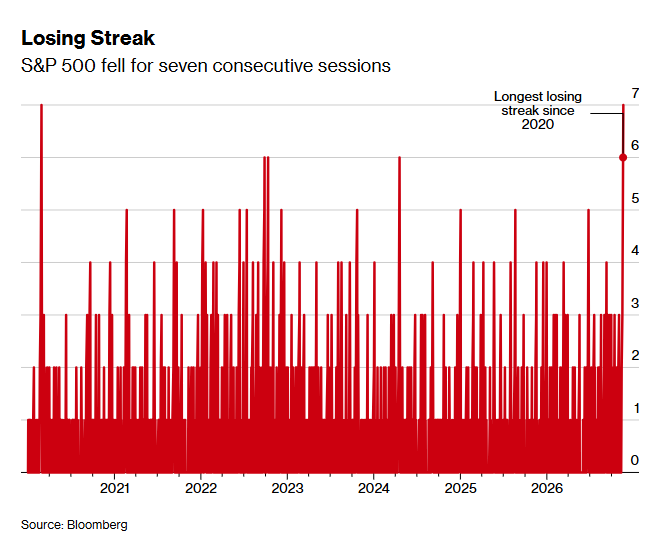
In recent weeks, the market has begun to question whether Wall Street's once-in-a-decade AI bull market will continue. Investors' confidence in the AI-driven epic market and AI's drive to overall economic growth continues to loosen. Meanwhile, the scandal that swept through Nvidia became the biggest drag on the S&P 500 approaching a technical pullback. After the incident came to light, Hwang In-hoon was forced to step down due to his multiple extramarital affairs.
Claude's big model developer Anthropic (ANT.US) landed on US stocks last week. The first trading day of listing closed up 17% from the $83 issue price; however, the stock closed down 8.5% last Friday. The much-anticipated performance of this much-anticipated IPO fell short of expectations and dragged down the overall market.
Daniel Kirsch (Daniel Kirsch), head of options at Piper Sandler, said: “Although we think there is limited room for a further sharp rise in VIX, especially close to the holidays, institutional clients are now asking more about how to hedge protection at the end of the year rather than falling to the bottom.”
The Goldman Sachs trading team believes that last week's decline has created an attractive buying opportunity for US stocks. However, the bank also suggested that overall investor positions are still high, which means that the market has yet to experience a general panic sell-off that could spawn a decent rebound.
The Goldman Sachs trading team wrote in a research report sent to customers on Sunday: Hedge funds' stock positions have been reduced quite enough, and the market is close to a “tactical buying point.” However, several key headwinds remain: stock positions in the entire market are still high, the Federal Reserve is likely to continue to raise interest rates, and the future profit prospects of huge AI investments are questionable.