
SoFi Stock Crashes to a 52-Week Low. Why You Should Buy the Dip.
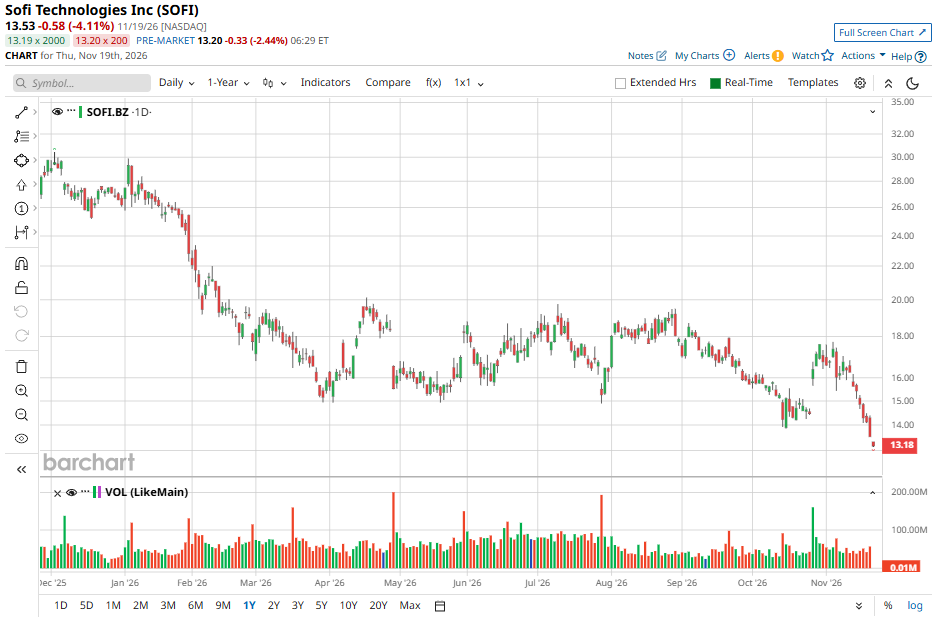
SoFi Technologies (SOFI) stock has taken a significant hit, falling to a 52-week low and losing more than 48% year-to-date. A high-interest-rate environment, amid shifting expectations about Federal Reserve interest-rate policy and rising Treasury yields, has weighed on the stock.
Higher interest rates tend to make borrowing more expensive, which can affect consumer spending and demand for loans. For SoFi, this could mean slower refinancing activity and weaker demand for some lending products. Ongoing affordability concerns may also make consumers more cautious about taking on additional debt, creating near-term challenges.
However, SoFi’s diversified revenue model and the ongoing strength in its non-lending businesses augur well for growth. This diversification could help cushion the impact of a higher-interest-rate environment. Further, its growing member base and existing members adopting multiple products are improving its overall profitability. In addition, the sharp decline in SoFi’s share price has improved its risk-reward profile.
SoFi to Sustain Its Solid Growth
SoFi continues to deliver strong growth, supported by rising membership, higher product adoption, and improving profitability. Further, SoFi is expanding its fee-based and other non-lending businesses, which are less capital-intensive and add stability.
The shift is already gaining traction. In Q3, fee-based revenue continued to increase, reducing SoFi's reliance on lending income. Fee-based revenue reached $571 million in Q3, representing 42% of total revenue, compared with 39% in the previous quarter. This puts the company closer to its goal of generating half its revenue from fee-based businesses. Meanwhile, loan platform originations increased to $3.8 billion, creating opportunities to generate additional fee income without relying entirely on balance-sheet lending.
While lending remains a major contributor to SoFi’s business, a growing share of non-lending revenue improves earnings stability and supports stronger margins over time.
SoFi's latest operating results highlight this momentum. Membership increased 35% year over year (YoY) to 17.1 million, while total products grew 44% to 26.7 million. Notably, existing members accounted for 51% of new product openings. This suggests SoFi is generating more growth through cross-selling to its existing customer base. Products per member also increased to 1.56 from 1.47 a year earlier, creating opportunities to increase customer lifetime value and revenue per member.
Profitability improved alongside this expansion. Adjusted EBITDA surged 70% to $470 million, with a 34% margin. Adjusted net income climbed 74% to $243 million, while adjusted EPS increased 64% to $0.18.
Looking ahead, management has projected adjusted net revenue to hit $5.04 billion in 2026, representing 40% annual growth, compared with the previous guidance range of $4.75 billion to $4.85 billion. Adjusted EBITDA is projected at $1.66 billion, while adjusted net income is expected to reach $840 million. SoFi raised its adjusted EPS forecast to $0.61 from $0.60.
As for 2027, SoFi's preliminary guidance points to continued expansion. Management expects adjusted net revenue of $6.4 billion, representing 27% YoY growth, and adjusted EBITDA of $2.24 billion, with margins expanding to approximately 35%. Adjusted net income is projected to reach $1.28 billion, while adjusted EPS is forecast at $0.90.
Overall, SoFi's growing membership, higher product adoption, expanding fee-based revenue, and improving profitability are likely to push its share price higher.
SoFi Stock Is a Buy Now
While SoFi stock has crashed to a 52-week low, its fundamentals remain strong. Rising membership, increased product adoption, expanding fee-based revenue, and improving profitability support its growth outlook through 2027.
Management's latest outlook also points to healthy growth in revenue and earnings over the coming quarters. Although elevated interest rates and economic uncertainty could keep pressure on the stock in the near term, the sharp decline in its share price has made the valuation more attractive for investors with a long-term investment horizon.
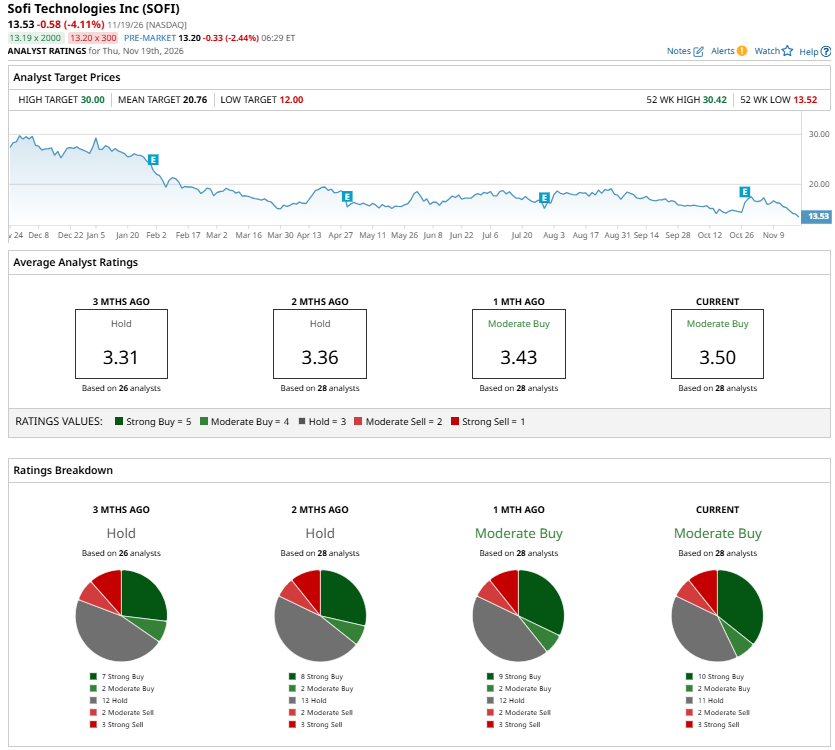
Wall Street analysts remain divided on SoFi, with the stock carrying a consensus rating of "Moderate Buy."
Nonetheless, SoFi's expanding business, improving financial performance, and lower share price make it worth buying now.
On the date of publication, Amit Singh did not directly have a position in any of the securities mentioned in this article. All information and data in this article is solely for informational purposes. For more information please view the Barchart Disclosure Policy here.