
Holds over $109 billion in Nvidia (NVDA.US) shares! The trusts and foundations behind Hwang In-hoon's wealth empire are nested in layers
The Zhitong Finance App learned that from being the founder of a startup with only enough living expenses for six months in a bank account to being among the richest couples in the world, Huang Renxun and his wife Lori have built a huge wealth empire around NVDA.US (NVDA.US).
In 1993, Hwang In-hoon co-founded Nvidia with Chris Malachowsky (Chris Malachowsky) and Curtis Priem (Curtis Priem). At the time, Hwang In-hoon and his wife already had two young children, and the savings in their bank accounts were only enough to maintain living expenses for six months. Since then, as Nvidia grew from a graphics processor supplier to a core company in the global field of artificial intelligence chips and accelerated computing, the company's stock price rose sharply, driven by the AI wave, and Hwang In-hoon and his wife also accumulated huge wealth as a result.
According to reports, Hwang In-hoon and his wife directly and indirectly control about 870 million Nvidia shares, which is equivalent to about 3.6% of the chipmaker's shares. At last Friday's closing price, these holdings are worth more than $109 billion.
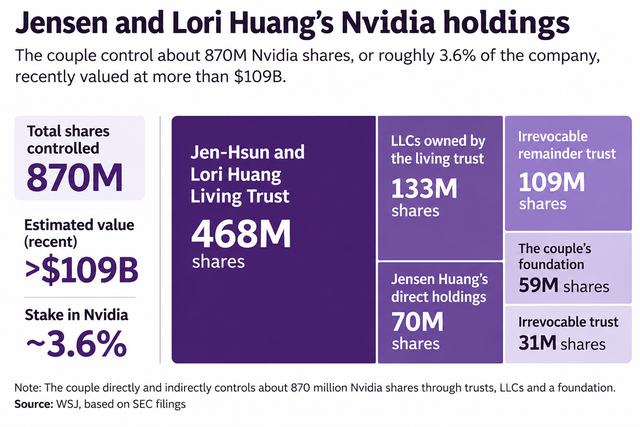
These holdings are spread across multiple trusts, limited liability companies, and a private foundation. The largest portion of these is nearly 468 million shares, held in the Jen-Hsun and Lori Huang Living Trust (Jen-Hsun and Lori Huang Living Trust) established in 1995. In addition, about 133 million shares are held by various limited liability companies under the trust. Huang Renxun himself directly holds about 70 million shares, and another irrevocable surplus trust holds about 109 million shares. Another independent irrevocable trust holds an additional approximately 31 million shares.
Judging from the legal structure, living trusts and irrevocable trusts have different wealth management and inheritance functions. A living trust is usually used to manage the client's assets during the lifetime, and can be adjusted if it complies with relevant laws; once established, an irrevocable trust cannot usually be unilaterally withdrawn or modified by the client at will. After the assets are transferred, their ownership and control arrangements are also bound by the terms of the trust. By placing shares in different trusts and their limited liability companies, Huang Renxun and his wife can make more detailed plans on asset management, voting rights, and future beneficiaries' arrangements.
Among them, the Grantor Retained Annuity Trust (GRAT) is a notable part of this structure. This type of trust usually allows the client to receive an annuity in accordance with the agreement within a certain period of time. After the period ends, the portion of the trust assets exceeding the relevant retained rights can be transferred to the designated beneficiaries. Since future asset appreciation may be transferred to the beneficiaries, GRAT has become a common tool for wealthy American families to carry out estate planning and reduce potential gift tax and inheritance tax burdens.
In March of this year, the two ten-year GRATs established in 2016 by Hwang In-hoon and his wife expired, and then transferred a total of about 58.96 million Nvidia shares to Hwang In-hoon's irrevocable surplus trust. According to relevant regulatory documents, the transfer was a free gift rather than a sale of shares on the open market. Based on the price of $181.93 per share at the time, this batch of shares was worth about $10.7 billion.
Notably, when these two trusts were established in 2016, the initial investment in Nvidia shares was around US$51 million. After ten years, as Nvidia's stock price rose sharply during the rapid development of the artificial intelligence industry, the value of this asset grew to more than 10 billion US dollars, fully demonstrating the wealth accumulation effect brought about by long-term holding shares of high-growth technology companies. This transfer also shows that the trust arrangement between Hwang In-hoon and his wife did not appear recently, but rather that the layout began long before Nvidia's AI business exploded.
Meanwhile, the foundation owned by Hwang In-hoon and his wife Lori holds nearly 59 million Nvidia shares. Lori Wong is the foundation's chairman, and Wong In-hoon is listed as Secretary General and Chief Financial Officer. According to the foundation's latest available tax filing documents quoted by the media, by the end of 2024, Jen-Hsun & Lori Huang Foundation (Jen-Hsun & Lori Foundation) had total assets of about US$9.2 billion and net assets of about US$9.1 billion, while in 2007 its assets were only US$12.6 million. The Foundation's rapid expansion is closely linked to the sharp rise in the value of Nvidia's shares.
However, the shares held by the Foundation are not exactly the same as those held by Hwang In-hoon and his wife. According to Nvidia's regulatory documents, since they are members of the foundation's board of directors, Hwang In-hoon and his wife may be regarded as having joint beneficial ownership and voting rights in the relevant shares in the shareholding disclosure, but the two do not enjoy personal financial rights in the shares held by the foundation. In other words, this part of the asset is legally a foundation and cannot simply be equated with the personal wealth of two people.
The Foundation's funds are mainly used for charitable donations and charitable projects. According to its fiscal year 2024 tax filing, the Foundation reported total revenue of about US$5.9 billion and total assets of about US$9.2 billion at the end of the year; expenditure for charitable purposes during the year was approximately US$126 million, including grants provided to external agencies. Beneficiaries include higher education, mental health, food aid, and other public welfare fields. For example, the Foundation provided several large sums of money to Oregon State University and over $9 million in grants to the mental health support agency Crisis Text Line.
Notably, the foundation's donations also include funding to the Donor-Advising Fund (DAF). Such funds usually allow donors to first transfer assets to a charitable account and then recommend recipients to specific charities. Since funds do not necessarily need to be distributed in full to the ultimate beneficiary immediately after being transferred to DAF, such arrangements sometimes trigger discussions about the speed and transparency of the actual disbursement of charitable funds.
The couple's wealth also supports large-scale philanthropic causes, including pledging donations to the San Francisco Opera and providing $75 million in grants to Vanderbilt University through their foundation. As the size of the Foundation's assets continues to expand, its influence in higher education, arts and culture, and social welfare is also growing.
Overall, the wealth management model of Hwang In-hoon and his wife embodies the common multi-level asset planning ideas for ultra-high net worth households in the US: individual shareholding, family wealth inheritance, and philanthropy are incorporated into different legal structures through different entities such as lifetime trusts, irrevocable trusts, limited liability companies, and private foundations. For Hwang In-hoon and his wife, Nvidia shares are not only the main source of their wealth, but also the core of this long-term asset planning system.