
Q3 earnings roundup: The Pennant Group and the rest of the senior health, home health & hospice segment

Looking back on senior health, home health & hospice stocks’ Q3 earnings, we examine this quarter’s best and worst performers, including The Pennant Group NASDAQ:PNTG and its peers.
The senior health, home care, and hospice care industries provide essential services to aging populations and patients with chronic or terminal conditions. These companies benefit from stable, recurring revenue driven by relationships with patients and families that can extend many months or even years. However, the labor-intensive nature of the business makes it vulnerable to rising labor costs and staffing shortages, while profitability is constrained by reimbursement rates from Medicare, Medicaid, and private insurers. Looking ahead, the industry is positioned for tailwinds from an aging population, increasing chronic disease prevalence, and a growing preference for personalized in-home care. Advancements in remote monitoring and telehealth are expected to enhance efficiency and care delivery. However, headwinds such as labor shortages, wage inflation, and regulatory uncertainty around reimbursement could pose challenges. Investments in digitization and technology-driven care will be critical for long-term success.
The 7 senior health, home health & hospice stocks we track reported a satisfactory Q3. As a group, revenues beat analysts’ consensus estimates by 1.9%.
While some senior health, home health & hospice stocks have fared somewhat better than others, they have collectively declined. On average, share prices are down 1.1% since the latest earnings results.
The Pennant Group NASDAQ:PNTG
Spun off from The Ensign Group in 2019 to focus on non-skilled nursing healthcare services, Pennant Group (NASDAQ:PNTG) operates home health, hospice, and senior living facilities across 13 western and midwestern states, serving patients of all ages including seniors.
The Pennant Group reported revenues of $300.4 million, up 32.1% year on year. This print was in line with analysts’ expectations, but overall, it was a mixed quarter for the company.
“Pennant delivered a solid quarter and strong year-over-year improvement across the organization,” said Brent Guerisoli, the Company’s Chief Executive Officer. “Our third quarter results are consistent with our full-year guidance and put us on track for a successful conclusion to the year. We continue to drive forward on our five key initiatives: leadership development, clinical excellence, margin, growth and employee experience. Our multi-year emphasis on developing great leaders has positioned us well to unlock significant upside across our portfolio.”
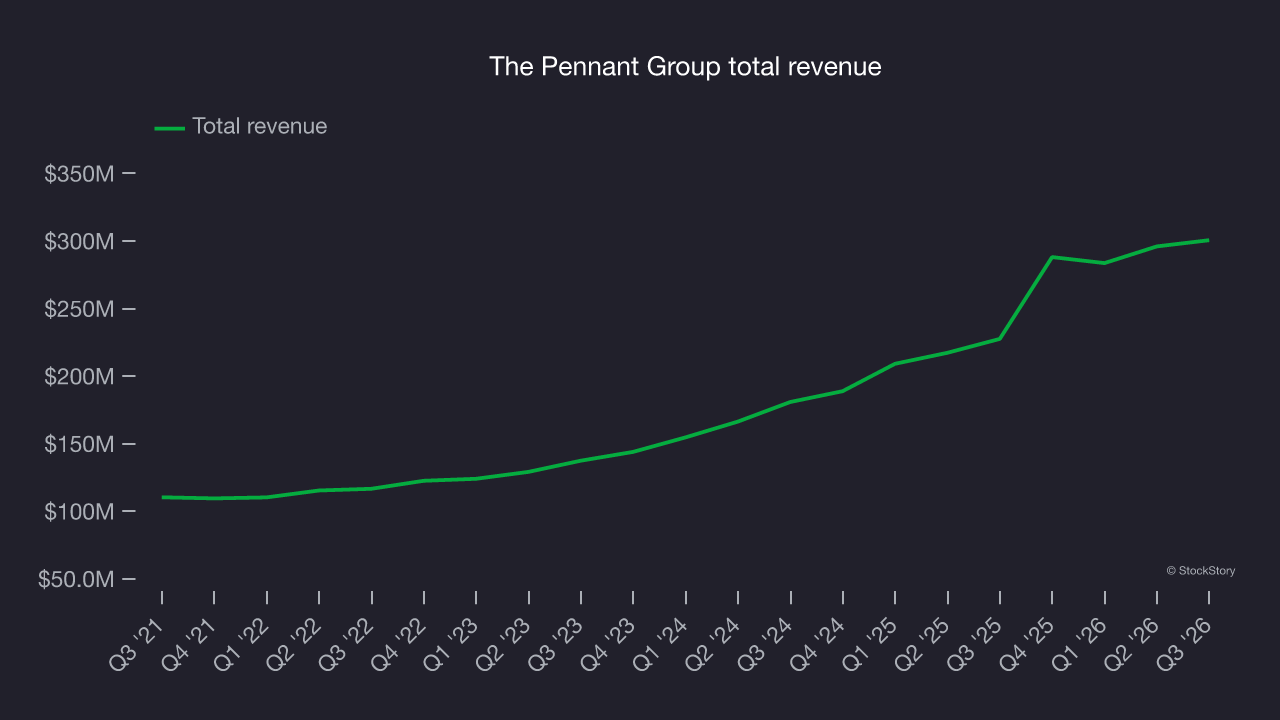
The Pennant Group pulled off the fastest revenue growth of the whole group. Still, the market seems discontent with the results. The stock is down 21.4% since reporting and currently trades at $34.62.
Read our full report on The Pennant Group here, it’s free.
Best Q3: BrightSpring Health Services (NASDAQ:BTSG)
Founded in 1974, BrightSpring Health Services (NASDAQ:BTSG) offers home health care, hospice, neuro-rehabilitation, and pharmacy services.
BrightSpring Health Services reported revenues of $4.21 billion, up 26.4% year on year, outperforming analysts’ expectations by 8.9%. The business had a very strong quarter with full-year revenue guidance exceeding analysts’ expectations and a beat of analysts’ EPS estimates.
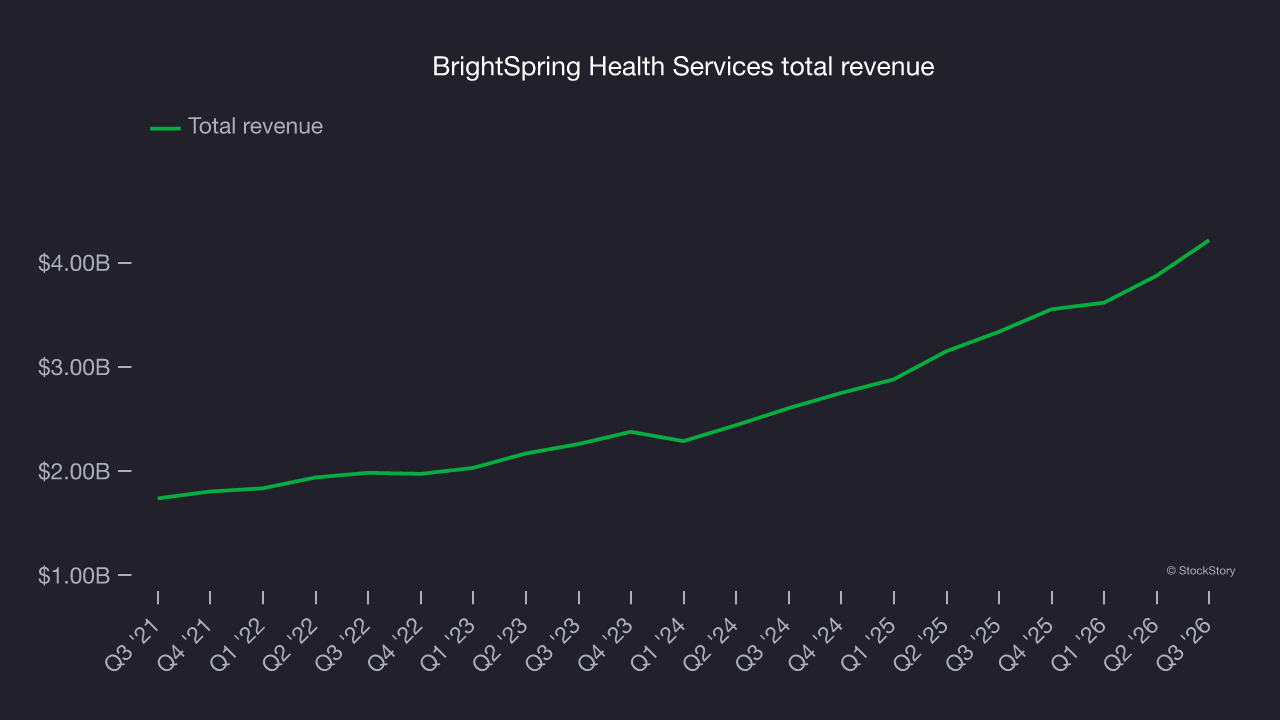
BrightSpring Health Services achieved the biggest analyst estimate beat and highest full-year guidance raise among its peers. The market seems happy with the results as the stock is up 5% since reporting. It currently trades at $63.26.
Is now the time to buy BrightSpring Health Services? Access our full analysis of the earnings results here, it’s free.
Weakest Q3: Brookdale (NYSE:BKD)
With a network of over 650 communities serving approximately 59,000 residents across 41 states, Brookdale Senior Living (NYSE:BKD) operates senior living communities across the United States, offering independent living, assisted living, memory care, and continuing care retirement communities.
Brookdale reported revenues of $712.1 million, down 12.4% year on year, falling short of analysts’ expectations by 0.5%. It was a sluggish quarter as it posted EPS in line with analysts’ estimates and full-year EBITDA guidance slightly missing analysts’ expectations.
Brookdale delivered the weakest performance against analyst estimates and slowest revenue growth in the group. As expected, the stock is down 17% since the results and currently trades at $8.98.
Read our full analysis of Brookdale’s results here.
Addus HomeCare (NASDAQ:ADUS)
Serving approximately 66,000 clients across 22 states with a focus on "dual eligible" Medicare and Medicaid beneficiaries, Addus HomeCare (NASDAQ:ADUS) provides in-home personal care, hospice, and home health services to elderly, chronically ill, and disabled individuals.
Addus HomeCare reported revenues of $387.7 million, up 7% year on year. This result was in line with analysts’ expectations. Aside from that, it was a mixed quarter as it failed to impress in some other areas of the business.
The stock is down 3.2% since reporting and currently trades at $122.54.
Read our full, actionable report on Addus HomeCare here, it’s free.
Option Care Health (NASDAQ:OPCH)
With a nationwide network of 177 locations serving 43 states and a team of over 4,500 clinicians, Option Care Health (NASDAQ:OPCH) is the largest independent provider of home and alternate site infusion services, delivering medications and clinical support to patients across the United States.
Option Care Health reported revenues of $1.49 billion, up 4.1% year on year. This number beat analysts’ expectations by 1.2%. Overall, it was a satisfactory quarter as it also logged EPS in line with analysts’ estimates.
The stock is flat since reporting and currently trades at $31.58.
Read our full, actionable report on Option Care Health here, it’s free.
Market update
Over the past year, investors have been forced to repeatedly answer the same question: What is the market’s biggest risk? The answer has changed several times, and each shift has reshaped market leadership.
Late in 2025 and early 2026, artificial intelligence became the market’s primary uncertainty. Investors questioned whether AI would erode software pricing power and weaken competitive moats as AI made it easier to replicate once-differentiated products.
By the spring, technology took a back seat to geopolitics. The U.S. conflict with Iran briefly became the market’s dominant narrative, raising concerns about oil prices, inflation, and global growth. But as energy markets remained orderly and fears of a prolonged supply disruption faded, investors quickly turned their focus back to fundamentals.
Want to invest in winners with rock-solid fundamentals? Check out our Strong Momentum Stocks and add them to your watchlist. These companies are poised for growth regardless of the political or macroeconomic climate.