
Jensen Huang Returns. What Comes Next For Nvidia?
Nvidia (NASDAQ:NVDA) shareholders have been through quite a lot over the past couple of weeks, and Monday morning brought a development few people would have predicted just days ago.
Jensen Huang is back. Call it an early Thanksgiving gift.
Missed AI’s "Act 1"? Act 2 Could Be 15x Bigger. Most investors think they missed the AI boat because they didn't buy Nvidia in 2005. But according to our analysts, we’re only at the end of "Act 1"—the R&D phase. "Act 2" is the global rollout. Continue »
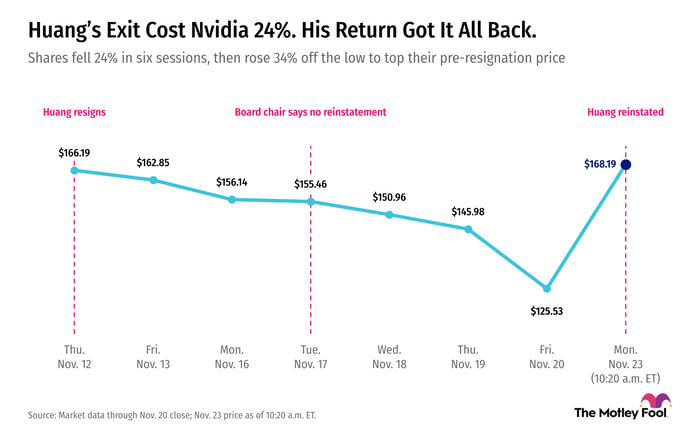
On Nov. 23, Nvidia announced that its board had voted unanimously to reinstate Huang as CEO, reversing a decision that had sent shock waves through the company and the broader market. The market responded enthusiastically, sending Nvidia shares up more than 30% and helping fuel a remarkable rebound across AI-related stocks.
For shareholders who watched Nvidia's stock tumble amid the uncertainty surrounding Huang's departure, today's news probably comes as an enormous relief. It's easy to understand why. Investors have spent the past couple of weeks contemplating what Nvidia might look like without him. Now, at least for the moment, they don't have to.
Why is the market so thrilled?
Remember that the stock market is constantly adjusting its expectations about what might happen next.
When Huang resigned on Nov. 12 amid revelations about his personal conduct and concerns involving a possible foreign intelligence effort, shareholders suddenly had to account for risks they hadn't anticipated. Nvidia faced an unexpected leadership transition at a particularly consequential moment in its history, along with regulatory uncertainty and questions about whether the controversy might damage the company's long-term competitive position.
Some of those concerns became less pressing this morning.
With Huang returning, the market can reasonably feel more confident that Nvidia will keep executing the strategy he's known for, one that has proved effective in the market's eyes.
That alone helps explain why so many people were eager to buy the stock. There may be some additional forces at work, too. Traders who had bet against Nvidia could be rushing to cover their positions, while momentum traders may be adding to the buying. Still, the enthusiasm surrounding his return speaks volumes about the value placed on his leadership.
That brings us to what may be the most interesting part of today's announcement.
What changed the board's mind?
As recently as Nov. 17, Nvidia's board chair, Harvey Jones, said publicly that the board did not intend to reinstate Huang. Less than a week later, the directors unanimously voted to bring him back. That's an extraordinary change of direction, particularly given the circumstances surrounding his departure. We don't know everything that happened behind the scenes, but several developments may have influenced the board.
For one, the pressure to reinstate Huang was substantial. More than 180,000 people signed a petition supporting his return, including Elon Musk. President Donald Trump also publicly advocated for reinstatement, arguing that Huang's leadership was important to both Nvidia and the United States.
Nvidia's announcement confirms that its board received input from senior levels of the U.S. government. Based on that input, the directors said they were confident that reinstating Huang posed no national security risk.
But perhaps the most consequential consideration was the potential cost of losing Huang himself.
For all the controversy surrounding his departure, Nvidia's directors may have concluded that the business risks of replacing their founder were simply too great. Finding someone who could take over Huang's responsibilities would be difficult enough. Finding someone who could replicate his particular combination of technological vision, industry relationships, and institutional knowledge might be considerably harder.
That's a reasonable shareholder-value argument. Nvidia has not publicly attributed its decision to any one of these factors. Even so, the reversal raises a question.
If Nvidia depends so heavily on Huang that losing him threatens an enormous amount of shareholder value, how much independence does its board really have when it comes to holding him accountable?
After all, the directors' responsibility is to oversee management on behalf of shareholders, and that responsibility doesn't disappear because the CEO happens to be exceptionally talented or influential.
It's entirely possible that Nvidia's board carefully weighed the available evidence and sincerely concluded that reinstatement was the best decision for the company. But given the speed of the reversal and the intense political and investor pressure surrounding it, it's fair to wonder whether the board can exercise sufficient independence from its founder.
Nvidia's announcement includes another important detail.
The independent investigation into the circumstances surrounding Huang's departure is continuing.
The board says it is satisfied with Huang's candor and ability to lead the company following a series of discussions with him. Nvidia also says it will continue cooperating with ongoing government investigations.
Meanwhile, the company is taking additional steps to strengthen oversight. It has established a board committee focused on national security and export controls and is searching for a new chief compliance officer.
These measures suggest the directors recognize that the company faces important responsibilities beyond deciding who occupies the CEO's office.
It's worth emphasizing that Huang has not been charged with a crime. The existence of an investigation should never be treated as proof of wrongdoing.
At the same time, investors should recognize that the board's endorsement today isn't a final legal exoneration. If the ongoing investigation produces evidence that changes the directors' understanding of what happened, they could find themselves confronting another difficult decision about Huang's future.
In certain enforcement cases, the SEC can also seek orders barring individuals from serving as officers or directors of public companies, although there's no reason to assume that such an outcome is likely here.
The broader point is that Nvidia has restored some stability to its leadership without resolving all the uncertainty surrounding the company. And depending on what the investigations ultimately uncover, some of those unresolved issues could become more consequential.
What should Nvidia shareholders do with today's news?
We can understand why the market is celebrating. Nvidia's leadership crisis introduced a tremendous amount of uncertainty into an already volatile market, and Huang's return addresses one of the most immediate concerns. But we would be reluctant to interpret the stock's rebound as evidence that everything is back to normal.
Today's buying tells us that the market feels considerably better about Nvidia's prospects with Huang back in charge. It doesn't tell us whether reinstating him was the right governance decision, whether the outstanding investigations will vindicate him, or whether the company has done enough to address the risks exposed by this episode.
For Foolish investors, it's also worth separating the excitement of the moment from the reasons they might have invested in Nvidia in the first place.
The company still needs to sustain its technological lead, capitalize on the enormous demand for AI computing, maintain its relationships with customers, and deliver the earnings growth necessary to justify its valuation. Huang's return may improve confidence in Nvidia's ability to do those things, but it doesn't guarantee their success.
There's also a lesson here about the risks of investing in a company whose identity and success are so closely associated with one person. Huang's leadership has undoubtedly been an extraordinary asset for Nvidia. The events of the past two weeks have also demonstrated how vulnerable the company may be to uncertainty surrounding him.
So while today's news offers plenty of reason to feel relieved, we wouldn't put the entire controversy behind us just yet.
Huang is back at the helm of Nvidia, and the market seems delighted to have him there. Whether the company emerges from this episode with stronger governance and a more resilient business remains to be seen.
That's something we'll be watching long after today's excitement fades.
The Motley Fool has positions in Nvidia. The Motley Fool has a disclosure policy.