
Shareholders Are Suining Alibaba Over Its Ties to Megaspeed. What That Means for BABA Stock.
Shareholders of Chinese e-commerce and increasingly AI giant Alibaba (BABA) have reportedly filed a class action lawsuit against the company in a Manhattan court over hiding its ties to Megaspeed. Megaspeed is the cloud and data center company that is at the center of the Nvidia-China espionage scandal that has rocked the AI industry and led to the brief resignation of Nvidia (NVDA) CEO Jensen Huang.
According to a report by Reuters, the shareholders allege that Alibaba knowingly failed to disclose the risks associated with U.S. export restrictions and had relations with Megaspeed, which has been accused of bypassing those restrictions, illegally gaining access to advanced Nvidia chips, and routing them to China.
About Alibaba
Founded in 1999 by the legendary Jack Ma as an e-commerce company, Alibaba has evolved into a conglomerate spanning e-commerce, cloud computing, artificial intelligence, logistics-related operations, digital services, and international commerce. Its strategic focus has increasingly shifted toward AI and cloud computing, while its commerce businesses remain the major source of its scale and cash-generating potential.
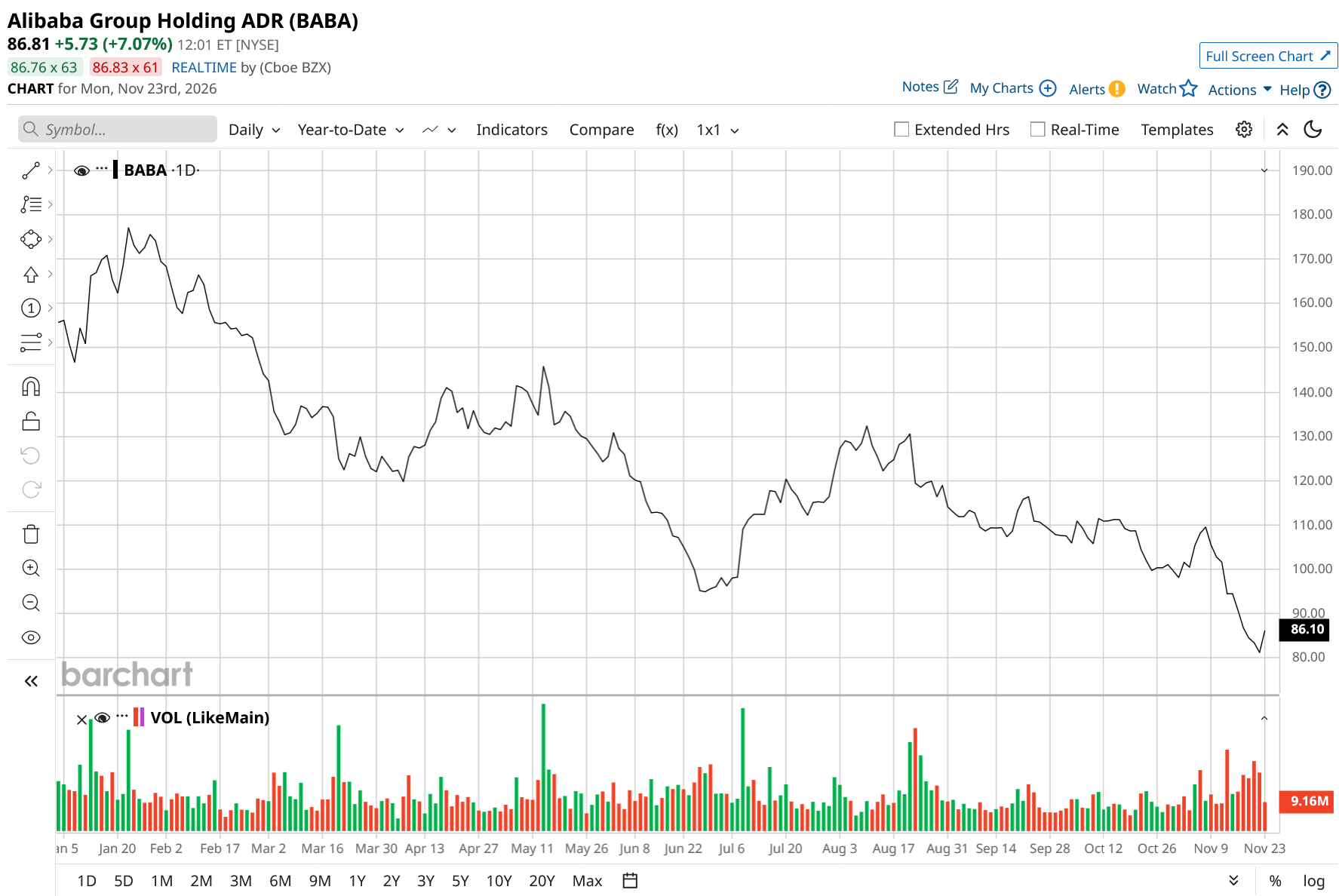
Its ADRs have a market cap of $201.7 billion, with a dividend yield of 1.24%. However, BABA stock is down 41% on a year-to-date (YTD) basis, primarily driven by geopolitical risks. Yet, where are the company's fundamentals placed amid all this? Let's find out.
Solid Q2 Results Driven By AI & Cloud, Yet Geopolitical Clouds Loom
As briefly touched upon earlier, Alibaba's AI and cloud business is gaining prominence rapidly and is its fastest-growing segment. While overall revenues grew by merely 10% from the previous year to RMB 271.5 billion, revenue for the AI Cloud and Compute Services segment jumped by 53% in the same period to RMB 61 billion. Moreover, while the company-wide adjusted EBITDA margin was 12%, the same for the AI business was 14.5%. Crucially, most of it was from external customers at RMB 47 billion, marking a year-over-year (YoY) growth rate of 64%.
The quarter also saw Alibaba moving ahead on its T-Head chip design cadence, as the company launched the Zhenwu M890 chip. The chip is the first in China capable of inference in models with more than two trillion parameters. Further, the company also gave a glimpse of its next-generation Zhenwu V900 chip and other AI equipment, set to launch in Q1 2027.
However, based on the specifications publicly disclosed so far, Alibaba has not demonstrated that the M890 or V900 matches Nvidia's Rubin or AMD's (AMD) MI455X in raw computing performance. While Rubin has 288 GB of HBM4, the Instinct MI455X accelerator deploys 432 GB of HBM4. The same specifications for the M890 and V900 are 144 GB HBM memory and 216 GB HBM, respectively. In terms of inter-chip bandwidth, too, Alibaba is far behind: Alibaba's chips run at 800 GB/s and 1,200 GB/s, compared to Rubin and MI455X's 3.6 TB/s. Thus, it is no wonder why the Chinese AI leaders like Alibaba are allegedly employing potentially underhanded measures to gain access to the most advanced American chips.
On the other hand, though, the company's AI labs, which include the Qwen app and Qwen models, saw revenues jump by 51% yearly to RMB 4.4 billion.
Having said that, powered by the AI business, the company's earnings witnessed a massive jump of 86% on a YoY basis to RMB 25.94 per share as net cash from operating activities rose to RMB 15.7 billion from RMB 10.1 billion in the year-ago period. Overall, the company closed the quarter with a substantial cash balance of RMB 487.9 billion and a net cash position of RMB 220.7 billion as the company reduced its debt by RMB 267.2 billion during the quarter while increasing its capex by 60.6% from the prior year to RMB 50.5 billion. However, this led to the company widening the negative nature of its free cash flow to RMB 34.5 billion from RMB 21.8 billion in the previous year.
Overall, in February 2025, Alibaba had committed to spend RMB 380 billion on AI investments, of which about 63.3% was already spent by the June 2026 quarter. Notably, the company expects to spend another RMB 118.2 billion in the first half of FY 2027. In the latest quarter, the company cited increasing pricing of components and the rapid scaling of its AI capabilities as the primary drivers of the capex. Moreover, the company expects to exceed the global data center capacity of 20 GW by 2032. Yet, restrictions on access to compute capacity and other policy-related headwinds have compelled the company to announce that it may have to rationalize its AI buildout.
E-Commerce Slowdown a Concern
This brings us to the proverbial cash cow of the company, which is, concerningly, going through a slowdown: e-commerce. During the September '26 quarter, the segment saw a YoY revenue growth of just 2% to RMB 197.2 billion. Within this, only the quick commerce part of the segment witnessed growth. At a growth rate of 22%, quick commerce sales came in at RMB 58.8 billion, whereas China e-commerce fell by 5% in the same period to RMB 98.5 billion. This was the third consecutive quarter of negative sales growth for the segment. However, its adjusted EBITDA margin of 19.7% was above the fast-growing AI segment's 14.5%.
This slowdown can be attributed to several factors, such as weakness in Chinese consumption trends, the property downturn, and intensifying competition. Thus, this is not all Alibaba's doing. For instance, total retail sales in October grew by just 0.4% when compared to October 2025, whereas online retail sales of goods for the first 10 months of the year rose by just 2.9%.
The latter figure is particularly relevant for Alibaba, as it primarily operates in an online goods marketplace. If the overall market it operates in is growing relatively slowly, it becomes much harder to generate strong organic growth without gaining market share or increasing monetization.
Analyst Opinion On BABA Stock
Alibaba's AI and cloud business, along with its massive cash reserves, certainly gives it a commanding position. However, the AI buildout it has envisaged requires heavy capex. Thus, Alibaba has to dip into its cash reserves, as the e-commerce segment, with its current pace of growth, will not be able to finance the buildout. Raising debt is also an option, as China's benchmark interest rates are near all-time lows.
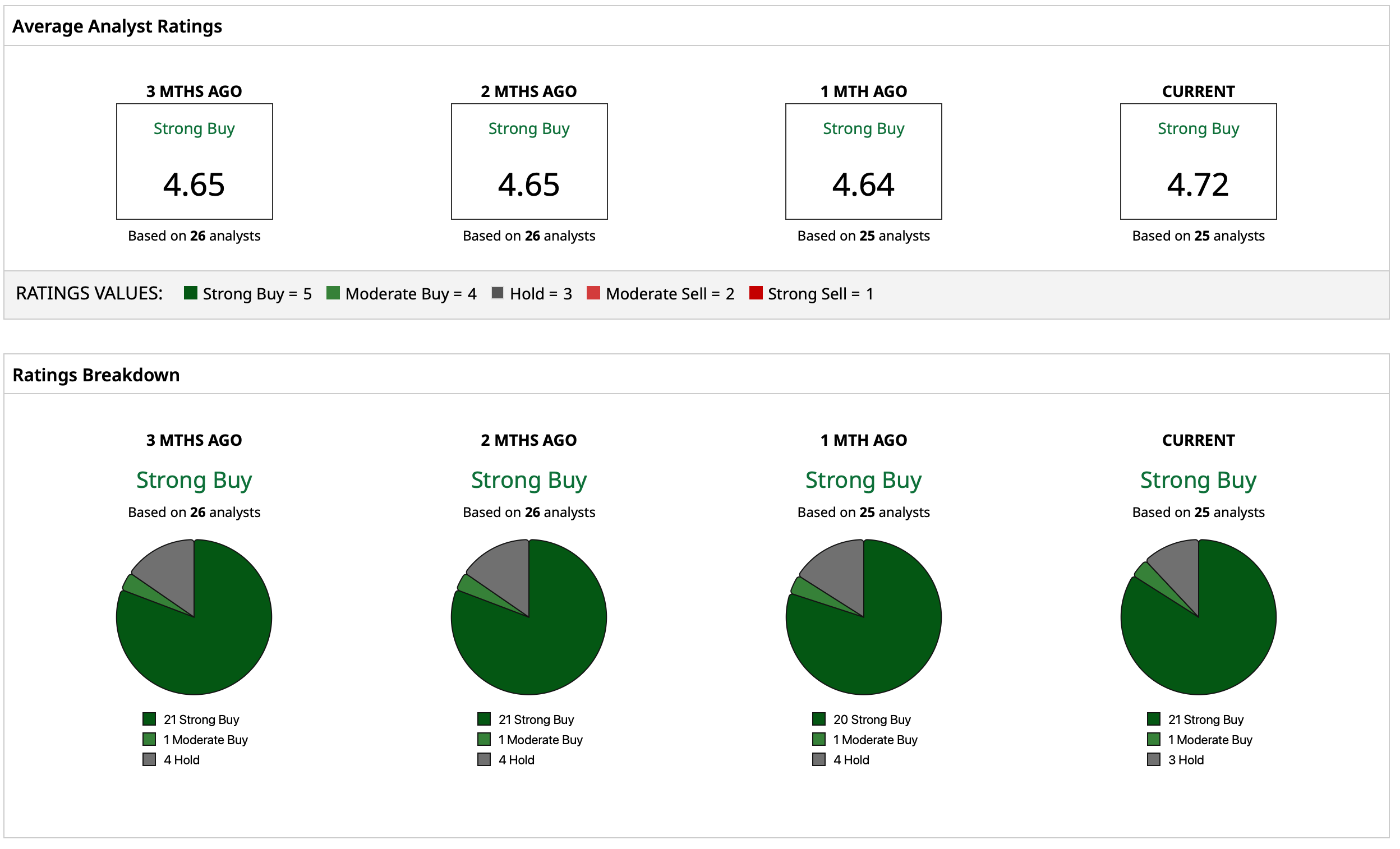
Wall Street analysts continue to remain bullish about BABA stock, assigning it an overall consensus rating of “Strong Buy.” The mean target price of $174.02 denotes a potential upside of 101% from current levels. Out of 25 analysts covering the stock, 21 have a “Strong Buy” rating, one has a “Moderate Buy” rating, and three have a “Hold” rating.
On the date of publication, Pathikrit Bose had a position in: NVDA . All information and data in this article is solely for informational purposes. For more information please view the Barchart Disclosure Policy here.