
Investors Might Be Underestimating Seagate's Long-Term AI Growth Opportunity
Seagate Technology (NASDAQ:STX) makes hard drives, but its chief executive measures the business with one metric. “Advancing areal density is our North Star,” Dave Mosley told analysts in October. That focus on packing more terabytes onto each platter has paid off for shareholders.
The stock is up 98.4% year-to-date, following a 225% gain in 2025. Shares have also dropped 17.59% over the past month to $544.55, well below their 52-week high of $1,143.27. Here’s what Seagate would need to do to reach $1,050 per share in 2027.
Wall Street Already Sees Seagate Nearly DoublingThe average analyst price target is $1,044.83. That implies about 92% upside. Analysts carry 4 Strong Buy and 18 Buy ratings, against 4 Holds and no Sells.
For the fiscal year ending June 2027, they expect revenue of $20.32 billion, up roughly 67% from fiscal 2026’s $12.195 billion. They also see EPS of $39.9789, a 157% increase over the $15.58 Seagate earned last year.
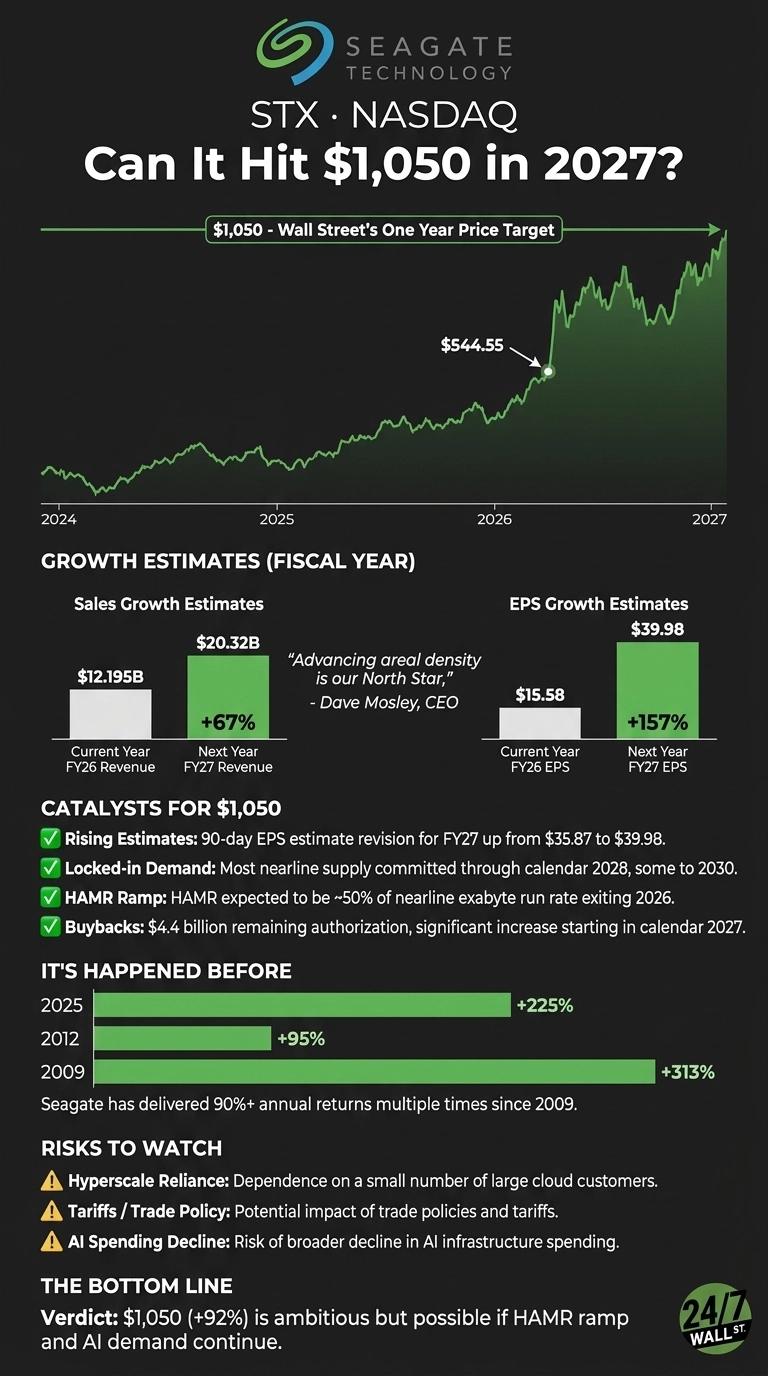 24/7 Wall St. Here’s What It Takes for Seagate to Reach $1,050
At today’s price, Seagate trades at about 14x fiscal 2027 estimates and 8x fiscal 2028 estimates of $65.3416. At $1,050, those multiples would rise to 26x and 16x.
The fiscal 2027 multiple would match today’s trailing P/E of 26x. For a company expected to grow EPS another 63% in fiscal 2028, that valuation looks reasonable.
What Could Push Seagate to $1,050?
- Rising estimates: 90 days ago, analysts expected fiscal 2027 EPS of $35.8745. Today that figure is $39.9789. Fiscal 2028 estimates rose from $55.3714 to $65.3416.
- Beat streak: Seagate has exceeded EPS estimates for five consecutive quarters. Its latest result was $7.68 against $7.40 expected, so actual results may keep running ahead of forecasts.
- Locked-in demand: Most nearline supply is committed under long-term agreements through calendar 2028, with some cloud deals extending through 2030. Management said “absolutely everything we can make above and beyond our plans is being spoken for.”
- HAMR ramp: HAMR should reach roughly 50% of the nearline exabyte run rate leaving 2026, and Microsoft (NASDAQ:MSFT) Azure has qualified Mozaic. Qualification shipments of Mozaic 5, at upwards of 50 terabytes, begin toward the end of calendar 2027.
- Buybacks: With $4.4 billion remaining under its authorization, Seagate plans to significantly increase share repurchases starting in calendar 2027.
- Near-term outlook: December-quarter guidance calls for EPS of $9.20 on $4.80 billion in revenue.
Reaching $1,050 would take a 92.8% gain. Seagate has done better than that in three full calendar years since 2004: 313% in 2009, 95% in 2012 and 225% in 2025.
It came close in 2013 (90%) and 2021 (88%), and it is ahead of that pace in 2026. With a beta of 2.201, the stock tends to move more than the market in both directions.
$1,050 Is a Stretch, but Here’s Why It’s PossibleHitting $1,050 would require Seagate to rise 92.8%. Even so, the consensus target already stands close to that level, estimates keep moving higher, and contracted demand reaches years into the future.
The main risks are Seagate’s reliance on a handful of hyperscale customers, tariffs and a wider decline in AI spending. If HAMR keeps scaling up and Seagate keeps beating estimates, the recent drop could set up a comeback. Gains this large are rare, and this is how Seagate could generate exceptional returns in 2027.