
This Healthcare Stock Just Raised Its Dividend by 3.5%
Most investors cheer a dividend raise. Merck's (MRK) shareholders got one the same week the company dropped a cancer drug program.
On Nov. 17, Merck announced a 3.5% increase to its quarterly dividend. That builds on 15 straight years of increases as of September 2026. The raise comes with a catch, though, since the forward payout ratio stood at 103.5%. That means expected dividends slightly topped expected earnings.
Not everything is going Merck's way, though. The company just ended its nemtabrutinib program, a blood cancer drug it had been testing. Meanwhile, MRK shares have slipped about 11% over the past three months.
So can Merck keep rewarding shareholders while it replaces Keytruda, its biggest earner, before the drug's patent expires in 2028? Let's dive in.
How Merck Is Actually Performing
Merck & Company, headquartered in Rahway, New Jersey, develops prescription medicines, vaccines, and animal health products for patients, physicians, and livestock producers worldwide. Its market capitalization stands near $329.65 billion, and the blockbuster cancer drug Keytruda anchors the lineup.
The company declared a 3.5% increase on Nov. 17, lifting the quarterly dividend to $0.88 per share from the $0.85 that went ex-dividend on Sept. 15. Over a full year, holders now collect $3.52 per share, up from $3.40, for a forward yield near 2.63%. Buyers must own the stock before the Dec. 15 ex-dividend date to receive the Jan. 8 payment.
Closing at $133.72 on Nov. 20, MRK stock sits 27% higher year-to-date (YTD) and 41% higher over the past 52 weeks.
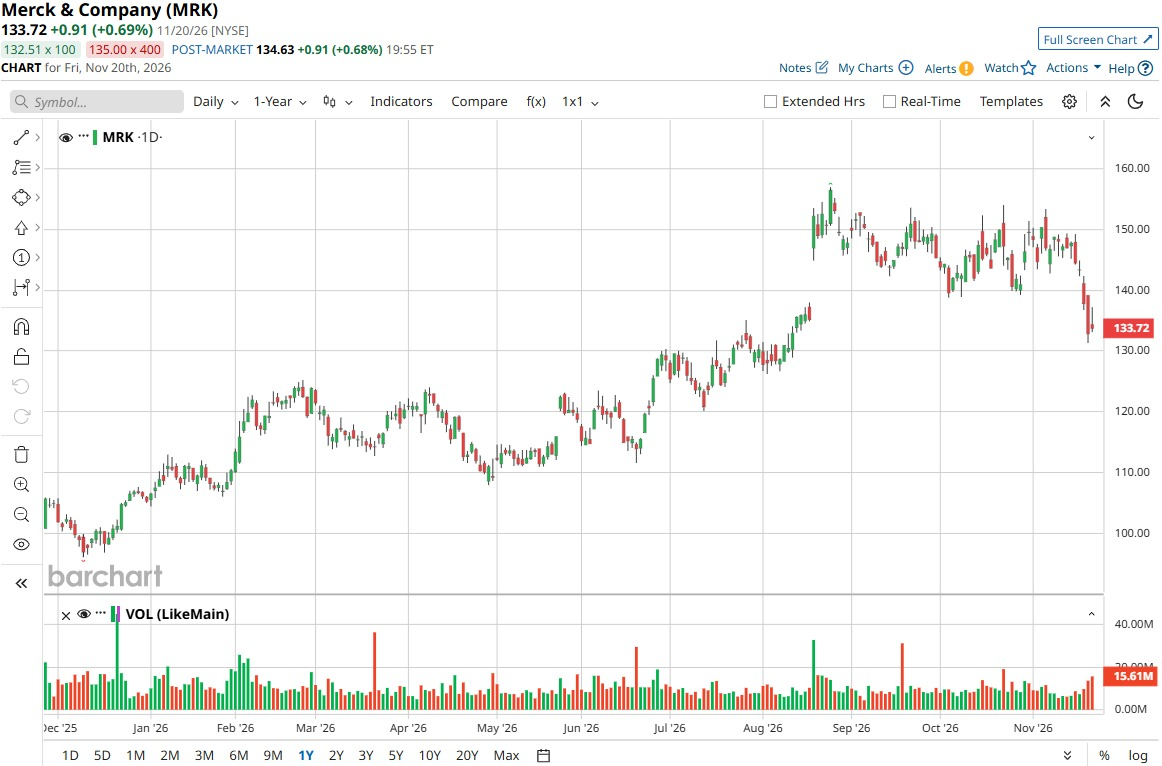
At 42.57 times trailing earnings, MRK trades significantly higher than the sector median of 19.03x, although its price-to-cash-flow multiple of 11.63x remains below the sector’s 15.64x median.
The company reported third-quarter results on Oct. 29, with revenue of $18.09 billion beating estimates of $17.31 billion. That marks 4.7% growth from a year ago, helped by Keytruda Qlex and Gardasil.
It posted adjusted earnings of $2.49 per share, 19.3% above the $2.09 estimate. This still trailed last year's $2.58 by 3.5%. Their operating margin fell to 30.9% from 37.7% last year. MRK lifted its full-year revenue outlook to a $67.05 billion midpoint from $66.8 billion, and adjusted EPS guidance rose 3.1% to $2.80 at the midpoint.
Building Its Post-Keytruda Pipeline
Merck is using the years before Keytruda's 2028 patent expiration to build its next act. The stakes are high, since Keytruda delivers about $8.4 billion per quarter.
Newer products are starting to help. Keytruda Qlex, a subcutaneous version of the drug, generated $463 million in the second quarter, and Winrevair brought in $588 million, up 75%. The personalized melanoma vaccine intismeran met its Phase 3 endpoints, though analysts said the data fell slightly short of the most bullish hopes.
On Nov. 20, Merck said Phase 3 TroFuse-015 met its primary endpoint of overall survival for sac-TMT, a TROP2-directed antibody-drug conjugate licensed from Kelun-Biotech. The trial enrolled 473 patients with gastroesophageal adenocarcinoma after two or more prior therapies. It is the first TROP2 ADC to improve survival against physician's choice treatment in a global Phase 3 study in these patients.
A day earlier, Merck partnered with AI-first Isomorphic Labs to find small-molecule candidates against an oncology target. Isomorphic gets an upfront payment, milestones, and tiered royalties, while Merck handles development, manufacturing, and commercialization.
Separately, director Thomas Glocer will retire in May 2027, and former Ecolab CEO Douglas Baker Jr. becomes independent lead director on January 1.
Taken together, these moves show Merck lining up trials, partnerships, and leadership for life after Keytruda.
What the Street Is Saying About MRK Stock
Merck's next earnings report is due Feb. 2, and analysts expect a softer quarter. For the period ending December 2026, the average estimate is $1.78 per share. That compares with $2.04 a year earlier, a 12.75% year-over-year (YoY) decline.
Even so, Wall Street has not backed away. Leerink Partners' Daina Graybosch stuck with her “Buy” view on Merck on Nov. 2. She also nudged her price target up $1 to $162, which implies about 21% upside.
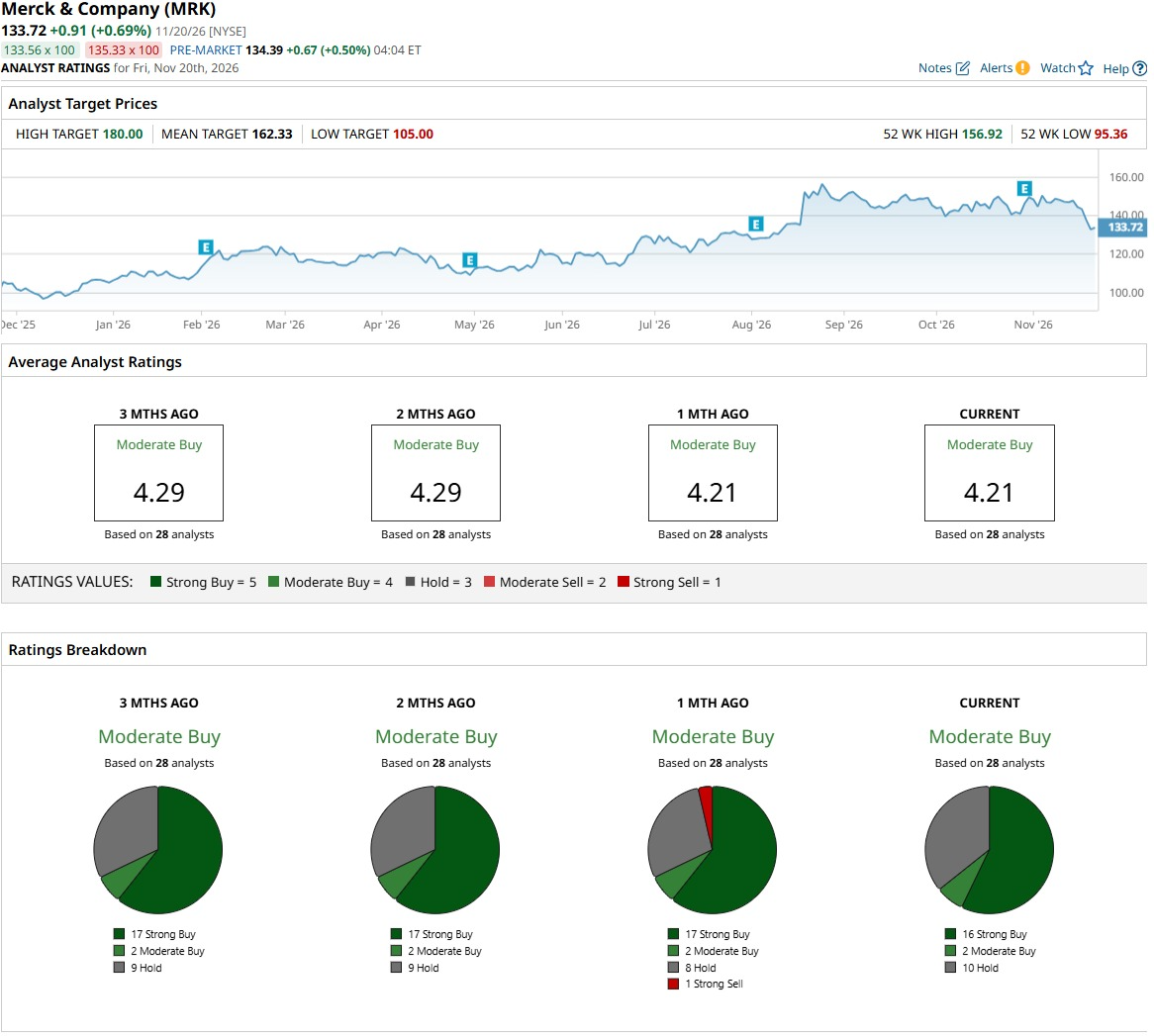
Graybosch is the most bullish voice here, but the wider group is not far behind. The consensus among 28 analysts surveyed is a “Moderate Buy” on MRK stock. Their average price target is $162.33, which sits about 21% above the Nov. 20 close of $133.72.
Conclusion
So, can Merck keep paying shareholders while it replaces Keytruda? Probably yes. The 3.5% raise to $0.88 per share is backed by growing sales, a deep pipeline, and fresh wins like TroFuse 015. That keeps the income story intact despite the heavy lifting ahead. Still, the 108.31% payout ratio and the 2028 patent expiration deserve attention. Most likely, MRK stock grinds higher toward analysts' $162.33 target as pipeline results arrive, with the Feb. 2 earnings report setting the tone.
On the date of publication, Ebube Jones did not directly have a position in any of the securities mentioned in this article. All information and data in this article is solely for informational purposes. For more information please view the Barchart Disclosure Policy here.