
Hwang In-hoon's return ignites Nvidia (NVDA.US)'s historic rebound! Wall Street is throwing cold water: don't be happy too soon
The Zhitong Finance App learned that the reinstatement of Nvidia (NVDA.US) CEO Huang Renxun pushed the stock to record the largest single-day market capitalization increase in US stock history on Monday, and investors regained their optimism. However, several Wall Street investment banks and analysts warned in the latest report that Hwang In-hoon's return has not dispelled all the uncertainty surrounding Nvidia — investigations surrounding his personal behavior are still ongoing, and questions about the sustainability of corporate governance, China's business prospects, and AI capital expenditure sustainability continue to hamper the chip giant's valuation.
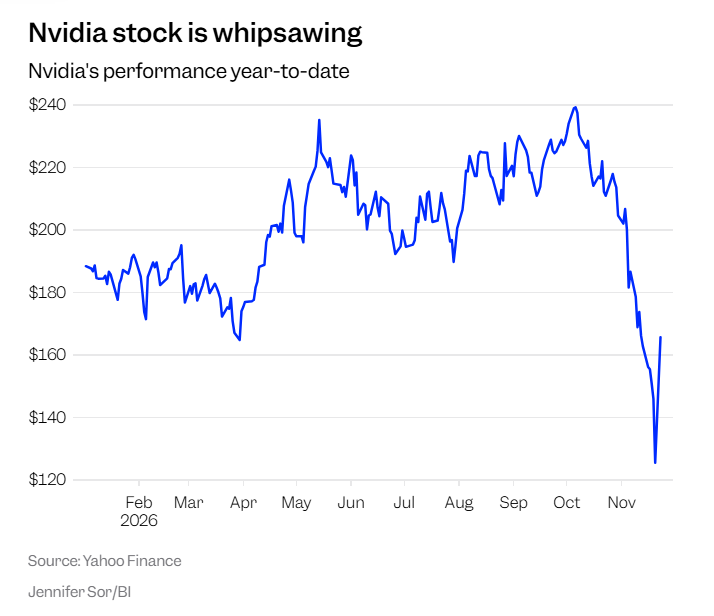
On Monday, Nvidia's stock price rose by more than 31%, and its market capitalization surged by more than US$952 billion, setting the record for the biggest increase in market capitalization of a single stock in history. But even after experiencing this sharp rise, the stock is still down more than 30% from its high in early October. This contrast has become the core context of reviews from many Wall Street agencies: there is no agreement on whether an “upward shock” can actually reverse market sentiment.
Bernstein: Upgraded but bluntly criticized governance and judgment
Bernstein analyst Stacy A. Rasgon and others confirmed in the report that Nvidia's board of directors immediately reinstated Huang Renxun as president, CEO and director after a unanimous vote, and that Harvey Jones will continue as chairman; investigations into Wong In-hoon's recent actions are still ongoing within the board of directors, but the board believes that his reinstatement “is in the best interests of shareholders, employees, partners, and customers.”
However, Rasgon's criticism of Nvidia's corporate governance was sharp. The bank said bluntly that despite Hwang In-hoon's return, the company still has “some suppressing factors” that may limit the room for stock prices to rise — given his personal turmoil, the CEO's credibility is still questionable, and the weaknesses of Nvidia's board of directors and corporate governance have also been “clearly revealed.”
“There are still doubts about Hwang In-hoon's judgment. We don't really care about what he does in private, but he apparently makes problematic peers from time to time, and his willingness to lie to the board and other key stakeholders unsettles us,” the bank wrote, adding that the relevant investigations are still ongoing.
Rasgon further criticized the board's repetition: “Although we are happy to see Wong In-hoon return, the board's attitude was erratic, and frankly a 'farce' — just last week they categorically called it out — which made people reasonably question their judgment and decision-making process, as well as how their other important decisions were made.” The bank also pointed out that investors are still concerned about the “attainability” of AI spending.
Bernstein raised Nvidia's rating from “on par with the market” to “outperforming the market,” but the target price remained the same at $200 — the price target was cut from $400 last week due to rumors of Wong In-hoon's second affair.
Dan Ives: Price target reduced from $300 to $225
Well-known tech giant Dan Ives has reservations about Nvidia even after Hwang In-hoon's return. In the client report, the senior managing director of Yorkville Ives reiterated Nvidia's target price of $225, a reduction from the previous price of $300, and the rating remained “outperforming the market.”
“We are maintaining our 'outperforming the market' rating and target price of $225 without directly increasing to the 'Hwang In-hoon successfully remaining in office' situation. The reason is that there are still several matters that need to be settled: the investigation by the Independent Commission is still ongoing, government inquiries that the company says it is cooperating with are still ongoing, and export control issues have not yet been resolved,” Ives wrote, referring to Nvidia's business in China.
He further explained, “Our analytical framework has not changed. The gap between $225 and $300 is the value corresponding to 'Hwang In-hoon after the governance issues have been clarified, 'not the value of Hwang In-hoon himself.”
Luke Lango: Nothing but an “emotional rebound”
Independent tech analyst Luke Lango is more cautious. He described the sharp rise in stock prices after Hwang In-hoon's return as “just an emotional rebound, nothing more,” and believes that the CEO's reinstatement will not ease the market's concerns about the slowdown in AI capital spending.
“Looking back on the logic — that is, the 'Nvidia Central Bank' reopens and AI construction progresses according to plan — is flawed,” he wrote, and believes that Hwang In-hoon is more likely to shrink his trading activities after his return. “Having just emerged from a highly public scandal, he is unlikely to restart that machine.”
In contrast, RBC analysts are more optimistic. The bank believes that Hwang In-hoon's reinstatement has strengthened Nvidia's multi-faceted logic because it has allayed market concerns that his departure may trigger a brain drain. “Nvidia's business fundamentals remain strong,” the bank said, but analysts also expect investigations into export control “and other issues” to continue.
Goldman Sachs: Maintain the purchase, target price of $220
Goldman Sachs, on the other hand, maintained a “buy” rating after the reinstatement news. The target price for 12 months was set at $220, corresponding to a 22 times price-earnings ratio multiplied by its normalized earnings per share forecast of $10.00.
Goldman Sachs believes that Hwang In-hoon's vision, influence, and ability to integrate external resources have always been critical to Nvidia and the entire AI industry chain. His return will generally strengthen the company's existing culture, and the company is expected to continue to advance according to the established product roadmap.
However, at the regulatory level, Goldman Sachs indicated that the US Department of Justice is investigating whether some Nvidia customers have violated export controls after shipping to regions including Singapore, and the SEC's investigation into the company's past disclosures is also reportedly ongoing; until these matters are concluded or the company discloses more information, related investigations may continue to suppress stock prices.
Goldman Sachs anticipates a revaluation of the valuation multiples, but the impact will continue while the investigation is pending.
Nomura: Quantifying buying detonates “too big to fail” transactions
Nomura Securities, on the other hand, analyzed the incident from a broader perspective. The bank's strategist Charlie McEligott pointed out in a client report that US President Trump's intervention in Nvidia's reinstatement decision essentially established the “too big to fail” attributes of AI and US stocks to the market, triggering a rare round of increases driven by programmatic trading.
McEligott described the unexpected extent of “Hwang In-hoon's reinstatement” as a “shock,” and the VIX Volatility Index collapsed in recent months, triggering what he called “massive programmatic buying.” The sharp drop in volatility caused deep false put options to quickly lose value. Short futures positions held by market makers to maintain hedging were forced to make up due to delta decay to protect exposure, short sellers were stopped, the S&P index was strongly boosted, and upward space continued to be chased. He also summed up this process with “hedging failure, bears being stopped, S&P futures being boosted, and capital surging upward.”
According to McEligott, the scale of programmatic buying at the second level is more impressive. After the S&P 500 index rebounded above 7043 points, Nomura's 12-month CTA trend signal went from empty to large, triggering about $161 billion in S&P futures “repurchase” capital flows and about $2.4 billion in Nasdaq futures buying. Although the volatility control model generated a sell-off of $11 billion to $16 billion due to excessive single-day increases, this scale was “dwarfed” by leveraged ETF rebalancing at the end of the session — the latter tracked more than $41 billion in purchases, making it the second-largest single-day “buy rebalance” in Nomura Data history, second only to the $46.5 billion record set in April of this year.
McEligott further analyzed that the stock market has become the primary mechanism for the transmission of financial conditions in the US economy. When the wealth efficiency crisis turns negative, regulators will “be forced to make asymmetrical 'dovish' responses.” The White House's intervention in Nvidia's reinstatement decision is a reflection of this consideration — after weeks of high worst-case scenario premiums, this move significantly lowered the market's left-tail risk pricing.
However, he also cautioned that it is “too naive” to think that a single day “upward shock” can completely resolve the market's fundamental concerns; structural headwinds such as tight financial conditions, higher real interest rates, and widening credit spreads have not been eliminated.