
How Contract Wins At Boeing (BA) Have Changed Its Investment Story
- Boeing recently secured fresh commercial and defense work, including a 15 jet Dreamliner order from Philippine Airlines and new missile and next generation fighter contracts that reinforce its role across civil and military aviation.
- The company is now a key player in the expanding airborne electronic warfare market, where rising global defense spending supports demand for AI enabled systems and longer term support contracts.
- We will now look at how Boeing's expanding electronic warfare footprint might reshape the existing investment narrative for the business.
Scan how Boeing's defense and AI themes play out across a curated group of peers by running through 45 profitable AI stocks that aren't just burning cash before you move deeper into this story.
Boeing Investment Narrative Recap
Owning Boeing today means believing the operating recovery that rcb9, an investor in the Simply Wall St Community, describes is durable. The Q2 numbers showed core operations generating US$156 million of operating profit while the net loss came from US$600 million of interest. The big near term catalyst remains free cash flow snapping back toward the US$1b to US$3b full year guide, helped by a US$715b backlog and ongoing debt reduction.
Execution still looks fragile. Commercial Airplanes is producing more jets but remains loss making, and any fresh charge above US$1b or a weak second half cash performance would directly challenge rcb9's thesis. Recent wins in electronic warfare and missile work help diversify away from civil aircraft cycles, although they do not change the fact that debt coverage by operating cash flow remains a headline risk.
The clearest tie in to today is Boeing's role in the expanding airborne electronic warfare market, which recent research highlights as moving toward US$19.07b by 2030. That segment leans into AI enabled systems and long term support contracts. It fits rcb9's view that the operating story is improving while the balance sheet slowly heals through debt paydown and lower interest expense.
Growth in airborne electronic warfare does not erase execution risk. Program charges, defense contract complexity and the need to deliver on next generation fighter and missile projects keep the possibility of cost surprises alive. For catalysts, you are essentially watching whether these AI heavy defense platforms and service agreements can provide steadier, less cyclical earnings that support debt reduction and make Boeing's recovery less dependent on flawless execution in commercial jets.
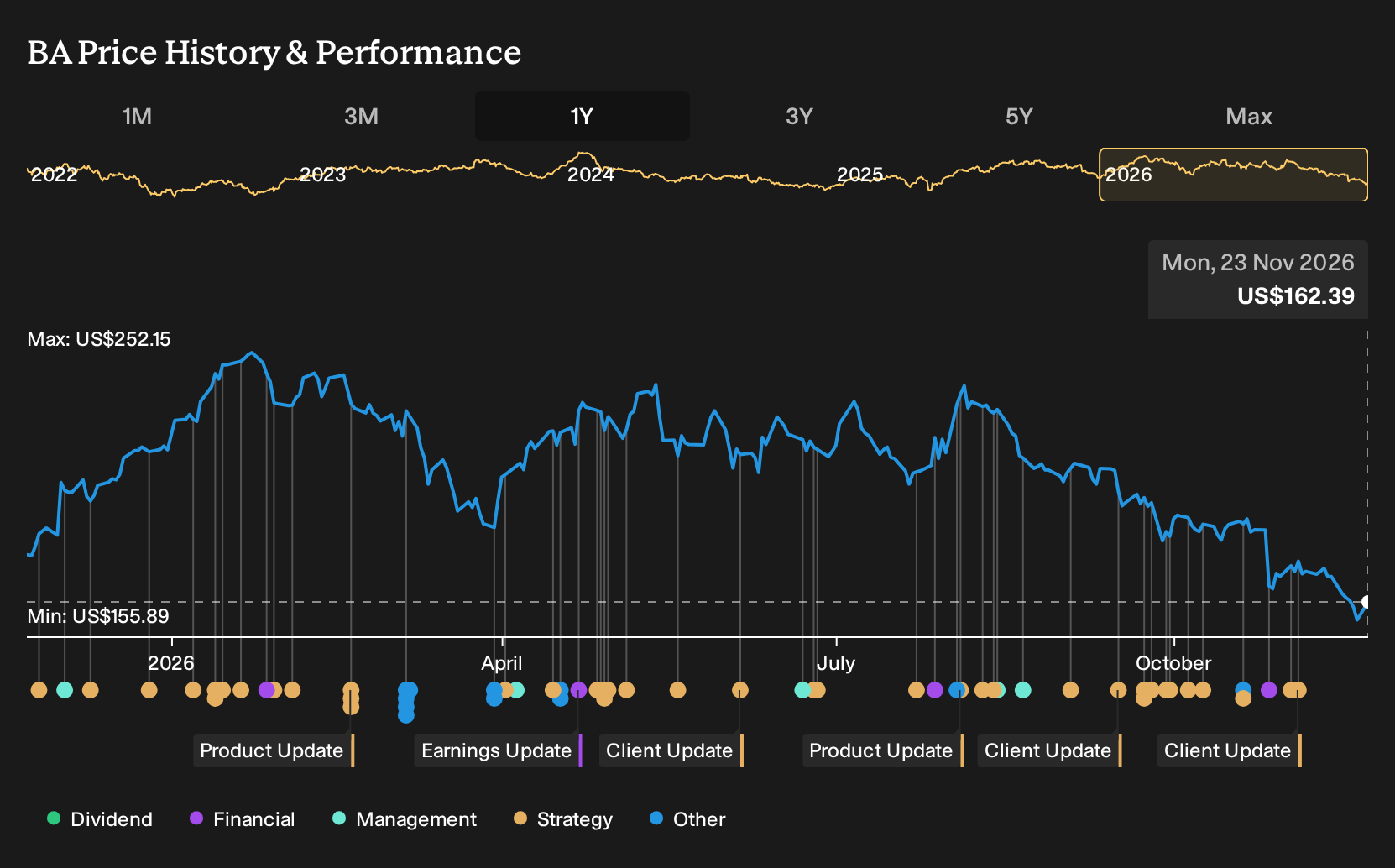
On rcb9's numbers, Boeing reaches a fair value of US$160.01, based on revenue expanding 8.0% a year to roughly US$131b by 2031 and net earnings settling at an 8.0% margin. Together, these factors support that equity value after accounting for dilution and the ongoing drag from interest expense.
Uncover why Boeing's fair value indicates a value roughly in line with its current price.
Exploring Other Perspectives
Some analysts see the real swing factor as Boeing’s commercial rebound rather than defense wins. Before this news, the most optimistic forecasts were banking on revenue reaching about US$142.2b and earnings of US$10.4b by 2029, supported by a 14.4% annual revenue clip. That is a far more upbeat script than the baseline, so treat it as one of several viewpoints to test rather than a default conclusion.
Explore 6 other Boeing fair value estimates, including one that suggests as much as 122% potential upside from the current price.
Decide For Yourself
Disagree with existing narratives? Extraordinary investment outcomes rarely come from following the herd, so consider trusting your own process.
- A helpful starting point for your Boeing research is our analysis highlighting 5 key rewards and 2 important warning signs that could influence your investment decision.
- See our latest analysis for Boeing. The report includes a comprehensive fundamental analysis summarized in a single visual, the Snowflake, making it easier to review Boeing's overall financial profile at a glance.
Looking For More Ideas Beyond Boeing?
If Boeing sits at the center of your watchlist right now, it can still help to compare the story against a wider field of opportunities using the Simply Wall St Screener.
- For investors who care most about getting value for every dollar, scan a curated pool of 37 high quality undervalued stocks that combine quality fundamentals with modest expectations baked into their prices.
- If capital preservation is a priority, focus on resilience first and growth second by filtering for 31 resilient stocks with low risk scores that score well on financial strength and volatility.
- When you want to move beyond well covered giants, broaden your hunting ground with a carefully filtered set of 19 high quality undiscovered gems that pair solid metrics with lower profile coverage.
Have feedback on this article? Concerned about the content? Get in touch with us directly. Alternatively, email editorial-team@simplywallst.com