
Xiaomo tests the waters of “digital gold” trading with HSBC and StoneX! The London gold market may face the biggest transformation in decades
The Zhitong Finance App learned that J.P. Morgan Chase (JPM.US) and other major precious metals traders are trading a new type of digital gold for the first time in London. This is a preliminary test of a new system, which is expected to reshape the underlying operating mechanism of the world's largest gold trading center. The World Gold Council (WGC), an industry organization, said in a statement that J.P. Morgan Chase, HSBC Holdings (HSBC.US), and StoneX Group (SNEX.US) completed the first batch of transactions last week, using partial ownership interests in physical gold bars. Although it is still in the experimental stage, if this new system is successfully promoted, it may become one of the most important new mechanisms in the London gold market structure for decades.
David Tait, CEO of the World Gold Council, who led the initiative, said: “This is a historic step forward for the gold market. For the first time, leading financial institutions have transferred, settled, and used part of their ownership of physical gold as collateral through real actual transactions.”
Every week, hundreds of billions of dollars worth of gold changes hands in London, setting the benchmark price for the global precious metals industry. In this market, the majority of transactions are “unallocated” (unallocated) paper contracts, meaning that treasury banks are obligated to deliver gold when requested by customers.
Trading undistributed gold is cheaper and more convenient than directly trading heavy 400-ounce gold bars, so traders can pay lower storage costs and trade according to the exact amount of metal. But this approach also has flaws — holders are still exposed to treasury bank credit risk, and these paper claims generally cannot be used as collateral.
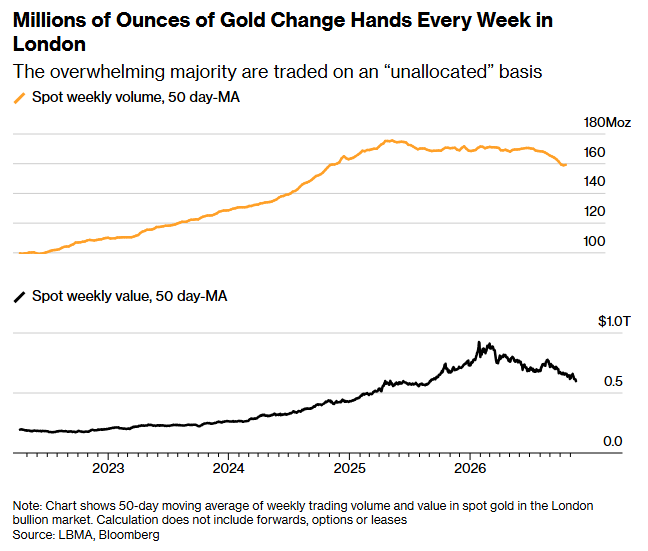
Millions of ounces of gold change hands in London every week, and the vast majority of gold transactions are carried out in an “undistributed” manner
Banks can use this new type of gold share — known as “pooled gold equity” (pooled gold equity) — as collateral without actually transferring gold, which is expected to make gold a more useful financial asset. The World Gold Council is also lobbying British regulators to include gold in the UK financial collateral system so that market participants can more easily use gold as collateral and enforce relevant rights in the event of bankruptcy and liquidation.
Mark Amlin, head of J.P. Morgan's global physical commodities business, said in a statement that if gold can be shared, easily transferred, and not affected by the bankruptcy of intermediaries, it can “be more widely used in the financial market, including as collateral.”
Meanwhile, Asia's financial centers are seeking more share of gold trading from London. Hong Kong began trial operation of a new gold clearing system similar to the London gold market this year; Singapore announced a series of measures, including providing gold custodian services for central banks.
Earlier this year, the UK Financial Conduct Authority (FCA) consulted the financial industry on the tokenization of gold and said that developing a new generation of gold market infrastructure would “consolidate and maintain London's position as a gold trading and custodian center.”
The London Treasury holds far more than $1 trillion worth of gold, including a large amount of gold held by central banks in the Bank of England's underground treasury. As a result, London is unlikely to lose its status as a leading global gold trading center in the short term. Many traders also expect that even if pooled gold equity is popular with traders and customers, the market is likely to maintain a structure dominated by “undistributed” transactions.
Notably, not all attempts to reform the London precious metals market have been successful. Four years ago, the London Metal Exchange (LME) abandoned a plan to push for more transactions to be transferred to the exchange. The plan was supported by banks such as Goldman Sachs Group (GS.US) and Morgan Stanley (MS.US), but ultimately failed to advance due to the failure of related contracts to attract sufficient trading volume.
Mike Oswin, head of global market structure at the World Gold Council, said that unlike previous plans to reshape the London gold market, pooling gold rights aims to operate in collaboration with the existing OTC (OTC) system rather than transfer transactions out of this system.
Mike Oswin said, “We're not claiming that the non-distributive market is no longer working. This mechanism complements the existing market.” He added that before pooled gold benefits can be rolled out more widely, there are still a number of issues to be resolved, including determining how this system will be governed.
Currently, there are five banks in the London market that provide gold escrow services and are responsible for overseeing existing clearing infrastructure, namely Citigroup (C.US), ICBC Standard Bank, UBS Group (UBS.US), HSBC, and the largest participant, J.P. Morgan Chase. In October, it was reported that Deutsche Bank (DB.US) and Morgan Stanley are also seeking to join this small club.