
Burlington misses Q3 2026 revenue estimates, but stock soars 5.3%
Off-price retail company Burlington Stores (NYSE:BURL) missed Wall Street’s revenue expectations in Q3 2026, but revenue rose 8.4% year on year to $2.94 billion. Next quarter’s revenue guidance of $3.94 billion underwhelmed, coming in 0.8% below analysts’ consensus estimates. Its non-GAAP profit of $1.70 per share was 1.1% below analysts’ consensus estimates.
For more on Burlington, read the full research report for free.
Burlington Q3 2026 highlights:
- Revenue $2.94 billion vs analysts’ consensus estimates of $2.98 billion, according to S&P (8.4% year-on-year growth, 1.3% miss)
- Adjusted EPS $1.70 vs analysts’ consensus estimates of $1.72, according to S&P (1.1% miss)
- Adjusted EBITDA $280.4 million vs analysts’ consensus estimates of $275.4 million (9.5% margin, 1.8% beat)
- Revenue guidance $3.94 billion at the midpoint for Q4 2026, below analysts’ consensus estimates of $3.97 billion
- Adjusted EPS guidance Management lowered its full-year adjusted EPS guidance to $11.75 at the midpoint, a 1% decrease
- Operating margin 9.4%, up from 5.6% in the same quarter last year
- Free cash flow -$217.3 million compared to -$109.6 million in the same quarter last year
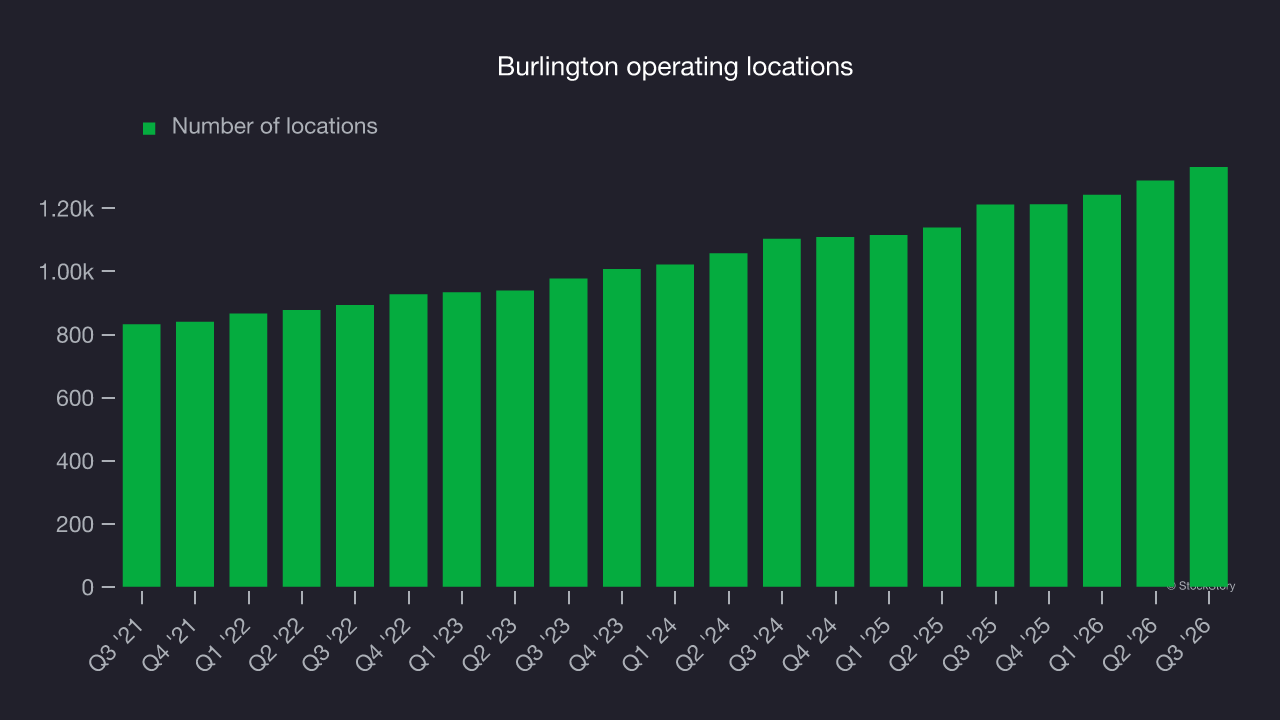
- Locations 1,330 at quarter end, up from 1,211 in the same quarter last year
- Same-store sales rose 1% year on year, in line with the same quarter last year
- Market capitalization $14.77 billion
Michael O’Sullivan, CEO, stated, “Total sales increased 8% in the third quarter, while comp store sales increased 1%. We are disappointed with this result. We saw good sales momentum through late September, but then our store traffic and comp trend were significantly impacted by unseasonably warm weather in October.”
Revenue growth
Examining a company’s long-term performance can provide clues about its quality. Any business can put up a good quarter or two, but the best consistently grow over the long haul.
With $12.44 billion in revenue over the past 12 months, Burlington is a mid-sized retailer, which sometimes brings disadvantages compared to larger competitors benefiting from better economies of scale. On the positive side, it can still achieve high growth rates because it’s working from a smaller revenue base.
Burlington grew its revenue at a solid 10% compounded annual growth rate over the last three years as it opened new stores and increased revenue at existing, established locations.
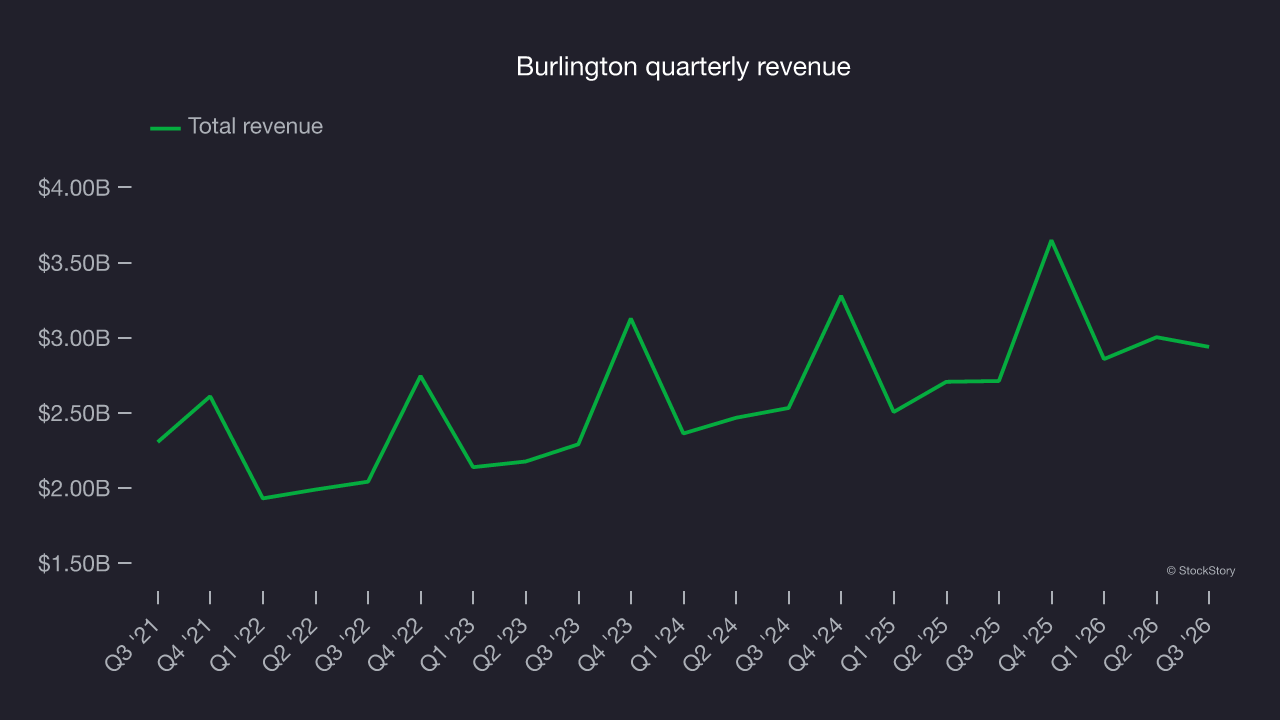
This quarter, Burlington’s revenue grew by 8.4% year on year to $2.94 billion, missing Wall Street’s consensus estimates. Management is guiding for an 8% year-on-year increase in revenue next quarter.
Looking further ahead, sell-side analysts expect revenue to grow 9.1% over the next 12 months, according to S&P, similar to its three-year rate. This projection is strong for a company of its scale and suggests the market expects its products to perform well.
Store performance
Number of stores
Burlington had 1,330 locations in the latest quarter. Over the last two years, it has opened new stores at a rapid pace, averaging 10% annual growth, among the fastest in the consumer retail sector. This gives it a chance to become a large-scale business over time.
When a retailer opens new stores, it usually means it’s investing for growth because demand is greater than supply, especially in areas where consumers may not have a store within reasonable driving distance.
Same-store sales
A company’s store base only paints one part of the picture. When demand is high, it makes sense to open more. But when demand is low, it’s prudent to close some locations and use the money in other ways. Same-store sales provide insight into this topic because they measure organic growth for a retailer’s e-commerce platform and brick-and-mortar shops that have existed for at least a year.
Burlington’s demand has been healthy for a retailer over the last two years. On average, the company has grown its same-store sales by 3.1% per year. This performance gives it the confidence to meaningfully expand its store base.
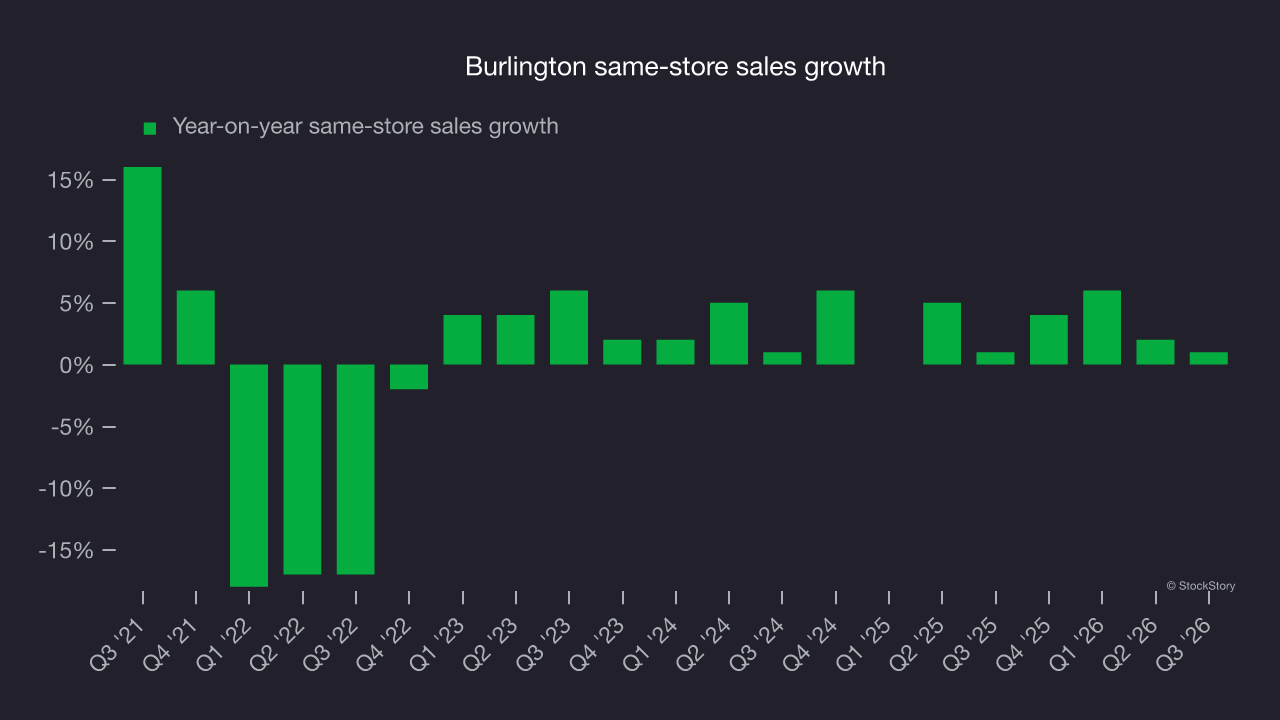
In the latest quarter, Burlington’s same-store sales rose 1% year on year. This was a meaningful deceleration from its historical levels. The question is whether Burlington can reaccelerate growth.
Key takeaways from Burlington’s Q3 results
Burlington’s quarter was weaker overall, with revenue slightly below Wall Street’s consensus estimates and next-quarter EPS guidance also falling short. EBITDA provided a bright spot, beating analysts’ consensus estimates. Shares surged 5.3% to $247.17 immediately after the report.
When assessing Burlington at its current price, consider its valuation, business quality and latest quarterly results. Read the full research report here (it’s free).