
J. M. Smucker reports Q3 CY2026 in line with expectations
Packaged foods company J.M Smucker (NYSE:SJM) met Wall Street’s revenue expectations in calendar Q3 2026 [fiscal Q2 2027], but revenue fell by 2% year on year to $2.28 billion. Its non-GAAP profit of $3.20 per share was 24.8% above analysts’ consensus estimates.
For more on J. M. Smucker, read our free full research report.
J. M. Smucker Q3 CY2026 highlights:
- Revenue $2.28 billion vs S&P consensus estimates of $2.27 billion (2% year-on-year decline, in line)
- Adjusted EPS $3.20 vs S&P consensus estimates of $2.56 (24.8% beat)
- Adjusted EBITDA $542.4 million vs analysts’ consensus estimates of $521.9 million (23.8% margin, 3.9% beat)
- Adjusted EPS guidance Management raised its full-year adjusted EPS guidance to $11 at the midpoint, a 2.3% increase
- Operating margin 18%, in line with the same quarter last year
- Free cash flow margin 8.9%, down from 12% in the same quarter last year
- Sales volumes were flat year on year (6% in the same quarter last year)
- Market capitalization $14.18 billion
"We are pleased with our second quarter results and the momentum of our portfolio through the first half of the fiscal year. Net sales and adjusted earnings per share exceeded our expectations in the quarter, reflecting the strength of our differentiated portfolio, disciplined execution of our strategic priorities, and the investments we continue to make in our brands and capabilities," said Mark Smucker, Chief Executive Officer, President and Chair of the Board.
Revenue growth
A company’s long-term revenue performance can indicate its overall quality. Any business can experience short-term success, but top-performing ones sustain growth for years.
With $9.11 billion in revenue over the past 12 months, J. M. Smucker is one of the larger consumer staples companies and benefits from a well-known brand that influences purchasing decisions. However, its scale is a double-edged sword because it’s harder to find incremental growth when its existing brands have penetrated most of the market. For J. M. Smucker to boost its revenue, it likely needs to adjust its prices, launch new offerings or expand into foreign markets.
J. M. Smucker’s 3.6% annualized revenue growth over the last three years was sluggish as consumers bought less of its products. We’ll explore what this means in the “Volume Growth” section.
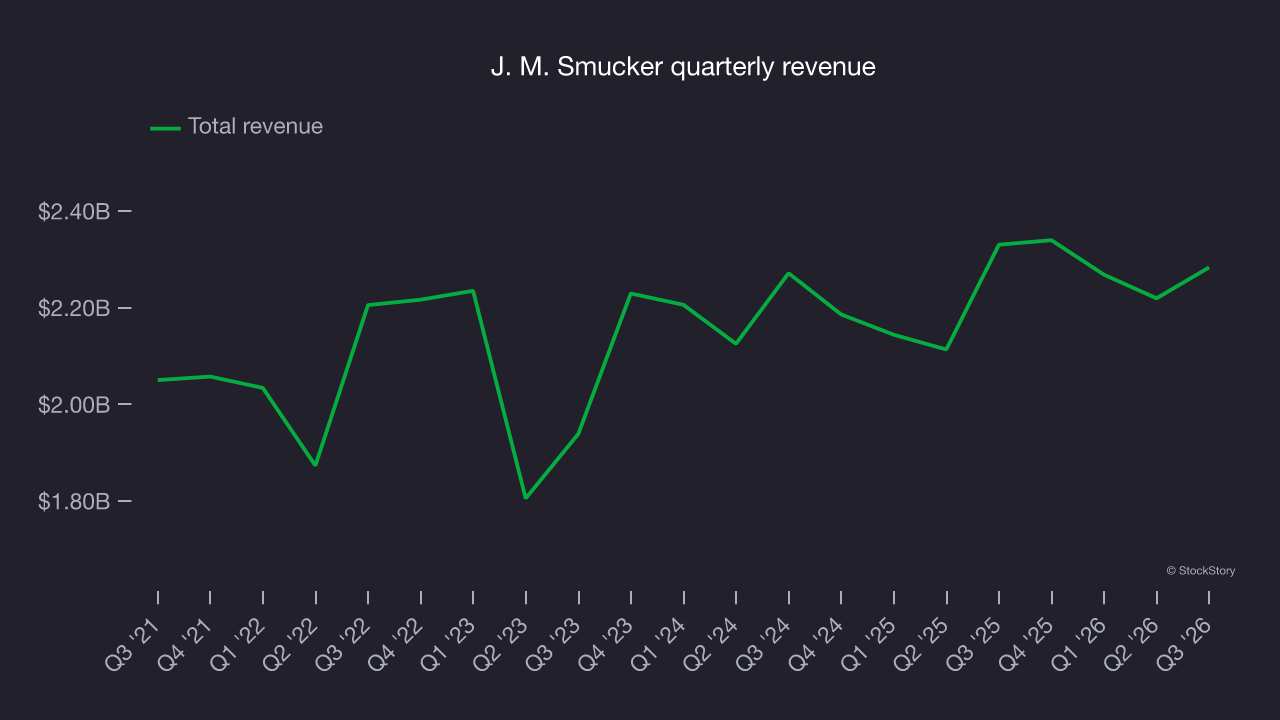
This quarter, J. M. Smucker reported an uninspiring 2% year-on-year revenue decline to $2.28 billion, in line with Wall Street’s consensus estimates.
Looking ahead, sell-side analysts expect revenue to decline by 1.4% over the next 12 months, according to S&P, a deceleration versus the last three years. This underwhelming projection implies its products will face some demand headwinds.
Volume growth
Revenue growth can be broken down into changes in price and volume (the number of units sold). While both are important, volume is central to a successful staples business as there’s a ceiling to what consumers will pay for everyday goods; they can always trade down to non-branded products if the branded versions are too expensive.
J. M. Smucker’s average quarterly sales volumes have shrunk by 1.4% over the last two years. This decrease isn’t ideal because the quantity demanded for consumer staples products is typically stable. 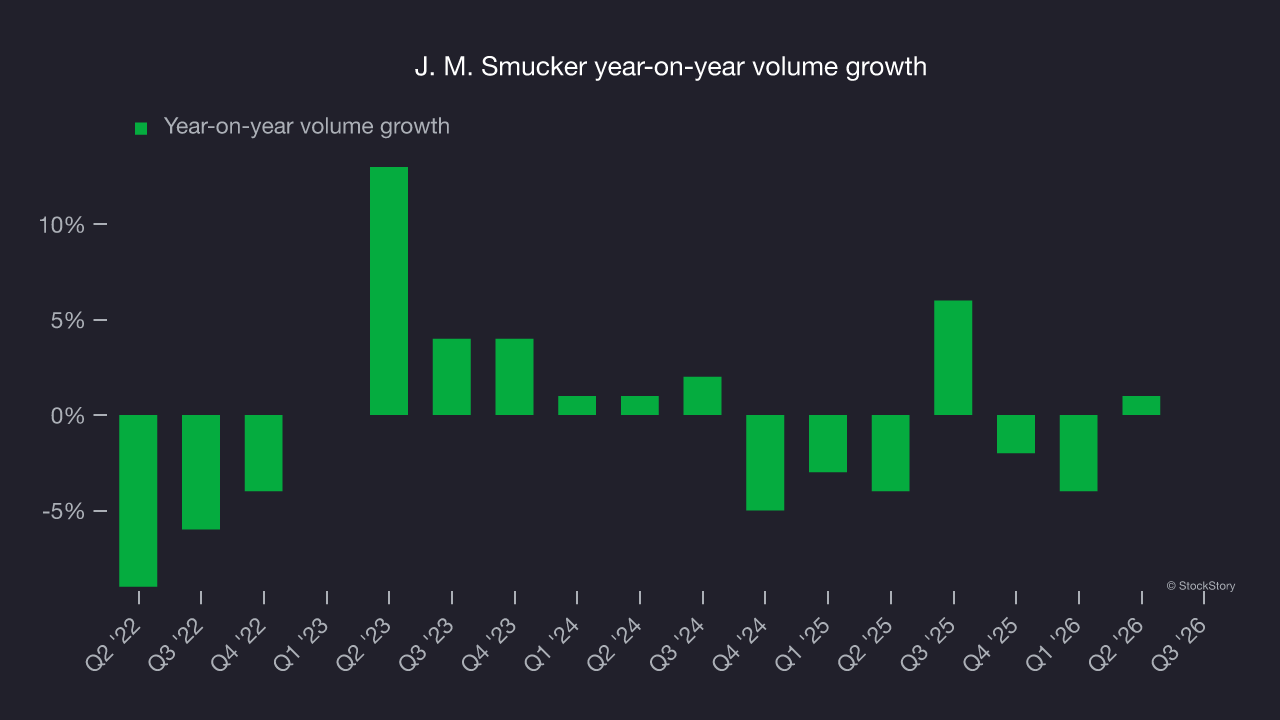
In J. M. Smucker’s Q3 2027, sales volumes were flat year over year. This result marked a turnaround from its historical levels, indicating the company is moving in the right direction.
Key takeaways from J. M. Smucker’s Q3 results
Earnings were a bright spot for J. M. Smucker in Q3: EPS beat analysts’ consensus estimates and EBITDA also topped Wall Street’s expectations, making for a solid quarter with clear positives. Still, the market seemed to be hoping for more. Shares fell 2% to $130.13 immediately after the report.
Is J. M. Smucker an attractive buy at the current price? What happened in the latest quarter matters, but not as much as longer-term business quality and valuation when deciding whether to invest in this stock. For more on those factors, read the full research report here (it’s free).