
Best Buy reports bullish Q3 CY2026, full-year outlook slightly exceeds expectations

Electronics retailer Best Buy (NYSE:BBY) reported calendar Q3 2026 [fiscal Q3 2027] results exceeding the market’s revenue expectations, with revenue rising 5.8% year on year to $10.24 billion. The company’s full-year revenue guidance of $43.15 billion at the midpoint came in 1.1% above analysts’ consensus estimates. Its non-GAAP profit of $1.62 per share was 8.6% above analysts’ consensus estimates.
For more on Best Buy, read our free full research report.
Best Buy Q3 CY2026 highlights:
- Revenue $10.24 billion vs analysts’ consensus estimates of $9.88 billion, according to S&P (5.8% year-on-year growth, 3.6% beat)
- Adjusted EPS $1.62 vs analysts’ consensus estimates of $1.49, according to S&P (8.6% beat)
- Revenue guidance The company lifted its revenue guidance for the full year to $43.15 billion at the midpoint from $42.55 billion, a 1.4% increase
- Adjusted EPS guidance Management raised its full-year adjusted EPS guidance to $6.98 at the midpoint, a 2.6% increase
- Operating margin 4.4%, up from 2% in the same quarter last year
- Free cash flow $75 million, up from -$287 million in the same quarter last year
- Same-store sales rose 6.1% year on year (2.7% in the same quarter last year)
- Market capitalization $20.34 billion
“Our team delivered strong third quarter performance, with comparable sales growth of 6.1% which was ahead of our expectations and our highest in five years,” said Jason Bonfig, Best Buy CEO. “Disciplined execution, a compelling product cycle and continued market share gains helped drive broad-based topline momentum across nearly all product categories, our services offerings, and both our digital and store channels. We also continued to scale Marketplace and Best Buy Ads, which are contributing to topline growth and supporting gross profit rate expansion.”
Revenue growth
A company’s long-term revenue performance can indicate its overall quality. Even a poor business can perform well for one or two quarters, but a high-quality one grows for years.
With $42.77 billion in revenue over the past 12 months, Best Buy is larger than most consumer retail companies and benefits from economies of scale, enabling it to gain more leverage on its fixed costs than smaller competitors. This also gives it the flexibility to offer lower prices. However, its scale is a double-edged sword because it’s harder to find incremental growth when you’ve penetrated most of the market. For Best Buy to boost its revenue, it likely needs to adjust its prices or focus more on foreign markets.
Best Buy struggled to increase demand as its $42.77 billion in revenue for the trailing 12 months was close to its revenue three years ago. This was mainly because it closed stores.
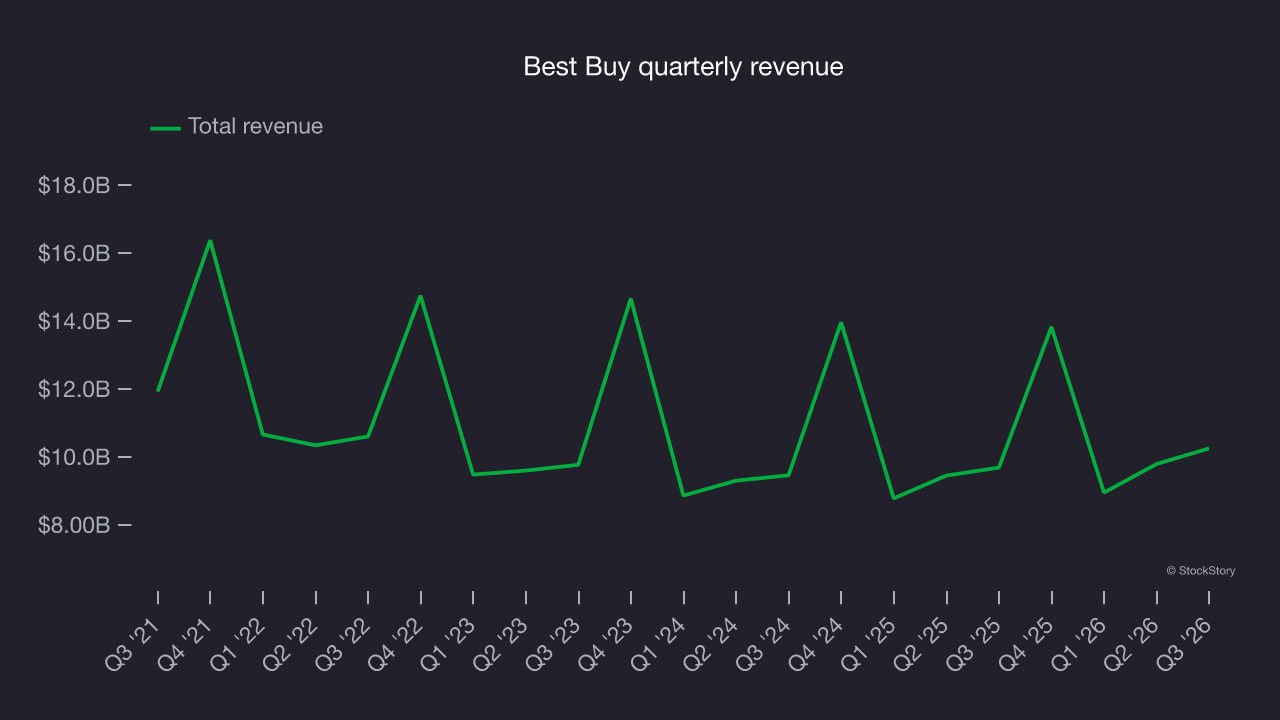
This quarter, Best Buy reported year-on-year revenue growth of 5.8%, and its $10.24 billion in revenue exceeded Wall Street’s consensus estimates by 3.6%.
Looking ahead, sell-side analysts expect revenue to remain flat over the next 12 months, according to S&P. Although this projection implies its newer products will spur better top-line performance, it is still below average for the sector.
Store performance
Number of stores
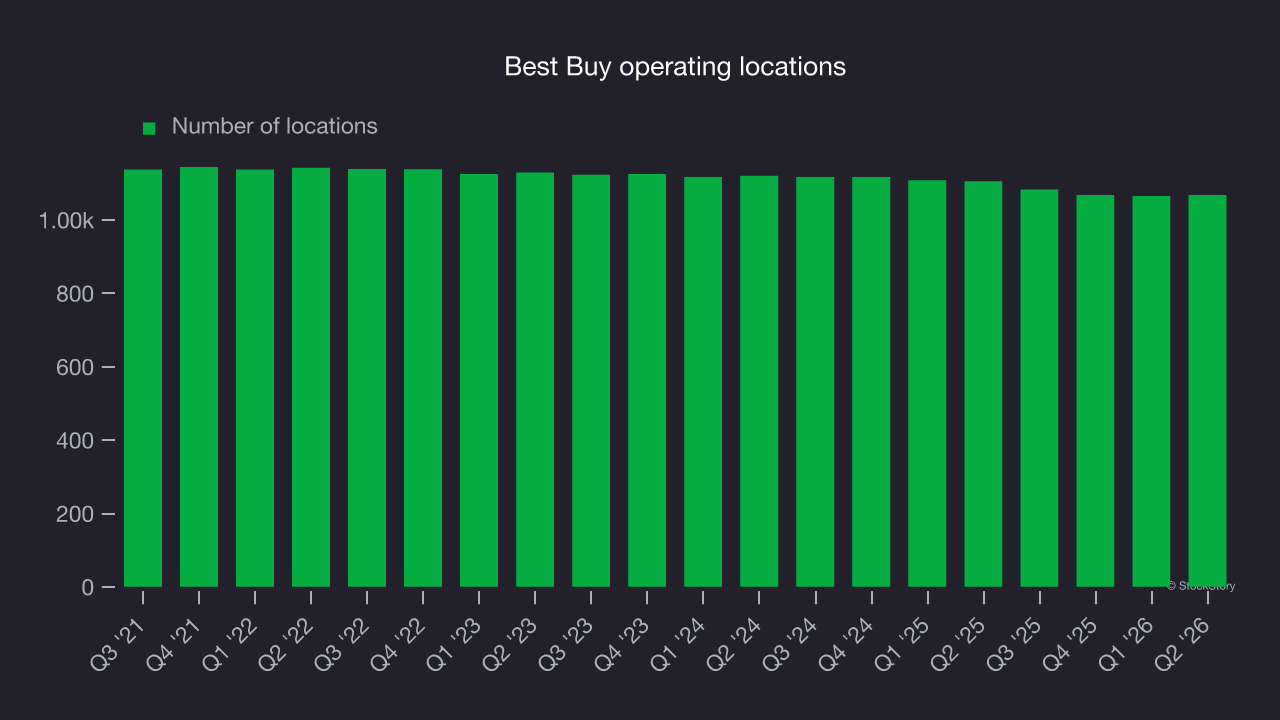
Over the last two years, Best Buy has generally reduced its store count, with annual declines averaging 2.5%.
When a retailer shutters stores, it usually means that brick-and-mortar demand is less than supply, and it is responding by closing underperforming locations to improve profitability.
Note that Best Buy reports its store count intermittently, so some data points are missing in the chart below.
Same-store sales
The change in a company’s store base only tells one side of the story. The other is the performance of its existing locations and e-commerce sales, which informs management teams whether they should expand or downsize their physical footprints. Same-store sales provide a deeper understanding of this issue because the metric measures organic growth at brick-and-mortar shops open for at least a year.
Best Buy’s demand within its existing locations has been relatively stable over the last two years but was below most retailers. On average, the company’s same-store sales have grown by 1.9% per year. Given its declining store base over the same period, this performance stems from a mixture of higher e-commerce sales and increased foot traffic at existing locations (closing stores can sometimes boost same-store sales).
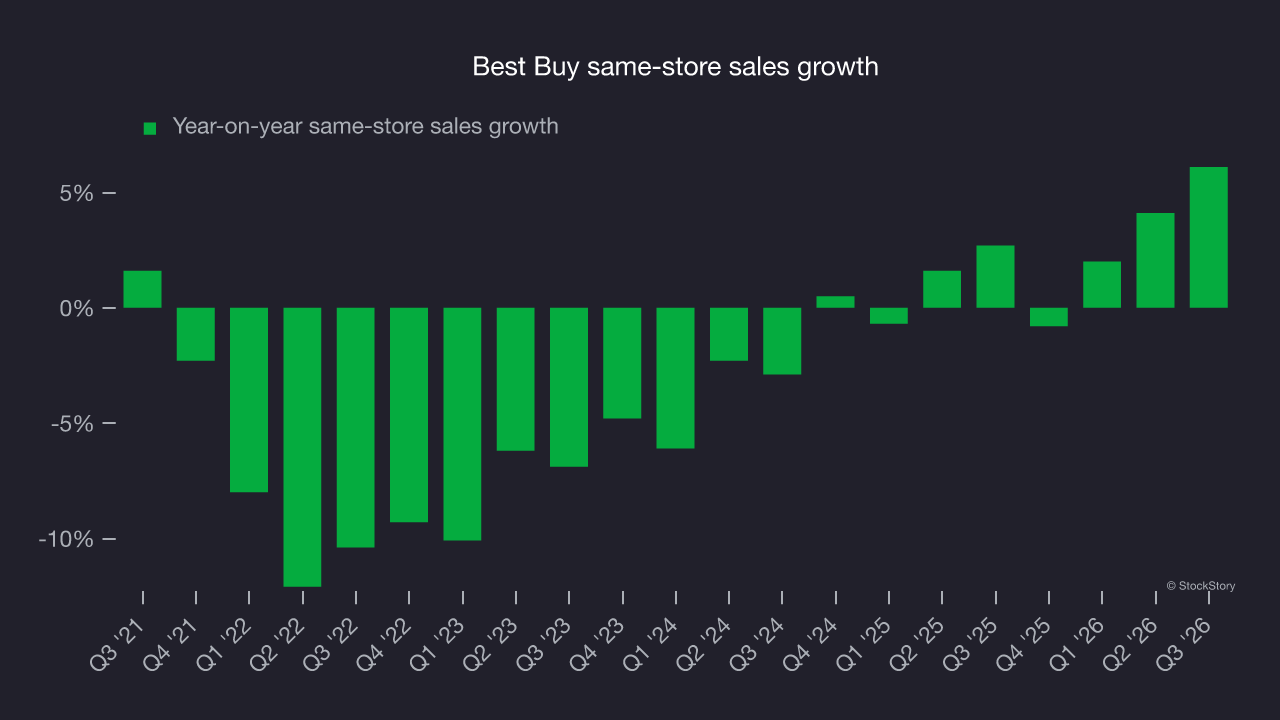
In the latest quarter, Best Buy’s same-store sales rose 6.1% year on year. This growth marked an acceleration from historical levels, a positive sign.
Key takeaways from Best Buy’s Q3 results
A revenue beat and full-year EPS guidance above Wall Street’s consensus estimates made this a decent quarter for Best Buy, with some key metrics ahead of expectations. Shares rose 3.7% to $100.55 immediately after the results.
Best Buy had a solid quarter, but one earnings result doesn’t necessarily make the stock a buy. To decide whether it is a good investment, the latest quarter matters, but not as much as longer-term business quality and valuation. For more on those factors, read our full research report here (it’s free).