
Urban Outfitters reports Q3 CY2026 in line with expectations but stock drops
Clothing and accessories retailer Urban Outfitters (NASDAQ:URBN) met Wall Street’s revenue expectations in calendar Q3 2026 [fiscal Q3 2027], with revenue up 8.9% year on year to $1.67 billion. Its non-GAAP profit of $4.57 per share was significantly above analysts’ consensus estimates.
For more on Urban Outfitters, read our free full research report.
Urban Outfitters Q3 CY2026 highlights:
- Revenue $1.67 billion vs S&P consensus estimates of $1.67 billion (8.9% year-on-year growth, in line)
- Adjusted EPS $4.57 vs S&P consensus estimates of $1.53 (significant beat)
- Operating margin 10.3%, in line with the same quarter last year
- Free cash flow $7.14 million, up from -$22.76 million in the same quarter last year
- Same-store sales rose 4.4% year on year (8% in the same quarter last year)
- Market capitalization $7.31 billion
“Our teams delivered another standout quarter, achieving record third-quarter sales and earnings per share,” said Richard A. Hayne, chief executive officer. “Every brand and segment contributed positively to our third-quarter performance, underscoring the strength of our portfolio and disciplined execution across the organization,” Hayne added.
Revenue growth
A company’s long-term revenue performance is one signal of its overall quality. Even a weak business can post strong results for one or two quarters, but a high-quality one grows for years.
With $6.61 billion in revenue over the past 12 months, Urban Outfitters is a mid-sized retailer, which sometimes brings disadvantages compared to larger competitors benefiting from better economies of scale.
Urban Outfitters’s 9.4% annualized revenue growth over the last three years was mediocre, but on the positive side, it opened new stores and increased revenue at existing, established locations.
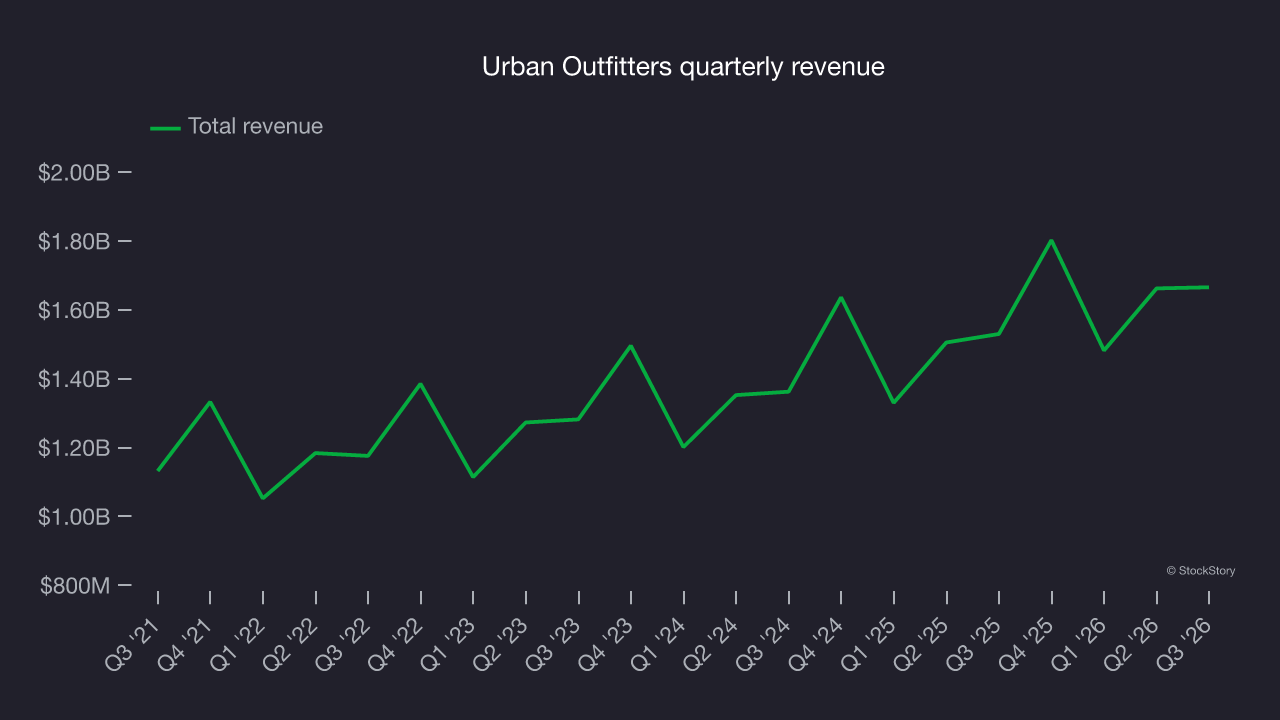
This quarter, Urban Outfitters grew its revenue by 8.9% year on year, and its $1.67 billion in revenue was in line with Wall Street’s consensus estimates.
Looking ahead, sell-side analysts expect revenue to grow 7.2% over the next 12 months, according to S&P, a slight deceleration versus the last three years. Despite the slowdown, this remains a solid growth forecast and indicates the market expects success for its products.
Store performance
Number of stores
A retailer’s store count influences how much it can sell and how quickly revenue can grow.
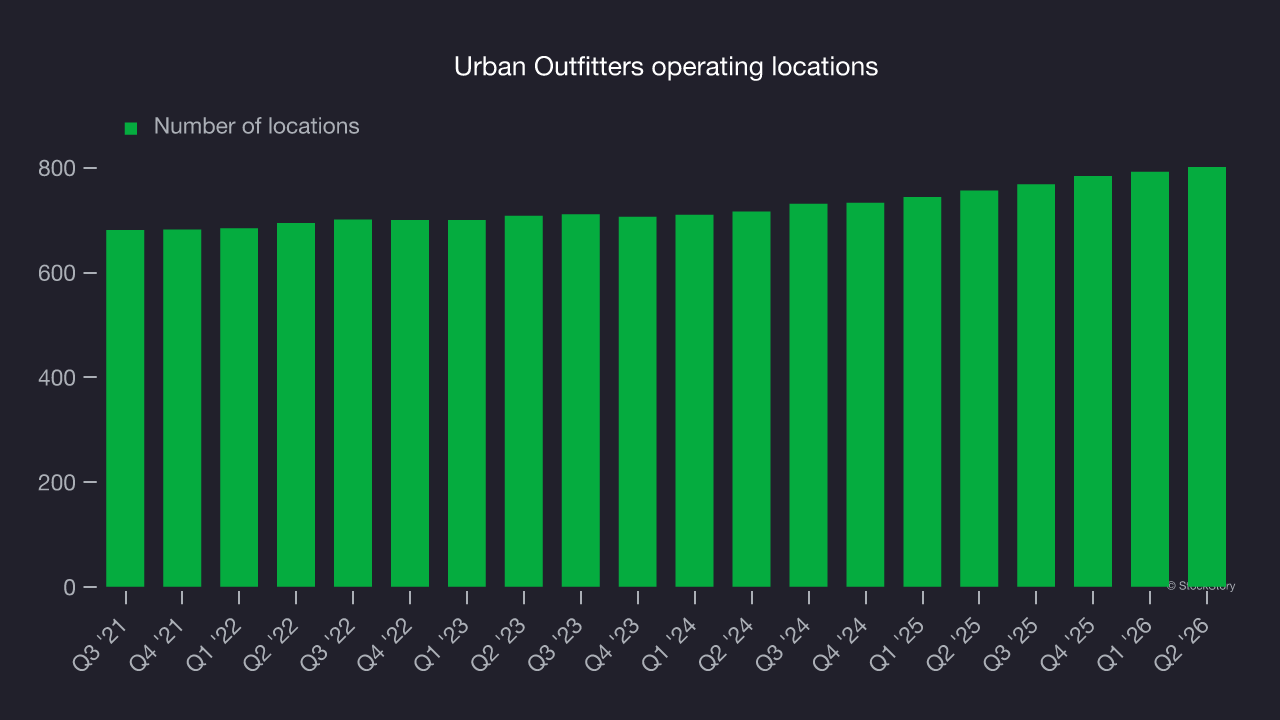
Urban Outfitters opened new stores at a rapid pace over the last two years, averaging 5.5% annual growth, much faster than the broader consumer retail sector. This gives it a chance to become a large, scaled business over time.
When a retailer opens new stores, it usually means it’s investing for growth because demand is greater than supply, especially in areas where consumers may not have a store within reasonable driving distance.
Note that Urban Outfitters reports its store count intermittently, so some data points are missing in the chart below.
Same-store sales
The change in a company’s store base only tells one side of the story. The other is the performance of its existing locations and e-commerce sales, which informs management teams whether they should expand or downsize their physical footprints. The same-store sales metric provides insight into this topic because it measures organic growth for a retailer’s e-commerce platform and brick-and-mortar shops that have existed for at least a year.
Urban Outfitters has been one of the most successful retailers over the last two years thanks to growing demand within its existing locations. On average, the company has posted strong year-on-year same-store sales growth of 5.6%. This performance suggests its rollout of new stores is beneficial for shareholders. This backdrop gives Urban Outfitters multiple avenues for growth: revenue can come from new stores, e-commerce or increased foot traffic and higher sales per customer at existing locations.
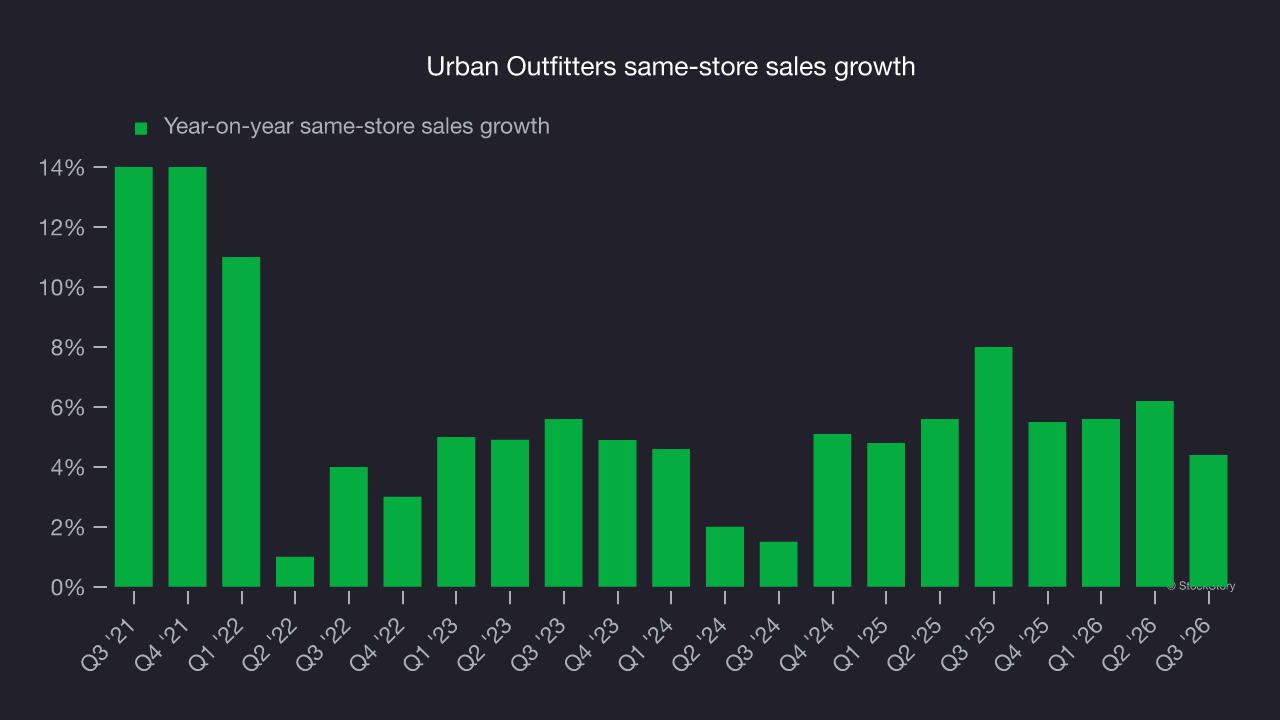
In the latest quarter, Urban Outfitters’s same-store sales rose 4.4% year on year. This growth was a deceleration from its historical levels, showing the business is still performing well but growth is slowing.
Key takeaways from Urban Outfitters’s Q3 results
Urban Outfitters beat analysts’ EPS expectations this quarter. On the other hand, its revenue and gross margin were just in line. The market seemed to be hoping for more, and the stock traded down 9.4% to $77.71 immediately following the results.
To assess Urban Outfitters at its current price, consider its valuation, business quality and latest earnings. Read our full research report here (it’s free).