
Dell reports strong Q3 CY2026, guides for strong full-year sales

Computer hardware and IT solutions company Dell (NYSE:DELL) beat Wall Street’s revenue expectations in calendar Q3 2026 [fiscal Q3 2027], as revenue rose 103% year on year to $54.94 billion. The company’s full-year revenue guidance of $202 billion at the midpoint came in 3.9% above analysts’ consensus estimates. Its non-GAAP profit of $9.45 per share was 44.2% above analysts’ consensus estimates.
For more on Dell, read the full research report for free.
Dell Q3 CY2026 highlights:
- Revenue $54.94 billion vs S&P analyst consensus of $49.6 billion (103% year-on-year growth, 10.8% beat)
- Adjusted EPS $9.45 vs S&P analyst consensus of $6.55 (44.2% beat)
- Revenue guidance The company lifted its revenue guidance for the full year to $202 billion at the midpoint from $192 billion, a 5.2% increase
- Adjusted EPS guidance Management raised its full-year adjusted EPS guidance to $29.68 at the midpoint, a 16.4% increase
- Operating margin 13.5%, up from 7.8% in the same quarter last year
- Free cash flow -$2.20 billion, down from $506 million in the same quarter last year
- Market capitalization $212.9 billion
Revenue growth
Reviewing a company’s long-term revenue performance reveals insights into its quality. Even a bad business can perform well for one or two quarters, but a high-quality one grows for years. Over the last five years, Dell grew its revenue at an impressive 13% compounded annual growth rate. Its growth beat the average business services company and shows its offerings resonate with customers.
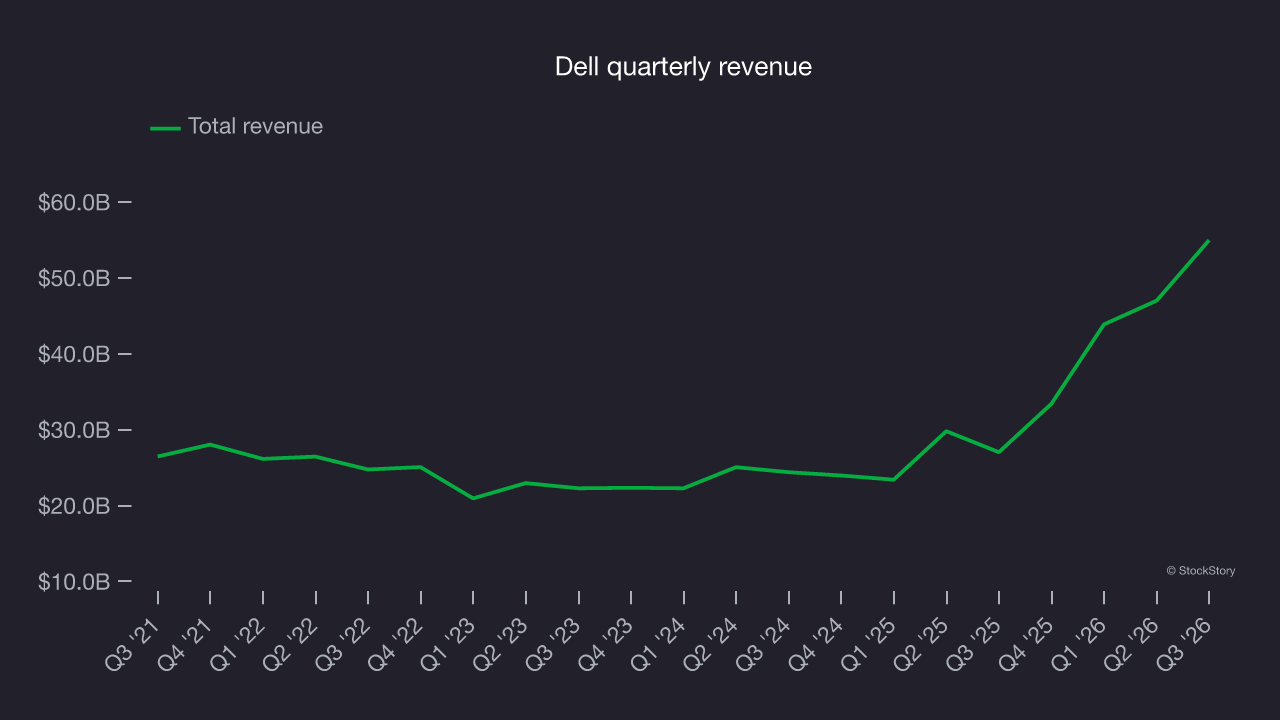
Long-term growth is the most important, but within business services, a half-decade historical view may miss new innovations or demand cycles. Dell’s annualized revenue growth of 38.1% over the last two years is above its five-year trend, suggesting its demand was strong and recently accelerated. 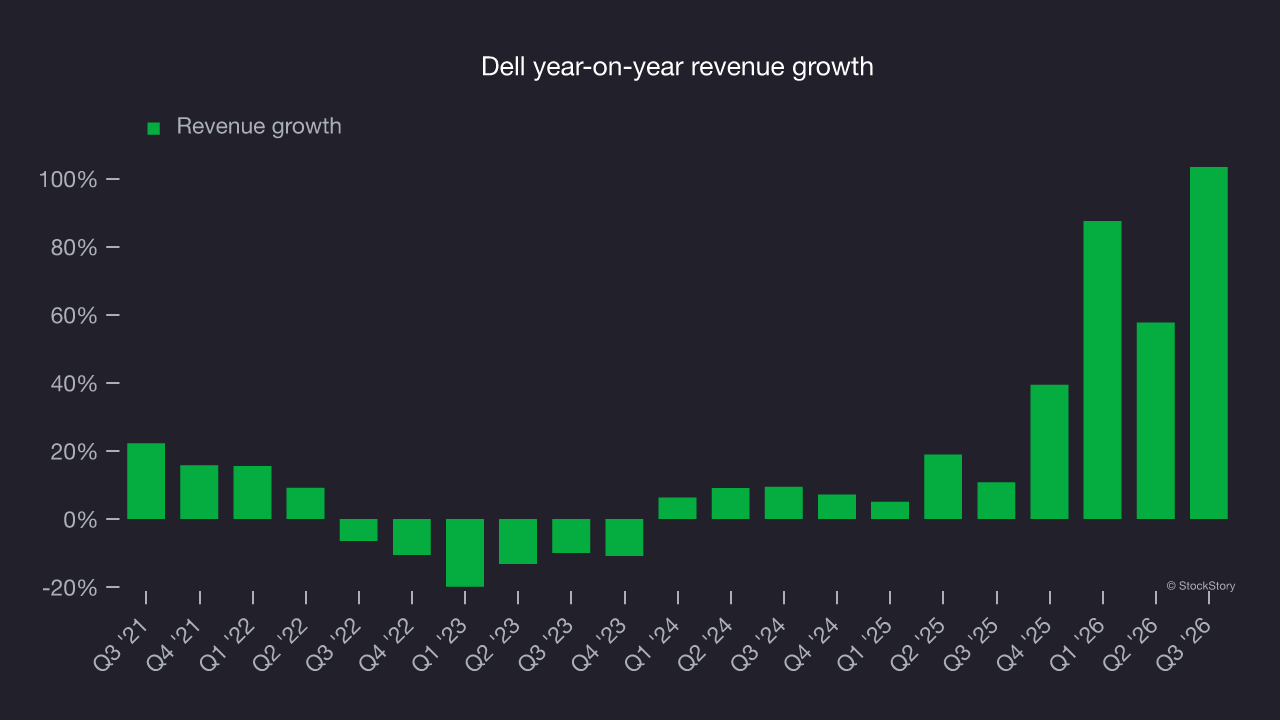
Dell also breaks out the revenue for its most important segments, Infrastructure Solutions and Client Solutions, which are 76.4% and 23.5% of revenue. Over the last two years, Dell’s Infrastructure Solutions revenue (servers and storage) averaged 113% year-on-year growth while its Client Solutions revenue (PCs, monitors and displays) averaged 11.3% growth. 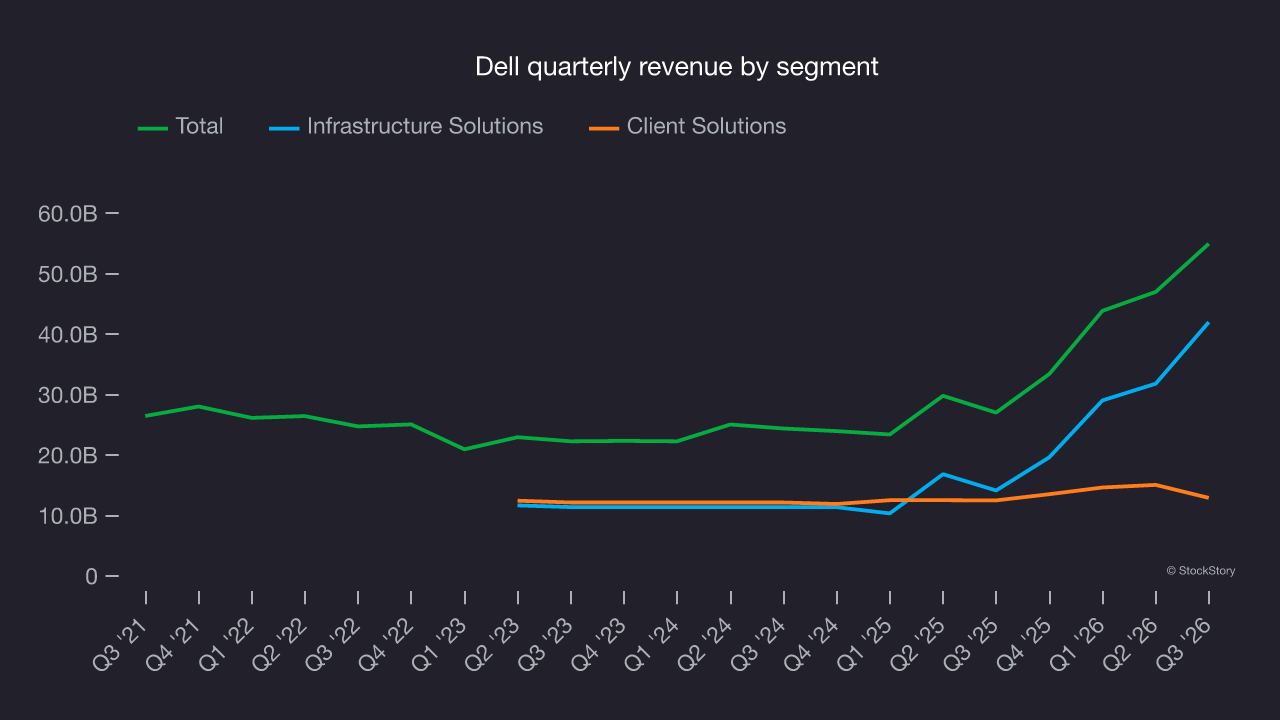
This quarter, Dell reported strong year-on-year revenue growth of 103%, and its $54.94 billion of revenue beat Wall Street’s consensus estimates by 10.8%.
Looking ahead, sell-side analysts expect revenue to grow 27.2% over the next 12 months, according to S&P, a deceleration versus the last two years. Still, this projection is strong given its scale and suggests the market expects success for its products and services.
Adjusted operating margin
Dell was profitable over the last five years but held back by its large cost base. Its average adjusted operating margin of 9.6% was weak for a business services company.
On the positive side, Dell’s adjusted operating margin rose by 3.7 percentage points over the last five years, as its revenue growth provided operating leverage.
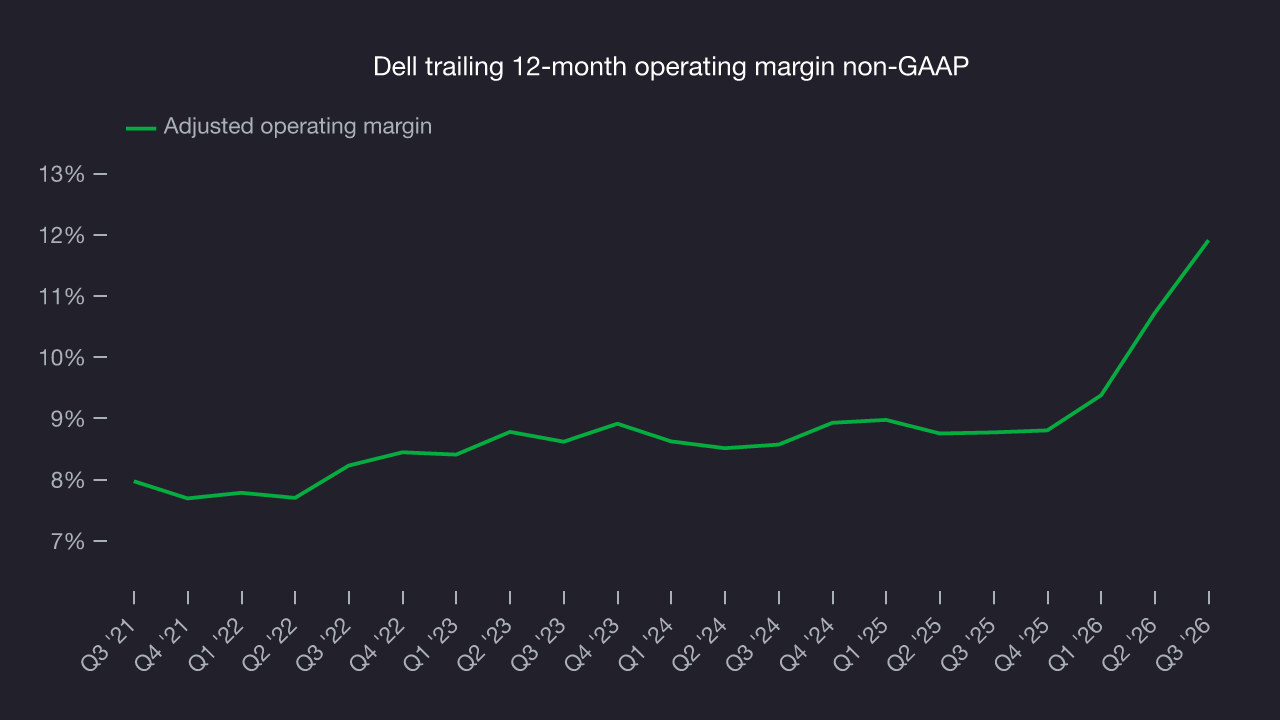
In Q3, Dell generated an adjusted operating profit margin of 13.9%, up 4.6 percentage points year on year. This improvement shows it was more efficient.
Earnings per share
We track the long-term change in earnings per share, or EPS, for the same reason as long-term revenue growth. Compared to revenue, however, EPS highlights whether a company’s growth is profitable.
Dell’s EPS grew at a 21.7% compounded annual growth rate over the last five years, higher than its 13% annualized revenue growth. This tells us the company became more profitable on a per-share basis as it expanded.
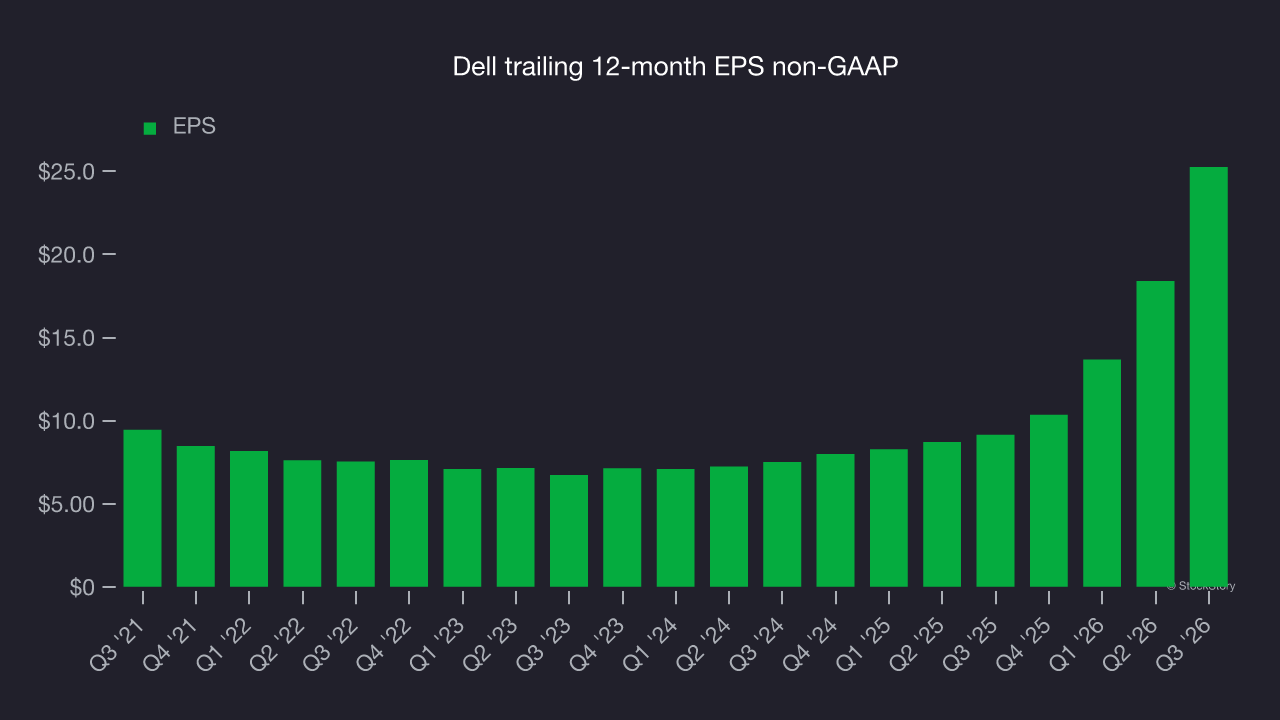
Diving into Dell’s quality of earnings can give us a better understanding of its performance. As we mentioned earlier, Dell’s adjusted operating margin expanded by 3.7 percentage points over the last five years. On top of that, its share count shrank by 18.4%. These are positive signs for shareholders because improving profitability and share buybacks boost EPS growth relative to revenue growth. 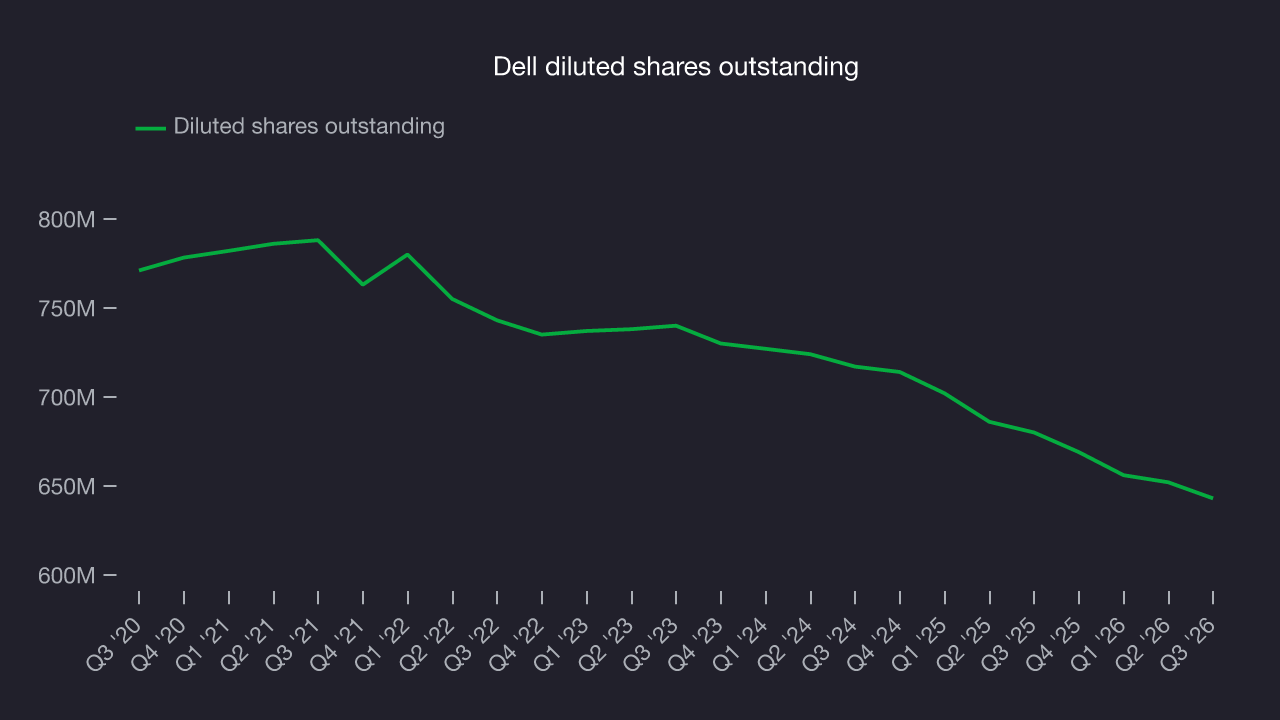
Like with revenue, we analyze EPS over a shorter period to see if we are missing a change in the business.
For Dell, its two-year annual EPS growth of 83.3% was higher than its five-year trend. That acceleration is a positive sign, especially given the already high base.
In Q3, Dell reported adjusted EPS of $9.45, up from $2.59 in the same quarter last year. The figure easily cleared analysts’ consensus estimates, a positive result for shareholders. Over the next 12 months, Wall Street expects Dell’s full-year EPS to grow 18.6% from $25.24 to $29.94, according to S&P.
Key takeaways from Dell’s Q3 results
Dell delivered a solid quarter, with EPS topping analysts’ consensus estimates and next-quarter EPS guidance coming in well above Wall Street’s consensus. Shares rose 3.8% to $308.14 immediately after the report.
Dell may have had a good quarter, but the investment case depends on more than that. What happened in the latest quarter matters, but longer-term business quality and valuation matter more when deciding whether to invest in the stock. For more on Dell, read the full research report here (it’s free).