
Autodesk’s Q3 CY2026 sales top estimates but stock drops
3D design software company Autodesk (NASDAQ:ADSK) reported revenue ahead of Wall Street’s expectations in calendar Q3 2026 [fiscal Q3 2027], with revenue rising 16.6% year on year to $2.16 billion. Guidance for next quarter’s revenue was better than expected at $2.23 billion at the midpoint, 0.8% above analysts’ consensus estimates. Its non-GAAP profit of $3.20 per share was 4.3% above analysts’ consensus estimates.
For more on Autodesk, read the full research report for free.
Autodesk Q3 CY2026 highlights:
- Revenue $2.16 billion vs. analysts’ consensus estimates of $2.13 billion, according to S&P (16.6% year-on-year growth, 1.2% beat)
- Adjusted EPS $3.20 vs. analysts’ consensus estimates of $3.07, according to S&P (4.3% beat)
- Revenue guidance $2.23 billion at the midpoint for Q4 CY2026, roughly in line with what analysts were expecting
- Adjusted EPS guidance Management raised its full-year adjusted EPS guidance to $12.73 at the midpoint, a 1.4% increase
- Operating margin 25.5%, in line with the same quarter last year
- Free cash flow margin 23.4%, down from 27.4% in the previous quarter
- Billings $2.07 billion at quarter end, up 11.6% year on year
- Market capitalization $53.37 billion
"As AI becomes more capable and accessible, differentiation will increasingly come from the ability to combine intelligence with trusted engineering capabilities, rich project context and complex industry workflows," said Andrew Anagnost, CEO of Autodesk. "That's the strategy we've been executing. As more work flows through Autodesk's platform, it creates richer project intelligence, enabling greater automation, better decisions and more valuable outcomes across the asset lifecycle. This reinforcing loop will not only amplify the value of our existing platform, but fundamentally expand what we can deliver, who we can serve and the value we can create for customers."
Revenue growth
A company’s long-term performance is an indicator of its overall quality. Any business can experience short-term success, but top-performing ones sustain growth for years. Over the last five years, Autodesk grew its revenue at a 14% annual rate. Though this growth is acceptable on an absolute basis, revenue growth alone is not enough in the software sector, which can display significant earnings volatility. The bar for the sector is particularly high, reflecting the non-essential and hit-driven nature of the products and services offered. Additionally, the five-year compound annual growth rate starts around Covid, when revenue was depressed before rebounding. Still, there are other things to like about Autodesk.
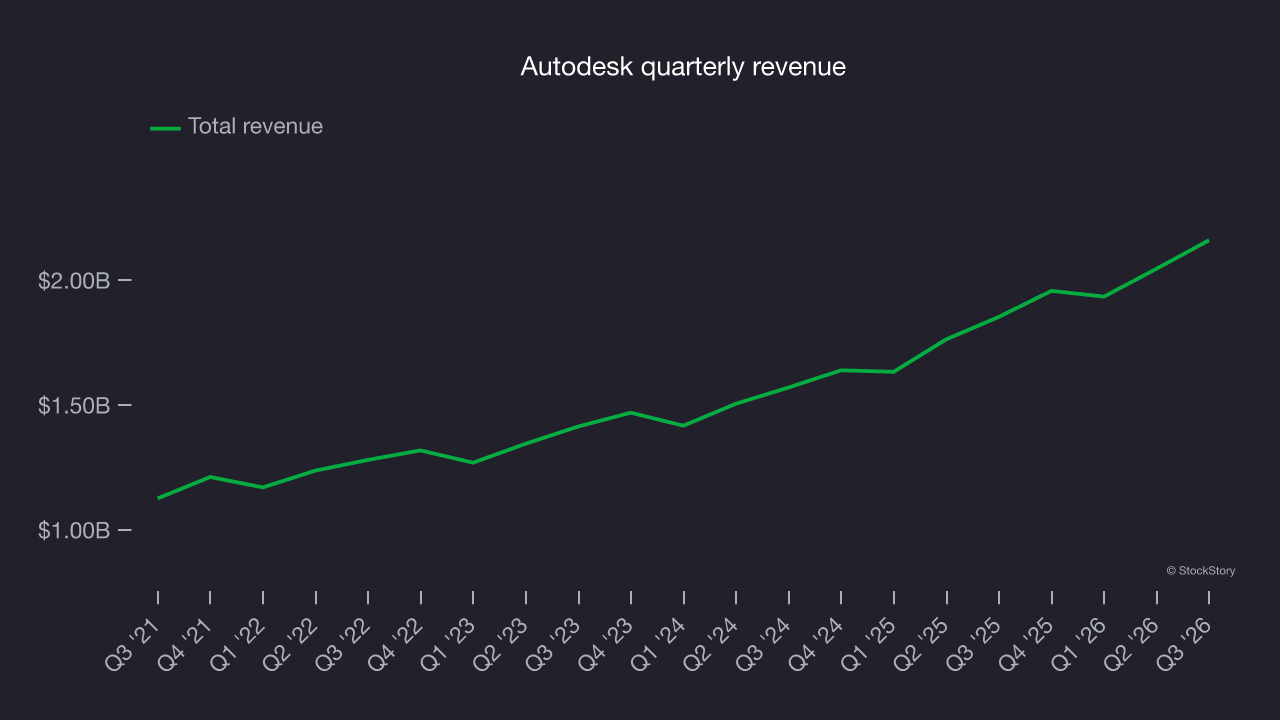
Long-term growth matters most, but within software, a half-decade historical view may miss recent innovations or disruptive industry trends. Autodesk’s annualized revenue growth of 16.5% over the last two years is above its five-year trend, suggesting some bright spots. 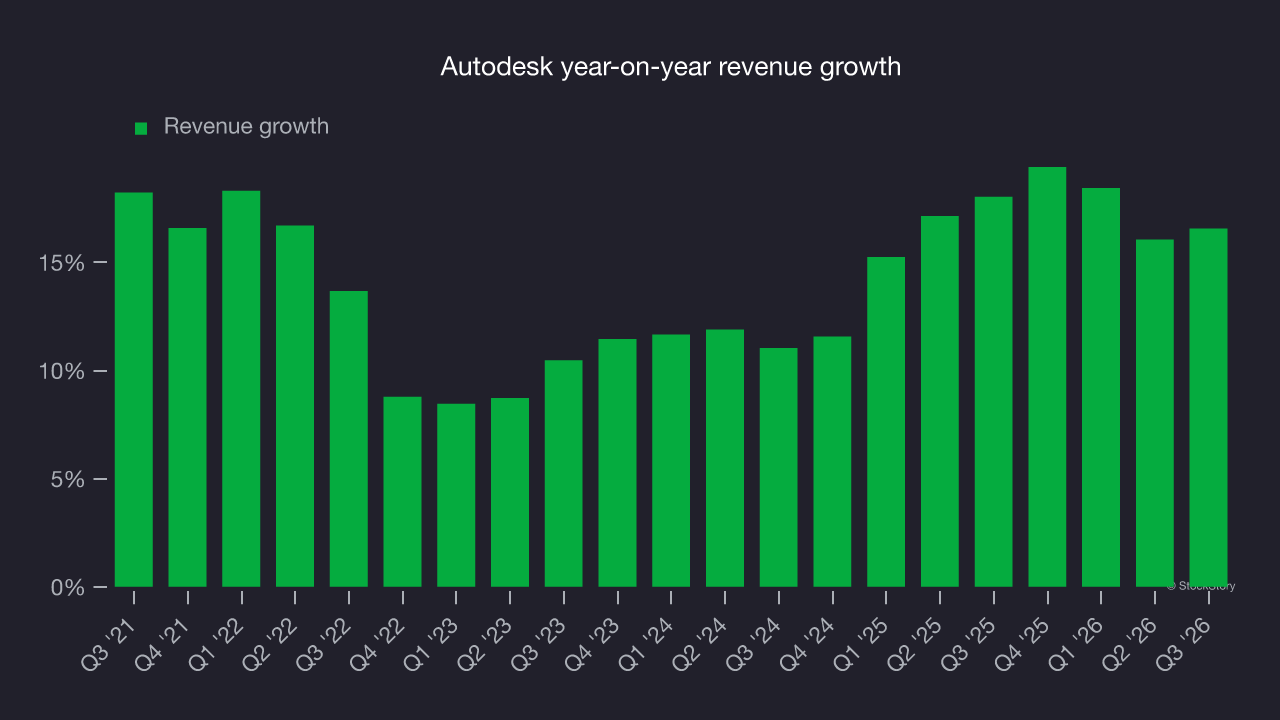
This quarter, Autodesk reported year-on-year revenue growth of 16.6%, and its $2.16 billion in revenue exceeded Wall Street’s consensus estimates by 1.2%. Management is guiding for a 13.8% year-on-year increase in revenue next quarter.
Looking further ahead, sell-side analysts expect revenue to grow 11% over the next 12 months, according to S&P, a deceleration versus the last two years. This underwhelming projection suggests its products and services will face some demand headwinds. On the positive side, the company is tracking well on other measures of financial health.
Billings
Billings is a non-GAAP metric that is often called “cash revenue” because it shows how much money the company has collected from customers in a certain period. This is different from revenue, which must be recognized in pieces over the length of a contract.
Autodesk’s billings totaled $2.07 billion in Q3, and over the last four quarters, billings growth was healthy, averaging 18.1% year on year. This performance aligned with its total revenue growth, indicating strong customer demand. The cash collected from customers also enhances liquidity and provides a solid foundation for future investments and growth. 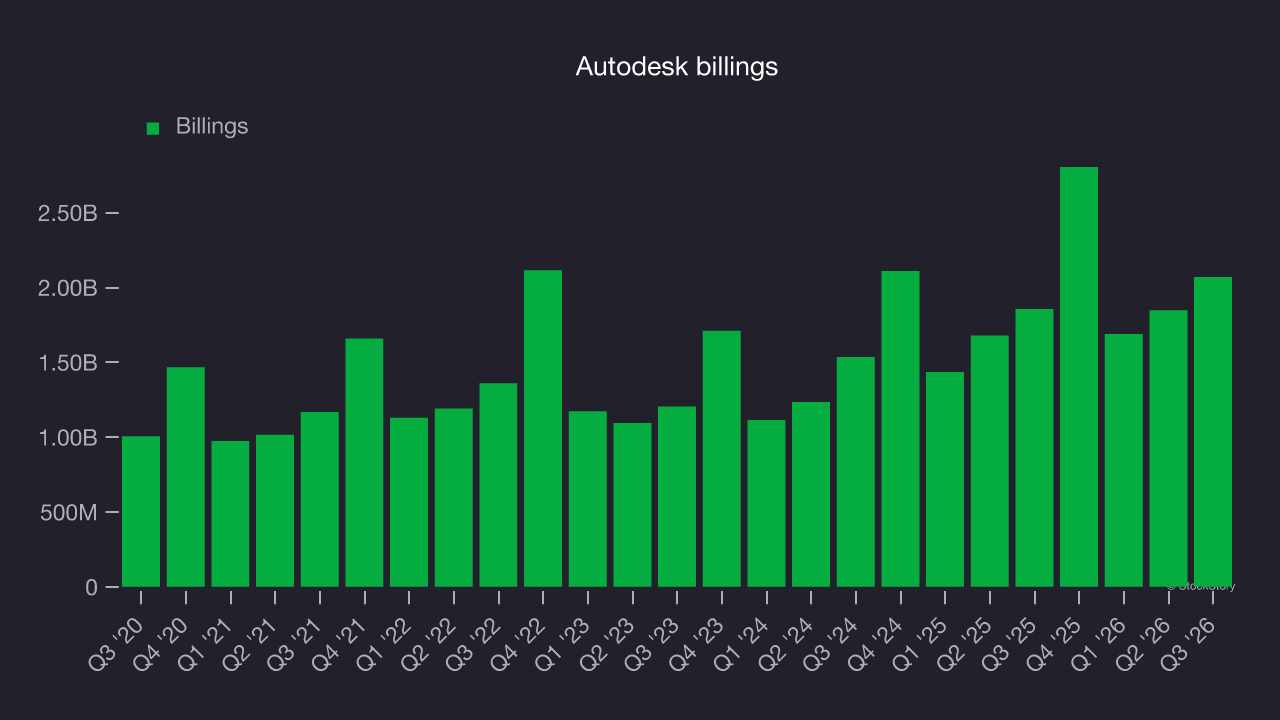
Customer acquisition efficiency
The customer acquisition cost, or CAC, payback period represents the months required to recover the cost of acquiring a new customer. Essentially, it’s the break-even point for sales and marketing investments. A shorter CAC payback period is ideal, as it implies better returns on investment and business scalability.
It’s relatively expensive for Autodesk to acquire new customers as its CAC payback period was 25.9 months this quarter. The company’s slow recovery of its sales and marketing expenses indicates it operates in a competitive market. On the positive side, once it acquires customers, they typically stay and increase their spending – a sign of high switching costs. 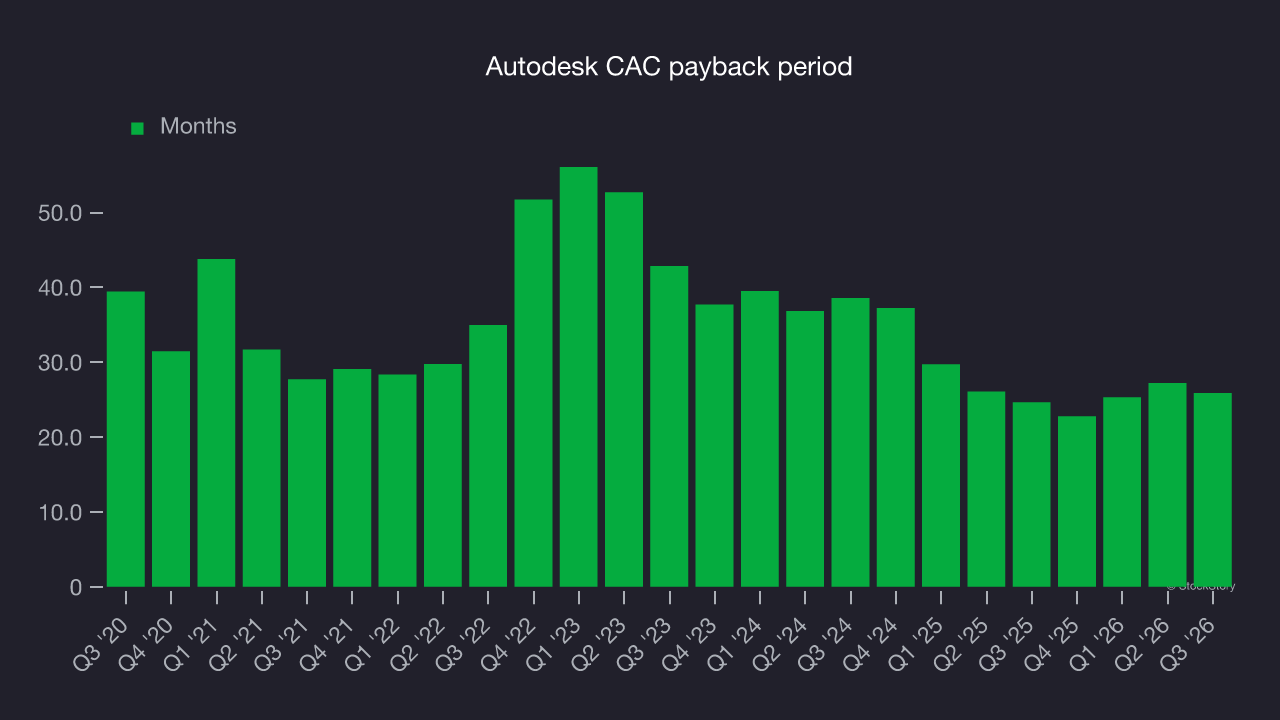
Key takeaways from Autodesk’s Q3 results
Autodesk’s guidance offered some key positives, with both its full-year and next-quarter EPS outlooks slightly above analysts’ consensus estimates. Still, the market seemed to be hoping for more, and shares tumbled 5.6% to $246.81 immediately after the report.
For investors considering Autodesk, the latest quarter matters, but not nearly as much as longer-term fundamentals and valuation when deciding whether the stock is a buy. Read the full research report here (it’s free).