
Is Remodel Push Altering The Investment Case For McDonald's Stock (MCD)?
- McDonald's is pushing ahead with expensive U.S. restaurant remodels, kitchen changes, and AI drive through tests, while early data shows a small 0.2% decline in Q3 2026 U.S. comparable sales and value focused bundles are being trialed to support traffic.
- The mix of costly upgrades, lighter Chicken McNugget weights versus a USDA benchmark, and franchisee resistance highlights real execution risk around value perception and profitability for McDonald's.
- We will now look at how McDonald's investment narrative could be reshaped by the costly U.S. remodel push and related value efforts.
McDonald's Investment Narrative Recap
For an investor to stay in McDonald's, the basic belief is that a high margin, mostly franchised model can keep generating steady cash, even when U.S. traffic wobbles. According to andre_santos, an investor in the Simply Wall St Community, the long term appeal rests on a wide moat and disciplined capital allocation. The recent 0.2% dip in U.S. comparable sales and scrutiny of Chicken McNugget weights mainly sharpen attention on near term value perception rather than altering that core thesis.
Right now, the key short term catalyst is whether remodels, menu tweaks, and value bundles can stabilise U.S. guest counts without eroding franchisee economics. The biggest risk sits in the same place. Expensive remodels, high debt, and franchisee pushback could pressure returns on new capital and limit flexibility if customer traffic stays soft.
The clearest announcement tied to this story is the test of low price value bundles at about 1,900 U.S. restaurants, alongside plans for a national entry level value menu in early 2027. These trials go straight at the current pain point. U.S. guests are visiting less often, even as average checks rise, and McDonald's is trying to keep orders affordable enough to protect visits.
Execution around those offers now feeds directly into the remodel debate, the Chicken McNugget weight headlines, and franchisee concerns about profitability. If value bundles succeed in supporting traffic while operating margin, recently reported at 50.2% in Q3 2026, remains healthy, that supports the type of steady profile andre_santos expects. If discounts, rising food and paper costs, and remodel spending squeeze franchise returns, that risk view strengthens instead.
The fair value of US$240.72 in the McDonald's narrative comes from andre_santos combining assumed revenue growth of 5.1% a year with a projected future net margin of 33.5%, then blending multiple valuation methods. These methods include DCF, an earnings growth model, and a cross check against historical P/E levels.
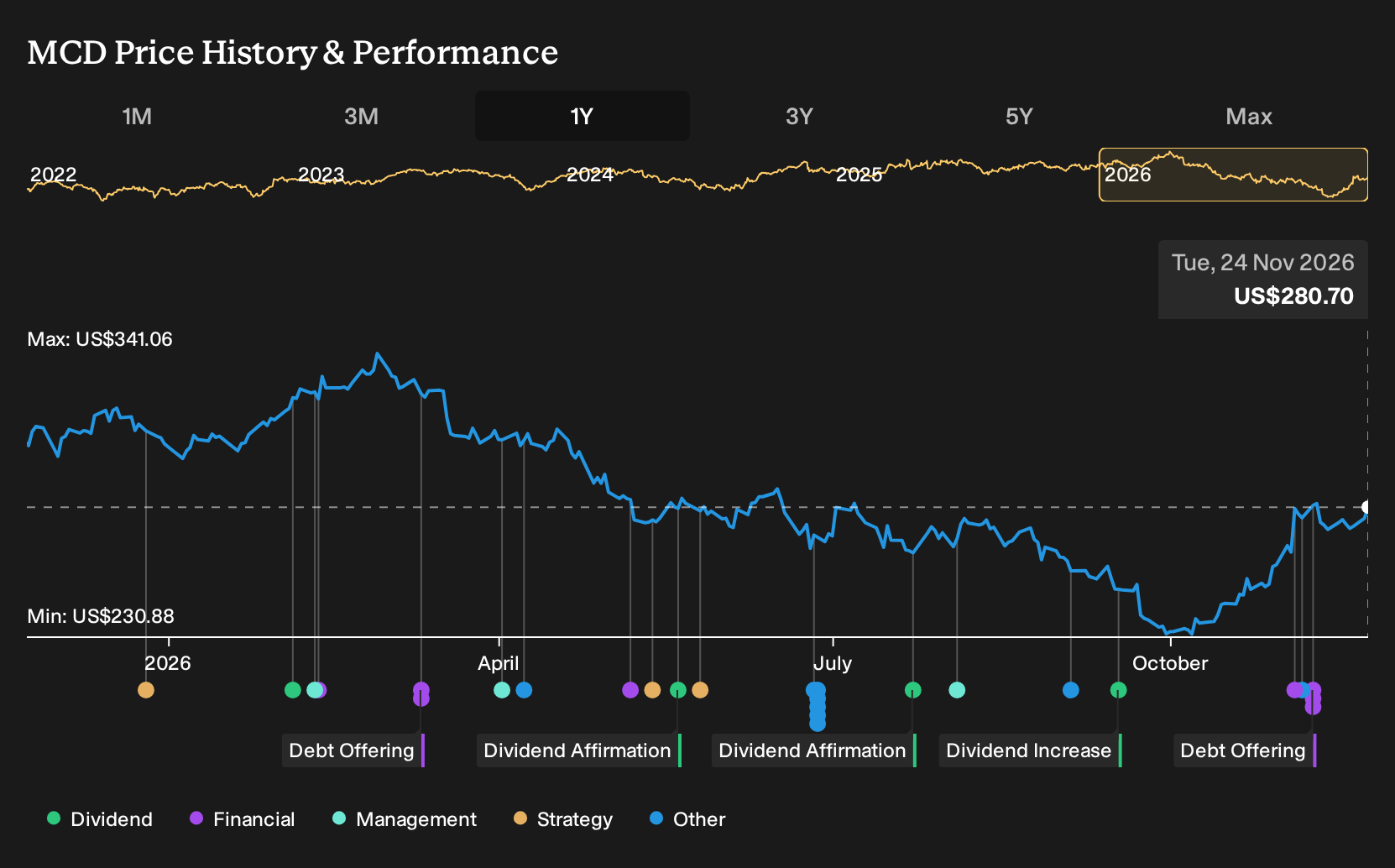
Uncover why McDonald's fair value indicates a 14% potential downside to its current price, leaving little room for error.
Exploring Other Perspectives
Another lens on McDonald's puts the AI pricing lawsuit and digital systems at the center of the risk. The most bearish analysts were already expecting revenue to decline about 3.2% a year and earnings of roughly US$10.0b by 2029 before this news. That is a far tougher story than the base case, so consider both narratives carefully before forming your own view.
Explore 6 other McDonald's fair value estimates, including one that suggests the potential for as much as 23% downside from the current price.
The Verdict Is Yours
Don't just follow the ticker. Dig into the data and build a conviction that's truly your own.
- A great starting point for your McDonald's research is our analysis highlighting 3 key rewards and 1 important warning sign that could impact your investment decision.
- See our latest analysis for McDonald's. The report includes a comprehensive fundamental analysis summarized in a single visual, the Snowflake, making it easy to evaluate McDonald's overall financial health at a glance.
Looking for more McDonald's sized investment ideas?
If the McDonald's story has sharpened your thinking about pricing power, value perception, and balance sheet strength, it can help to compare it with a wider set of companies facing similar pressures. The Simply Wall St Screener lets you quickly filter for businesses that match the mix of quality, financial resilience, or income focus you want to research next.
- For investors who want income upfront and prefer cash flows they can see regularly, review a set of companies offering reliable payouts through a 11 dividend fortresses.
- If capital preservation and stability matter most, focus on resilient businesses with robust finances by scanning a 31 resilient stocks with low risk scores.
- To widen your watchlist beyond widely followed large caps, check a curated 19 high quality undiscovered gems that surface lesser known companies with solid fundamentals.
Have feedback on this article? Concerned about the content? Get in touch with us directly. Alternatively, email editorial-team@simplywallst.com