
What Investors Got Wrong About Zscaler Before The Drop
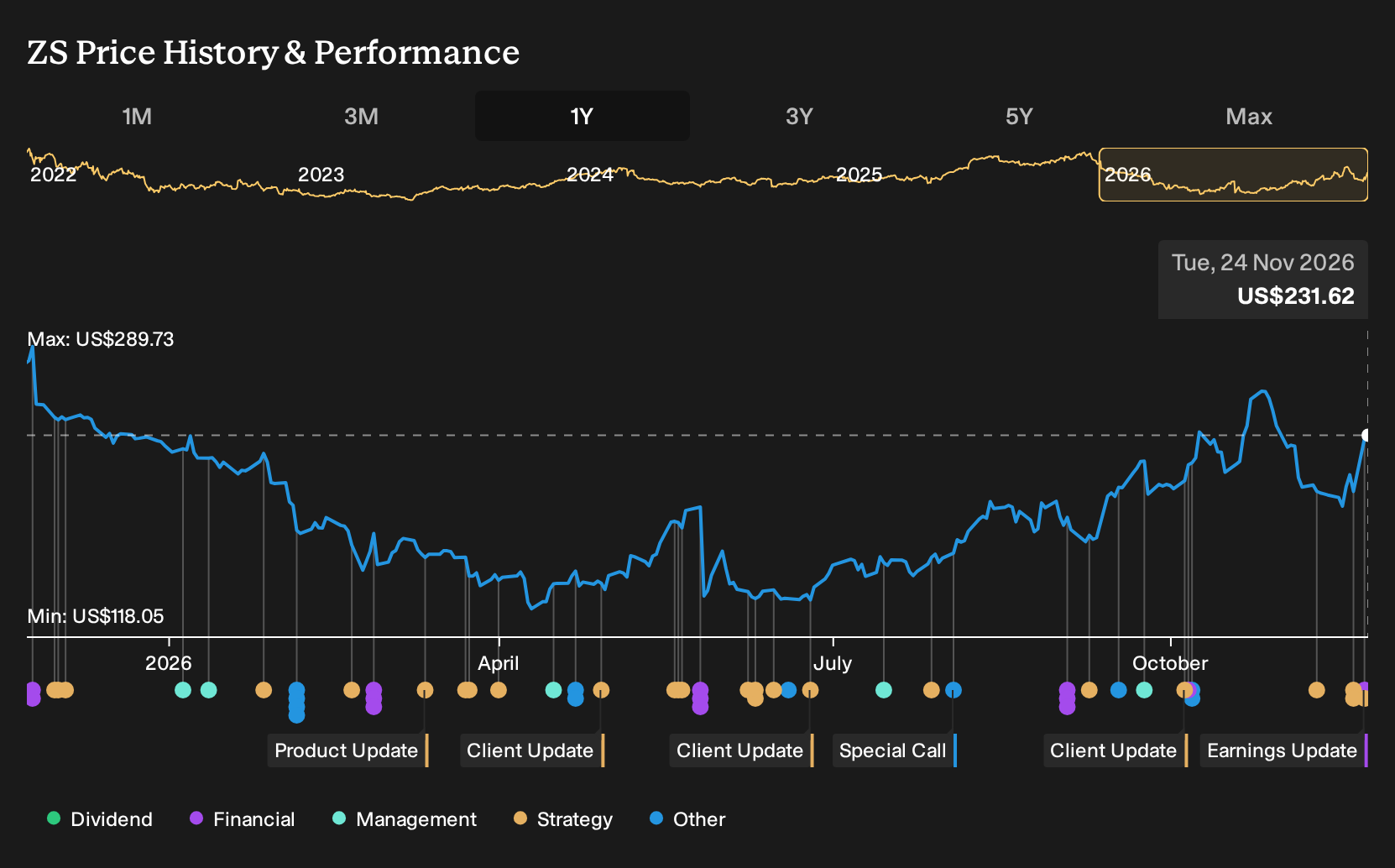
Zscaler’s past year has been anything but quiet, from securities investigations and a 31% one day share slump after cautious 2027 guidance to its eventual removal from the Nasdaq-100. For Zscaler shareholders, the loss over the past year was 20.1%, including dividends. If you had weighed up the bullish November 2025 growth story against the more cautious December 2023 view, how much of that gap between promise and outcome could you reasonably have seen coming?
The move put Zscaler in the middle of this trade. Scan 53 AI infrastructure stocks for other companies exposed to it.
The Two Zscaler Stories Investors Had To Weigh
At the start of this period the Zscaler share price was US$280, which left investors choosing between two sharply different stories about what came next.
The bullish November 2025 narrative saw Zero Trust and AI security opening new markets, with a Fair Value near US$325, a price implied by its assumptions. That view leaned on projected revenue growth of 20.5% a year and an eventual profit margin of 3.0%.
The more cautious December 2023 case argued rising competition from Palo Alto Networks and CrowdStrike justified a Fair Value around US$173. That framework still assumed revenue growth of 18.7% but required a much higher 15.0% profit margin to make the numbers work.
What The Evidence Did To The Zscaler Thesis
Zscaler reaffirmed fiscal 2027 guidance and continued to highlight AI driven Zero Trust security, which supported the bullish focus on new markets. The measured results told a different story. Revenue in Q1 2027 was US$949.3m versus US$788.1m in Q1 2026, while the business still reported a loss and net margin moved from -1.5% to -2.9%. The evidence cut both ways.
The big assumption investors had been paying for was a turn to positive profitability. When you assess another high growth security stock, track whether net margin is actually moving toward the stated target in each set of reported results.
What You Are Paying For In Zscaler Today
Zscaler shares are now US$232, leaving the one year return down 20.1%. The bearish analyst Narrative on Simply Wall St places its Fair Value below the current price, framing today’s quote as already expensive against that cautious set of assumptions.
The Narrative focuses on slower ARR and revenue growth while Zscaler absorbs sales changes and the Red Canary deal. It raises the question of whether a buyer today is assuming that newer AI, data and SecOps offerings will offset any wobble in the mature business, and whether the lower price fully reflects that execution risk.
"The current valuation suggests that Zscaler is priced for very strong long term ARR expansion and margin delivery, which leaves limited room for disappointment if growth or execution slip."
One Narrative has put a figure on that disagreement. → See the Narrative with its lower Fair Value, assumptions and all
One Step Beyond Zscaler
Zscaler asks you to think carefully about security outcomes. The next step is considering who helps customers operate those protections effectively.
Defensive tools only matter if people can use them well. Many enterprises now want AI agents that assist with complex technical work.
One specialist builds AI assistants that support coding, research and daily workflows. Those tools can sit beside security platforms, helping staff respond more quickly.
The interesting angle is how demand for capable AI helpers rises as systems grow more complex. Your question becomes whether that supporting role gains greater importance over time.
It is written up in full, assumptions and all. → Explore the Narrative that puts this company 76% above its price
Have feedback on this article? Concerned about the content? Get in touch with us directly. Alternatively, email editorial-team@simplywallst.com