
PCE and GDP have pieced together a “hot image” of the US economy, and AI transactions continue to be “heated” by expectations of interest rate hikes
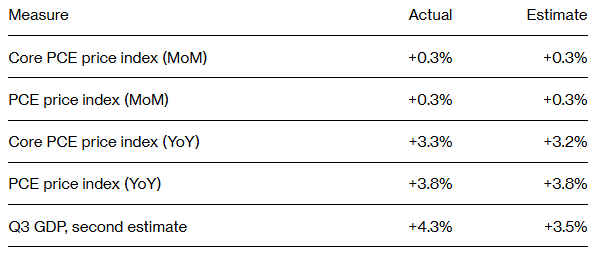
The Zhitong Finance App learned that on Wednesday, the US Bureau of Economic Analysis (BEA) announced the October PCE price index, revised GDP for the third quarter, and personal income expenditure in one go. The Department of Labor released initial unemployment claims on the same day. Overall PCE was 3.8% in line with expectations, but core PCE rushed to 3.3% year over year, 0.1 percentage points higher than consensus, the highest since November 2023; the actual GDP annualized growth rate in the third quarter rose sharply to 4.3% from the initial value of 3.4%. Inflation is stickier and growing more sharply, and there is little doubt about the December rate hike.
Data Implementation: A Report on “Strong Growth, Weak Consumption, and Sticky Inflation”
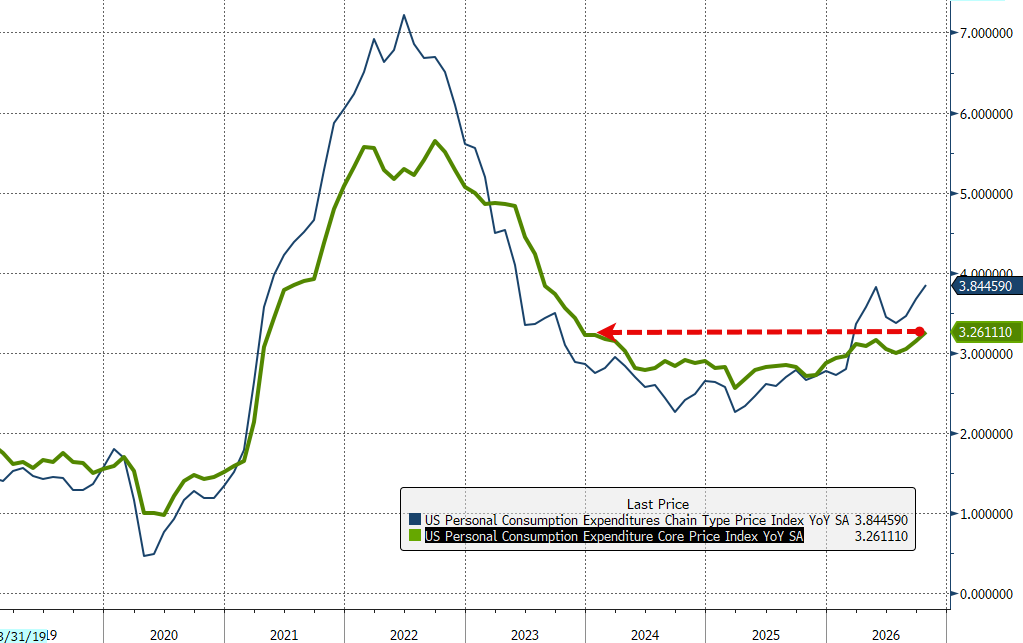
Let's look at inflation first. Overall PCE rose 0.3% month-on-month and 3.8% year-on-year in October, all in line with the Dow Jones survey consensus, almost double the Federal Reserve's 2% target; the previous value in September was revised up from 3.60% to 3.7%; the month-on-month ratio fell to 0.3% from 0.5% in September. What really tightens the market is the core: the core PCE excluding food and energy was 0.3% month-on-month, the same as in September, and in line with expectations, but it rose from 3.1% in September to 3.3%, exceeding the consensus 3.2%, by 0.1 percentage points, the highest since November 2023.
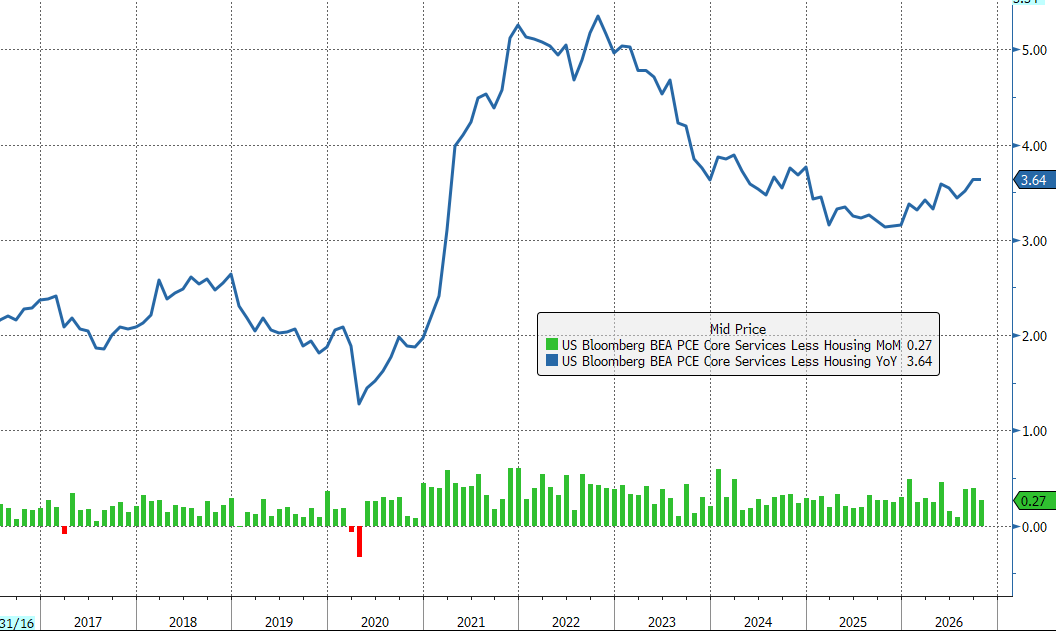
The main reason is that prices jumped again after the US-Israel attack on Iran at the end of February, continued tariff pressure, and strong demand related to AI construction; the St. Louis Federal Reserve's research estimates that about two-thirds of the excess portion of the core PCE can be attributed to supply shocks, but more and more officials are worried that strong demand is “solidifying” the impact that should have subsided, excluding energy and housing service inflation, which still rose 0.3% month-on-month in October.
Looking at growth, this is the most worthwhile layer of upgrading. BEA raised the actual quarterly GDP annualized rate for the third quarter by 0.9 percentage points from the initial value of 3.4% to 4.3%, the fastest in three years. 2.2% in the second quarter. The market previously expected about 3.5%-3.6%. Upgrades mainly come from investment and consumer spending. The investment side is led by intellectual property products, especially software — BEA is clearly attributed to “revisions in price information for system and application software publishers,” which analysts interpret as “enterprise investment is boosted by software spending, which is a sign of large AI-related spending”; the consumer side is a synthesis of product upgrades and service downgrades (pharmaceuticals, computer software and accessories, gasoline, and other energy products, medical drag down services). Private domestic final actual sales, which represents domestic demand, rose 5.8%, 0.9 percentage points higher than the previous estimate, faster than overall GDP; actual GDI rose 4.4%, and the average GDP and GDI were 4.4%; the company's current production profit increased by 206 billion US dollars in the third quarter, down from 384 billion yuan in the second quarter.
The third aspect is consumption, which is also the only weakness. Nominal consumer spending rose 0.3% month-on-month in October, which is exactly the same as the price increase and 0.1 percentage points lower than expected; after excluding inflation, actual personal consumption expenditure had almost zero growth, and households “hit the brakes” before the holiday season. However, the income side is strong: personal income rose 0.7% month-on-month, far exceeding expectations of 0.4%. Actual disposable income rebounded from -0.2% in September to 0.5%, the biggest jump since January. The personal savings rate rose to a three-month high of 4.1%, and the savings scale was about 1 trillion US dollars. At the beginning of the fourth quarter, households cut spending on cars, furniture, restaurants, and hotels. Target's chief product officer Carla Sylvester said on the November 18 earnings call that “busy families are keeping an eye on the budget and making careful calculations” and cut prices for nearly 2,000 products in the third quarter.
Furthermore, the consumption structure is also fragmented — spending is mainly driven by high-income households supported by the wealth effect of the stock market, and before the recent AI-led sell-off, other households relied on historically low layoffs and moderate recruitment, and inflation eroded actual wages. One buffer was gasoline: the national average price fell below $4 per gallon in November, for the first time since July, and consumer confidence improved.
On the same day, employment was on the strong side: the number of jobless claims dropped by 13,000 to 189,000 at the beginning of the week of November 21, far below expectations of 200,000, returning to near the lowest level since the late 1960s. Renewals fell to 1.697 million, and a weekly decrease of 95,000, due to the announcement of Thanksgiving one day earlier. Economists have summed it up as “low recruitment and low layoffs” under full employment, which “cleared the way” for the Federal Reserve to continue to raise interest rates after December. Durable goods orders rose only 0.2% month-on-month in October, far below expectations of 1.1%.
The Federal Reserve raised interest rates by 25 basis points and the battlefield moved to 2027; tariffs on the same day became a new variable
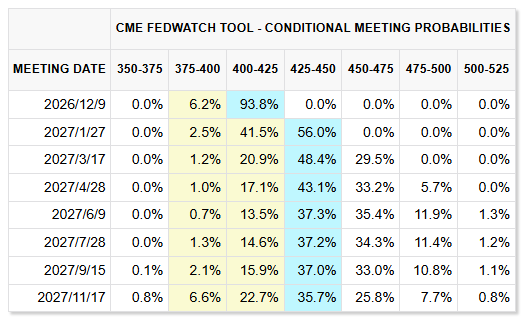
Before and after the data was released, CME FedWatch's pricing of 25 basis points for the December rate hike was completely digested, and the market switched from betting plus or not to betting plus 25 or 50 basis points. The current policy interest rate is 3.75%-4.00%; Director Waller previously stated that if the core remains 0.3% or higher, a one-time interest rate hike of 50 basis points should be considered to suppress inflation; otherwise, “credibility is at risk,” but now the core month-on-month ratio is exactly 0.3%, but this end has not become the main line.
The US economy is showing stronger growth momentum than previously anticipated. Against the backdrop of rising borrowing costs and continued stubborn inflation, this highlights the astonishing resilience of the US economy, and may also leave more room for the Federal Reserve to raise interest rates further.
The “monetary policy does not limit economic activity” narrative was greatly strengthened by 4.3% of GDP, giving the hawks' toughest argument. Goldman Sachs believes that the data supports the December rate hike and January rate hike are still options. The GDP update confirms a soft landing and the risk of recession is falling, but the core PCE is falling slowly and interest rates will remain high for longer; Morgan Stanley summarized the situation as “strong growth, weak consumption, and sticky inflation” to warn against the correction brought about by early market trading; Deutsche Bank is more eagerly judging December, January, and March, adding 25 basis points each for a cumulative total of 100 basis points; then Ackman Warn that financial conditions are tight, Continued interest rate hikes raise the risk of a recession. Chris Rupke, chief economist at Fwdbonds, put it bluntly: “Inflation is too hot, and as long as economic demand is too hot, it can't be suppressed.”
On the same day, there are also taxes that could change the 2027 inflation path. The Office of the United States Trade Representative (USTR) proposed imposing new 15%-20% tariffs on 14 major trading partners, including China, the European Union, and Japan, based on the “Section 301” overcapacity investigation for about eight months. It will take effect as soon as January next year, and publicity and hearings must be completed first. Policymakers usually view tariffs and supply shocks as temporary, but officials are concerned that the effects are spreading and may become entrenched. At the political level, affordability and inflation are the core topics of this round of midterm elections. The Democratic Party won a majority of the House of Representatives and Senate and came into effect in January — tariffs, inflation, and the legislative impasse are intertwined.
AI trading continues to be tested by high interest rates
The 4.3% increase in GDP, mainly due to investment in software and intellectual property products, is directly interpreted as “large AI-related expenses” in market narratives; however, it is AI stocks that are leading the recent decline. While AI capital expenditure adds fuel to growth and inflation, it also takes away its own valuation support due to expectations of interest rate hikes — “AI is both a driver of inflation and a closed loop of inflation-sensitive assets.”
This round of AI boom is a structural redistribution within the economy rather than inclusive growth. Capital and labor continue to concentrate computing power and squeeze traditional industries; Goldman Sachs also suggests that AI equipment imports will offset some domestic growth. Once capital spending on computing power slows down, this pillar of growth will loosen — and this is what the interest rate path most wants to hold down, and is afraid to collapse.
On Tuesday, SoftBank's five-year CDS spread soared to 501 basis points, with Oracle, Alphabet, SpaceX and CoreWeave set a record, with CoreWeave 1,314 basis points in the difficult range; Franco-strategist Manish Kabra pointed out that when VIX rose above 30, the volatility peaked at about 80%. The S&P 500 rose by an average of 22% over the next 12 months, and the probability of an increase of 87%, but the credit spread has not expanded uncontrolled, and the valuation was reduced by about 30% After that, it will still be necessary for the Federal Reserve to release policy signals to trigger a full revaluation. This also explains why “the rate hike in December is locked in, and the probability of a third rate hike in 2027 is instead lowered” — the market interprets austerity as a short move bound by credit conditions rather than an endless cycle of interest rate hikes.
Binky Chadha, chief US stock strategist at Deutsche Bank, anticipates that strong earnings and expansion of recovery will push the S&P 500 to 9,000 points by the end of 2027, the highest mainstream target price on Wall Street. He believes that the sell-off of technology stocks is only a temporary shock that will take six to eight weeks to digest; Rupki's phrase “demand is too hot to be suppressed” represents the other side.
The 50 basis point rate hike debate has not been restarted, but the breathing window for AI hardware hasn't opened — because it's not the interest rate path itself that is holding down the market this time, but the self-deleveraging of tariffs and AI transactions. Tonight's data answered the 25 basis points in December, but left the number of interest rate hikes in 2027, the extent of implementation of tariffs, and the sustainability of AI capital expenditure together as questions to be solved this winter.