
Smoke Free Growth Could Be A Key Test For Philip Morris Stock
- Philip Morris International is leaning further into its smoke free shift as IQOS, ZYN, and VEEV contribute more meaningfully to net revenue and profitability, while a completed US$2b cost saving program reshapes the expense base.
- State Street’s Consumer Staples Select Sector SPDR ETF recently raised its Philip Morris International holding to 5.74% of the fund, which highlights how large pooled capital is responding to the company’s mix shift toward smoke free products and heavier U.S. investment.
- The next area of focus will be how Philip Morris International’s smoke free momentum and ETF accumulation could influence the broader investment narrative.
Philip Morris International Investment Narrative Recap
To own Philip Morris International, you need to buy into a smoke free transition in which IQOS, ZYN, and VEEV gradually matter more than traditional cigarettes, while a completed US$2b cost program supports earnings quality. According to LunaRodas, an investor in the Simply Wall St Community, the appeal is tied to earnings growth, high quality profits, and a 3.47% dividend yield.
The short term catalyst is execution in smoke free products after a third quarter where net revenues rose and net profit margins reached 24.8%. The key operational risk is the high level of debt and reliance on external borrowing, which could matter more if U.S. investments keep U.S. income around breakeven for a while.
The piece of news most closely tied to these catalysts is State Street’s XLP lifting Philip Morris International to 5.74% of the ETF. That move reflects how a large pool of capital is aligning with a business mix that is gradually leaning toward smoke free lines and heavier U.S. spending.
LunaRodas argues that ZYN’s recent U.S. progress, the faster earnings growth of 24.2% over the past year, and completion of the US$2b cost savings plan help support that thesis, even as IQOS ILUMA and ZYN modified risk labeling remain quieter in recent commentary. Those silences keep regulatory and product rollout timing firmly on the risk list for anyone watching near term catalysts.
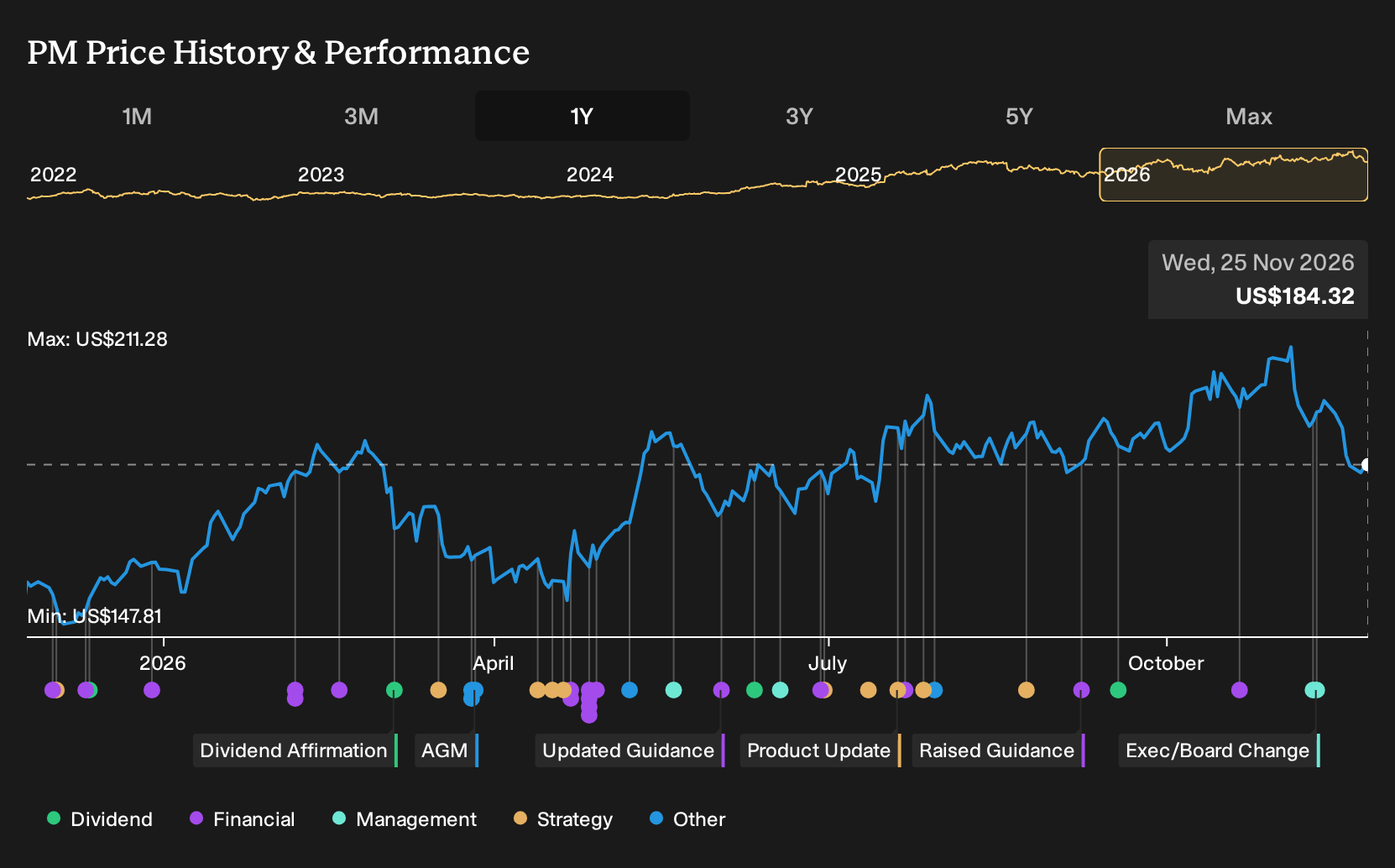
LunaRodas sets a fair value of US$188.78 for Philip Morris International, based on the view that record EPS of US$2.36, ZYN’s stronger U.S. traction, and the completed US$2b cost savings program collectively support higher earnings quality and a richer valuation multiple for the group over time.
Uncover why Philip Morris International's fair value indicates that the stock is in line with its current price.
Exploring Other Perspectives
Some of the lowest analysts fixate on regulation risk for Philip Morris International. They warn that tighter rules on oral nicotine or heat not burn products could leave revenue closer to about US$48.7b and earnings near US$15.3b by 2029, which they saw as a stretched case even before the latest ETF buying. That more cautious read shows how far opinions can diverge, so it may be worth exploring both the upbeat and the hesitant forecasts before deciding which story you think might evolve from here.
Explore 4 other Philip Morris International fair value estimates, including one that suggests it could be worth just $188.78.
Decide For Yourself
Don't just follow the ticker. Dig into the data and build a conviction that's truly your own.
- A great starting point for your Philip Morris International research is our analysis highlighting 4 key rewards and 1 important warning sign that could impact your investment decision.
- See our latest analysis for Philip Morris International. The report includes a comprehensive fundamental analysis summarized in a single visual, the Snowflake, making it easy to evaluate Philip Morris International's overall financial health at a glance.
Looking for more Philip Morris International sized ideas?
Once you have a handle on Philip Morris International, it can help to line it up against other opportunities that share some of the same qualities, whether that is income potential, balance sheet strength, or a mix of quality and value.
- For investors who want dependable income streams, check out a curated set of higher yielding candidates through the 11 dividend fortresses.
- If capital preservation sits high on your list, filter for companies with steadier risk profiles using the 31 resilient stocks with low risk scores.
- When you want sturdier fundamentals alongside healthy cash positions, start with a list of solid balance sheet and fundamentals (23 results) to see which businesses currently clear that bar.
Have feedback on this article? Concerned about the content? Get in touch with us directly. Alternatively, email editorial-team@simplywallst.com