
This Dividend Stock Yields 5% and Trades Near 52-Week Lows. Buy It for 2027 and Beyond.
Ford (F) stock has whipsawed this year. Shares peaked in May amid the optimism over its energy storage business which, among other things, is a play on soaring energy demand from data centers. However, as I noted around that time, Ford stock’s rally wasn’t sustainable. Weakness in the artificial intelligence (AI) trade and the recent broader market selloff pushed F stock to a 52-week low of $11.05 last week.
Ford has since recovered slightly from its 2026 lows but is still down more than 9% for the year. Given the inverse relationship between dividend yield and stock price, Ford’s dividend yield has climbed to over 5%.
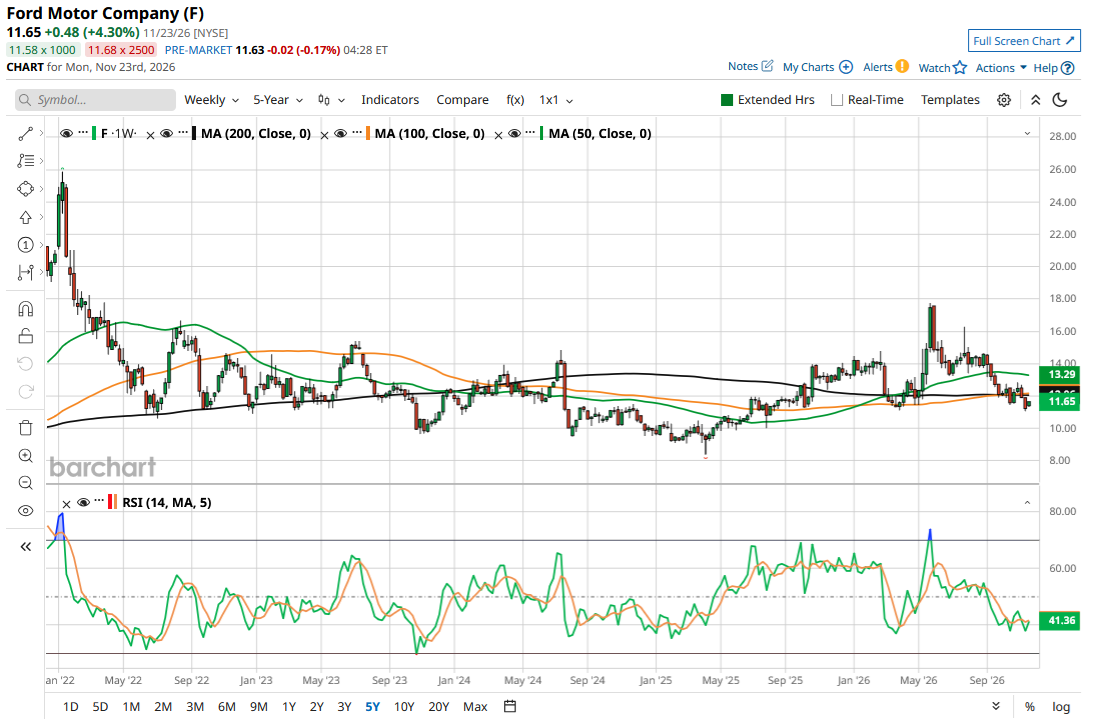
Ford’s Dividend Yield Is Over 5%
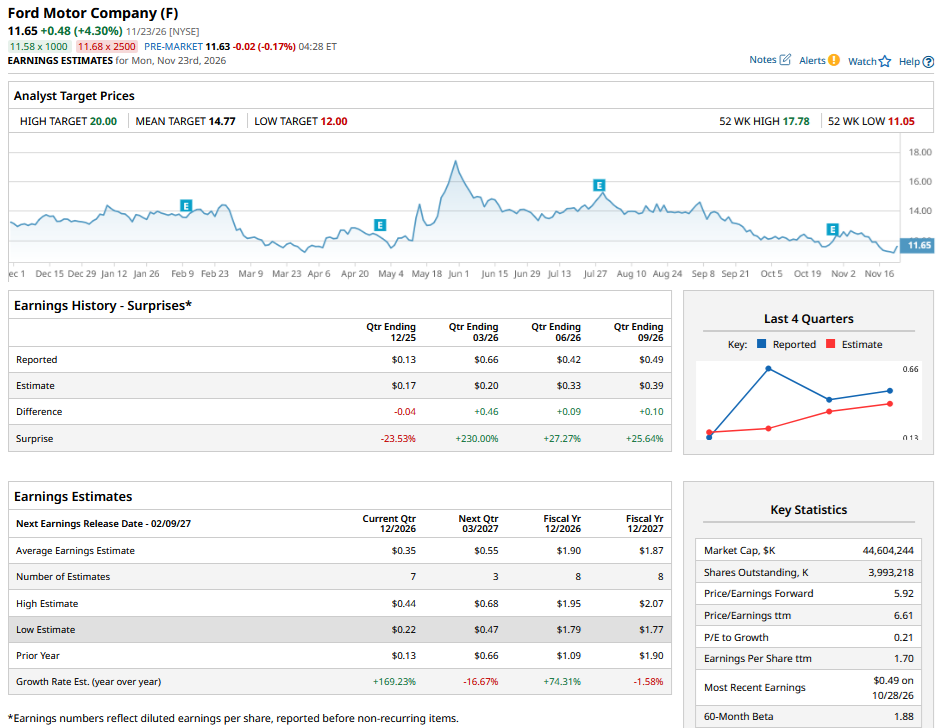
While dividend yield is a function of both the per-share dividend (numerator) and the stock price (denominator), in Ford’s case only the price action has been moving the yield, as the quarterly dividend has been static since July 2022. Investors shouldn’t expect a dividend hike anytime soon, particularly since the company expects next year’s profits to be similar to 2026.
Ford has a well-defined dividend policy and intends to pay between 40% and 50% of its free cash flow as dividends. In recent years, we’ve seen it top up the regular dividends with special dividends to reach that target. However, current earnings leave little scope for special dividends, and investors will have to contend with the $0.15 quarterly dividend. Still, a dividend yield of more than 5% places Ford among the highest-yielding stocks in the S&P 500 ($SPX). Moreover, its dividend policy is a lot more generous than other legacy automakers.
While Ford’s fat dividend yield is appealing, investors should also be watchful of its price movement. The performance has been dismal at best, with the stock falling 37% over the last five years. In August, I noted that while the analyst community was turning bullish on Ford, I wouldn’t jump to buy shares. With F stock now down sharply from those levels, largely because of the market meltdown, let’s explore whether it is a dividend stock worth buying for 2027.
Ford's 2027 Outlook
Ford faces several headwinds and tailwinds heading into 2027. On the positive side, the Novelis fire incident is now behind Ford, and hopefully so are tariff-related issues. Its auto business is resilient, while the revenue share from its high-margin software and services business continues to rise. Ford has lowered warranty and material costs, which is a structural tailwind for its profits. However, the company expects higher commodity, memory, and logistics costs to be a headwind to the tune of $2 billion next year.
Looking at the product portfolio, Ford should start accepting pre-orders for its Fathom electric pickup early next year and expects to commence deliveries by the end of 2027. The Fathom would be the first product based on the company’s Universal Electric Vehicle (UEV) platform, which Ford CEO Jim Farley touted as the company’s next “Model T” moment.
Farley termed 2027 a “foundational year” as Ford strives toward its goal of an 8% adjusted earnings before interest and taxes (EBIT) margin by 2029. The company expects its Model e segment, which produces electric vehicles (EVs), to achieve breakeven by 2029. The segment’s losses have come off their highs, but Model e still lost more than $1 billion in the most recent quarter. Meanwhile, Ford’s energy storage business is set to gradually ramp up. Coupled with the UEV platform, that should help buoy profitability in 2028 and 2029 as well as help the company hit its 8% target.
I believe Ford is more of a 2028 and 2029 story, when the UEV platform and energy business will start contributing meaningfully to its earnings. From a valuation perspective, though, Ford’s forward price-to-earnings (P/E) multiple has now fallen below 6 times, which I see as a good entry point. Overall, Ford stock can fit into the portfolios of dividend investors given the high yield and the potential for decent appreciation over the next couple of years.
On the date of publication, Mohit Oberoi had a position in: F . All information and data in this article is solely for informational purposes. For more information please view the Barchart Disclosure Policy here.