
Ministry of Industry and Information Technology: Telecom business revenue totaled 1.43 trillion yuan in the first 10 months, down 2.6% year on year
The Zhitong Finance App learned that on November 27, the Ministry of Industry and Information Technology announced the economic performance of the communications industry for the first 10 months of 2026. For the first 10 months, the communications industry was generally running smoothly. The total volume of telecommunications services is growing steadily, mobile Internet access traffic continues to grow rapidly, and construction of new infrastructure such as 5G, gigabit, and the Internet of Things continues to advance. In the first 10 months, telecom business revenue totaled 1.43 trillion yuan, a year-on-year decrease of 2.6%. The total telecom business volume, calculated at constant prices for the previous year, increased 7.2% year over year.
The original text is as follows:
The economic performance of the communications industry in the first 10 months of 2026
For the first 10 months, the communications industry was generally running smoothly. The total volume of telecommunications services is growing steadily, mobile Internet access traffic continues to grow rapidly, and construction of new infrastructure such as 5G, gigabit, and the Internet of Things continues to advance.
I. Overall operation
In the first 10 months, telecom business revenue totaled 1.43 trillion yuan, a year-on-year decrease of 2.6%. The total telecom business volume, calculated at constant prices for the previous year, increased 7.2% year over year.
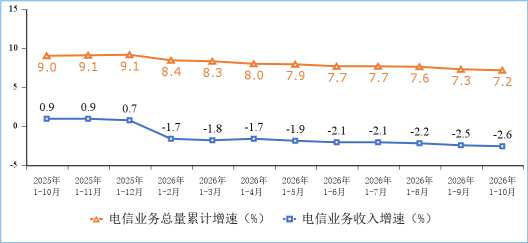
Figure 1. Cumulative growth rate of telecom business revenue and total telecom business volume
II. Development of telecom users
The number of fixed broadband access users is growing steadily, and the number of gigabit users continues to increase. By the end of October, the three basic telecom companies had 710 million fixed Internet broadband access users, a net increase of 19.51 million over the end of the previous year. Among them, fixed Internet broadband access users with an access rate of 100 Mbps and above reached 679 million, accounting for 95.6% of the total number of users; the number of fixed Internet broadband access users with an access rate of 1000 Mbps and above reached 267 million, a net increase of 28.69 million over the end of the previous year, accounting for 37.6% of the total number of users, an increase of 3.1 percentage points compared to the end of the previous year.
The number of mobile phone users is growing steadily, and the number of 5G users is increasing rapidly. By the end of October, the three basic telecom companies and China Radio and Television had reached 1,854 billion mobile phone users, a net increase of 26.7 million over the end of the previous year. Among them, 5G mobile phone users reached 1,326 million, a net increase of 122 million over the end of the previous year, accounting for 71.6% of mobile phone users.
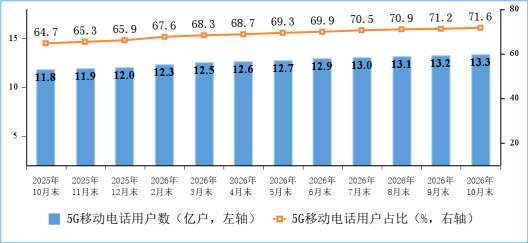
Figure 2 5G mobile phone user situation
Mobile IoT end users are growing rapidly. By the end of October, the three basic telecom companies had developed 3.118 billion mobile IoT end users, a net increase of 230 million over the end of the previous year. The number of Internet TV (IPTV, OTT) users reached 406 million, a decrease of 1.715 million compared to the end of the previous year.
III. Telecom service usage
The cumulative mobile Internet access traffic grew rapidly, and the DOU value reached a record high in October. In the first 10 months, the cumulative mobile Internet access traffic reached 377.7 billion GB, an increase of 16.8% over the previous year. By the end of October, the number of mobile Internet users reached 1.64 billion, a net increase of 29.9 million over the end of the previous year. In October, the average household mobile Internet access traffic (DOU) reached 25.28 GB/ (household/month), an increase of 13.8% year-on-year, and 2.24 GB/ (household/month) higher than at the end of the previous year.
Telephone calls continued to decline. In the first 10 months, mobile phone inbound call time was 1.57 trillion minutes, a year-on-year decrease of 7.2%; landline callers completed 46.61 billion minutes, a year-on-year decrease of 16.8%. In the first 10 months, the national mobile SMS business volume fell 11.6% year on year; mobile SMS business revenue fell 11.9% year on year.
IV. Status of communication capabilities
The construction of gigabit fiber broadband networks is progressing in an orderly manner. By the end of October, the number of Internet broadband access ports nationwide reached 1,275 billion, a net increase of 23.98 million over the end of the previous year. Among them, the number of optical fiber access (FTTH/O) ports reached 1,234 million, a net increase of 23.2 million over the end of the previous year, accounting for 96.8% of the number of Internet broadband access ports. By the end of October, the number of 10G PON ports with gigabit network service capabilities reached 33.63 million, a net increase of 2.09,000 over the end of the previous year.
The construction of 5G networks continues to deepen. By the end of October, the number of 5G base stations reached 5.281,000, showing a continuous growth trend, accounting for 40.6% of the number of mobile base stations, an increase of 0.6 percentage points compared to the previous three quarters.
5. Regional developments
All regions are speeding up the penetration of gigabit and 5G users. By the end of October, the penetration rates of fixed broadband access users of 1000 Mbps and above in the East, Central, West and Northeast regions were 36.9%, 38.3%, 38.9%, and 33.6%, respectively, up 2.3, 4.4, 2.8 and 4.6 percentage points from the end of the previous year; 5G mobile phone user penetration rates were 70.9%, 72.3%, 71.6%, and 72.4%, respectively, up 5.4, 5.8, 5.7 and 5.9 percentage points from the end of the previous year.
Mobile Internet access traffic in all regions maintained double-digit growth. In the first 10 months, mobile Internet access traffic in the East, Central, West and Northeast regions reached 160.4 billion GB, 87.54 billion GB, 107.1 billion GB, and 22.58 billion GB respectively, up 18.2%, 15%, 16.3%, and 16.8%, respectively.
This article was selected from the “Ministry of Industry and Information Technology” official website, Zhitong Finance Editor: Feng Qiuyi.