
Berkshire Hathaway (BRK.A) Following Its Japan Bond Sale Is The Stock Fully Valued
Berkshire Hathaway (BRK.A) has just raised JPY 182,005 million through a multi tranche issue of senior unsecured notes in Japan, giving investors fresh information on its funding mix and balance sheet flexibility.
Recent trading backs up this funding move. Berkshire Hathaway’s 1 month share price return of 7.17% and 90 day share price return of 14.80% point to building momentum, while the 3 year total shareholder return of 60.42% and 5 year total shareholder return of 107.83% show how longer term holders have been rewarded.
Scan how Berkshire Hathaway’s funding move compares with other balance sheet focused opportunities by running through the hand picked list of solid balance sheet and fundamentals (23 results).
Berkshire Hathaway now trades below both analyst targets and an intrinsic value estimate that screens higher, even as fresh yen funding underlines its firepower. Is that discount caution or mispricing as the valuation work begins next?
Most Popular Narrative: 7% Overvalued
Berkshire Hathaway last closed at $870,150, while the analyst consensus Narrative on Simply Wall St sets fair value at $816,101, using a 7.47% discount rate and detailed earnings and revenue assumptions to frame that 7% premium.
The main condition for this view is that Berkshire Hathaway’s post Buffett leadership under Greg Abel and Howard Buffett maintains the existing culture, capital allocation discipline and measured approach to opportunities such as AI related power demand and global insurance expansion.
See why 15 investors see Berkshire Hathaway as 7% overvalued.
Result: Fair Value of $816,101 (OVERVALUED)
Still, if Berkshire Hathaway’s leadership transition unsettles confidence, or AI related power projects face stronger pushback, the 7% valuation premium could quickly look fragile.
Find out about the key risks to this Berkshire Hathaway narrative.
Another View On Berkshire Hathaway’s Valuation
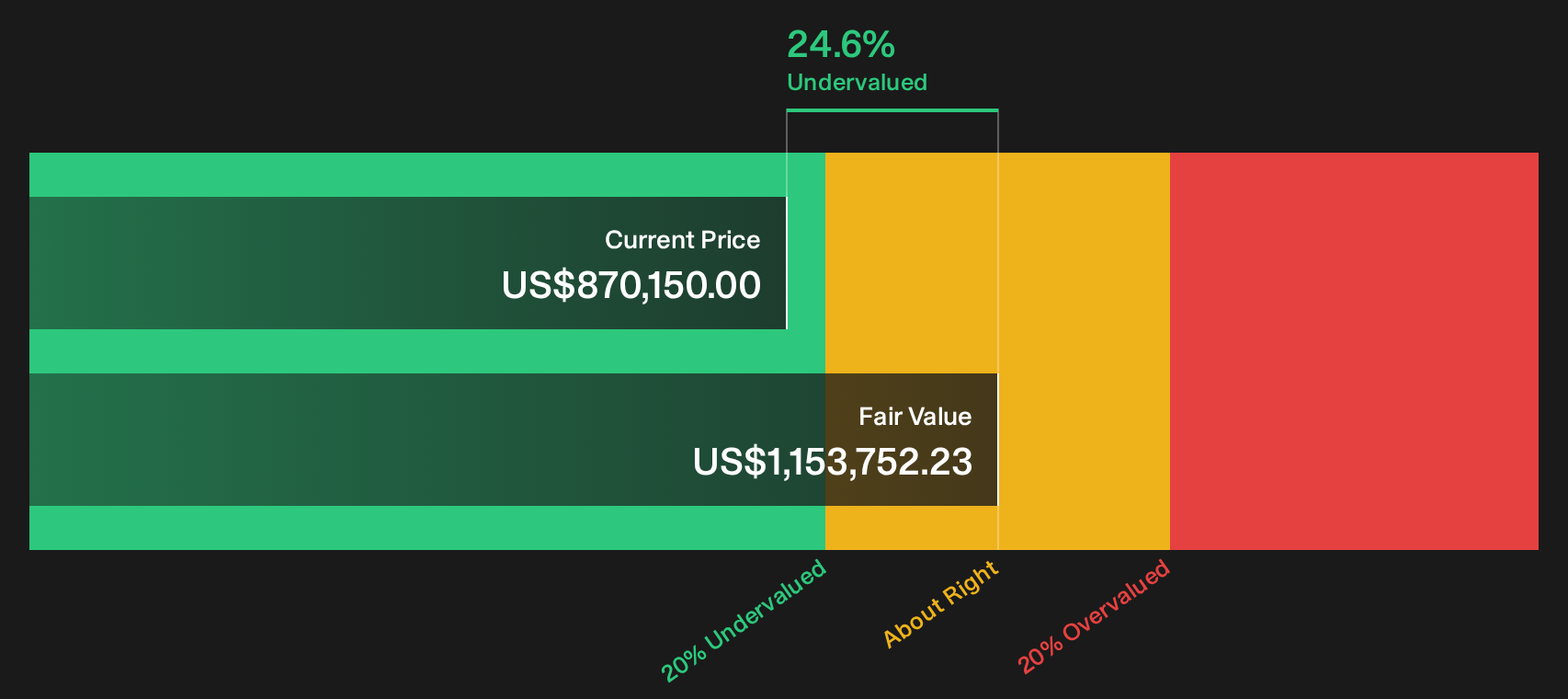
The earlier narrative framed Berkshire Hathaway as about 7% overvalued using analyst targets and earnings forecasts. A different lens tells another story. Simply Wall St’s DCF model puts fair value near $1.15b per share, which places the current $870,150 price at a sizeable discount. That raises a simple question for investors: Which set of assumptions feels more realistic to you?
Look into how the SWS DCF model arrives at its fair value.
Next Steps
If the split between DCF and narrative views on Berkshire Hathaway leaves you torn, that tension is exactly where good research starts. Move quickly, review the full picture for yourself, then weigh up the 2 key rewards and 1 important warning sign.
Ready for more Berkshire Hathaway style ideas?
If Berkshire Hathaway sharpened your thinking, do not stop here. Use the Simply Wall St screener to uncover fresh, data driven opportunities built on clear fundamentals.
- Target resilient compounding potential by reviewing the 37 high quality undervalued stocks that combine quality metrics with pricing that still leaves room for upside.
- Secure stronger income streams by scanning the 39 dividend fortresses that focus on higher yields backed by underlying financial strength.
- Protect your downside by filtering for the 30 resilient stocks with low risk scores that prioritise balance sheet resilience and lower overall risk scores.
Have feedback on this article? Concerned about the content? Get in touch with us directly. Alternatively, email editorial-team@simplywallst.com