
Is Merck Stock Outperforming the Dow?
Founded in 1891, Merck & Co., Inc. (MRK) is a global healthcare and pharmaceutical powerhouse headquartered in Rahway, New Jersey. The company is dedicated to discovering, developing, manufacturing, and commercializing innovative medicines and vaccines that address some of the world's most challenging health conditions. Its extensive portfolio spans oncology, infectious diseases, cardiovascular health, immunology, diabetes, and animal health.
Merck is particularly renowned for its blockbuster cancer immunotherapy Keytruda, alongside a broad range of vaccines, prescription medicines, and veterinary healthcare products. Presently commanding a market capitalization of approximately $345.85 billion, Merck comfortably ranks among the market’s mega-cap stocks, a category reserved for companies valued at $200 billion or more. With a strong emphasis on scientific research and innovation, Merck continues to advance treatments and preventive healthcare solutions for patients and animals across the globe.
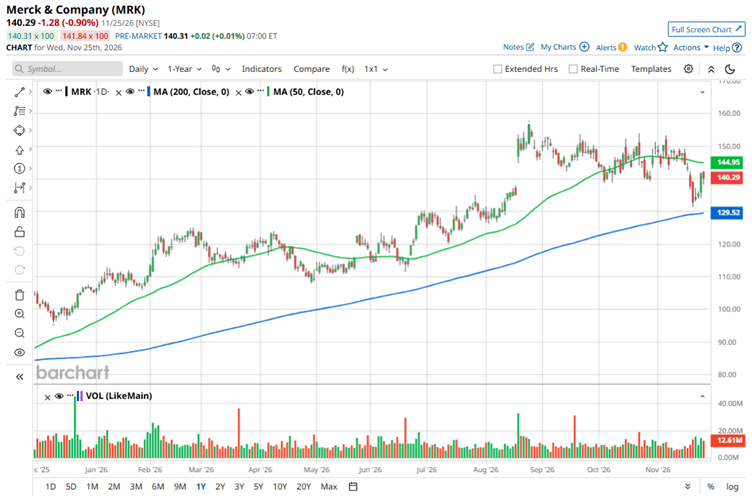
Merck’s stock has experienced some near-term weakness after an impressive rally, retreating approximately 10.6% from its 52-week high of $156.92, reached in August. The recent pullback has also weighed on its short-term performance, with shares declining 10.3% over the past three months, underperforming the Dow Jones Industrial Average ($DOWI), which slipped 6.3% over the same period.
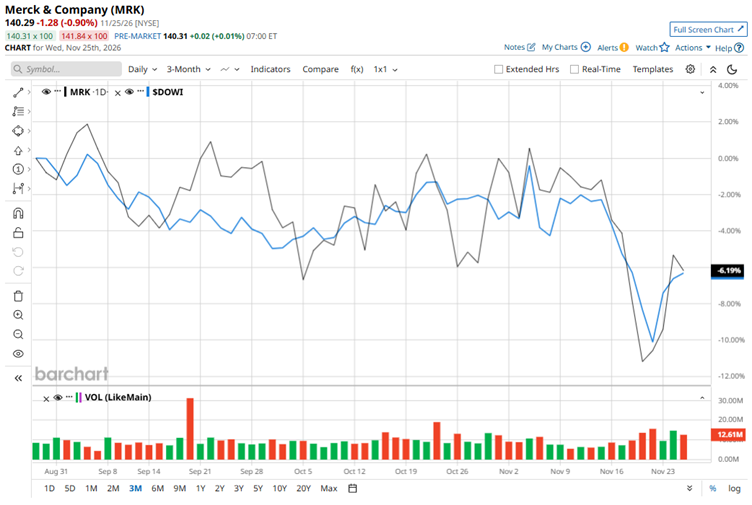
However, the longer-term picture tells a considerably brighter story. Despite the recent correction, Merck has delivered impressive gains of 32.8% over the past 12 months and 33.3% so far in 2026, comfortably outperforming the broader market. By comparison, the Dow Jones Industrial Average has advanced just 6.5% over the past year and 4.4% year to date.
Merck’s technical outlook remains broadly positive, with the stock maintaining a position above its 200-day moving average since last year, reflecting a sustained longer-term uptrend. However, the recent momentum has shown signs of weakening. After trading above its 50-day moving average for much of this period, MRK slipped below this key technical level around mid-November, signaling mounting near-term selling pressure and a potential pause in its otherwise strong rally.
It has been a particularly strong year for Merck, with its stock performance kept afloat largely by the continued strength of its blockbuster cancer drug Keytruda and renewed investor confidence in the company's efforts to extend the drug's commercial life. However, the pharmaceutical giant continues to face a significant long-term challenge: the looming patent expiration of Keytruda in 2028.
Despite the drug's remarkable commercial success, investors have increasingly questioned where Merck's next phase of growth will come from once competing manufacturers gain access to the market following the loss of exclusivity. To address this looming patent cliff, Merck is looking to extend Keytruda's commercial life through innovation.
The company has introduced Keytruda Qlex, a subcutaneous formulation that allows the drug to be administered as an injection under the skin rather than through the traditional intravenous infusion. The new formulation has helped bolster investor confidence by offering a potential pathway to preserve Keytruda's revenue contribution even after the original formulation loses patent protection.
Merck has also held its ground against key competitors in the fiercely competitive pharmaceutical industry, outperforming Bristol Myers Squibb (BMY) over the past year. While Bristol Myers Squibb has delivered a respectable performance, with its shares climbing 25.5% over the past 12 months and 14.1% so far in 2026, Merck has posted even stronger gains over both periods.
Wall Street analysts remain upbeat about Merck’s growth prospects, with the stock carrying a consensus “Moderate Buy” rating from the 28 analysts covering it. Reinforcing this positive outlook, the Street’s average price target of $162.33 suggests potential upside of approximately 15.7% from current levels.
On the date of publication, Anushka Mukherji did not directly have a position in any of the securities mentioned in this article. All information and data in this article is solely for informational purposes. For more information please view the Barchart Disclosure Policy here.