
Bank of America Stock: Is BAC Underperforming the Financial Sector?
Bank of America Corporation (BAC) is one of the world’s leading financial institutions, offering a broad range of banking, investment, wealth management, and financial services to individuals, businesses, and corporations. The bank serves more than 69 million clients across the United States through approximately 3,500 financial centers and 15,000 ATMs, complemented by an award-winning digital banking platform with around 60 million verified users. It is also a global leader in corporate and investment banking, wealth management, and trading.
Presently commanding a market capitalization of approximately $334.94 billion, Bank of America comfortably ranks among the market’s mega-cap stocks, a category reserved for companies valued at $200 billion or more. With operations spanning all 50 states, U.S. territories, and more than 35 countries and jurisdictions, Bank of America maintains an extensive global footprint and a diversified presence across the financial services industry.
Bank of America’s recent stock performance has come under considerable pressure, with shares retreating 24.3% from their 52-week high of $65.22, reached in August. The weakness has also been evident in the near term, as the stock has fallen 19.3% over the past three months, significantly underperforming the State Street Financial Select Sector SPDR ETF (XLF), which has declined just 1.4% over the same period.
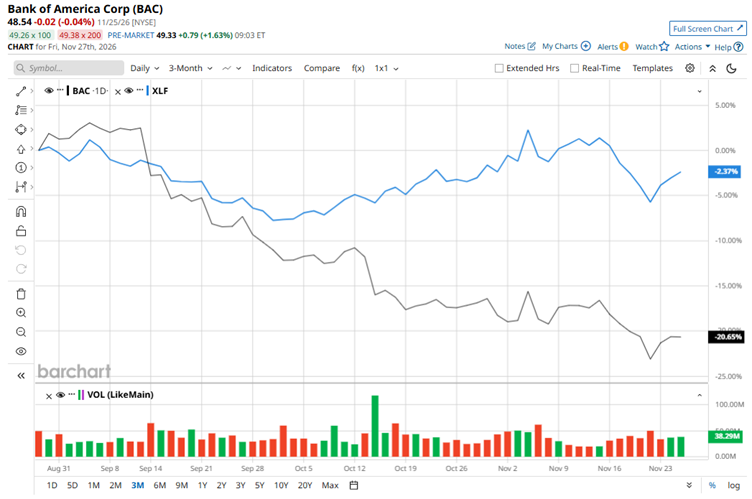
The broader performance picture is equally disappointing. Bank of America shares have lost 6.8% over the past year and are down another 10.2% in 2026. In contrast, XLF has delivered gains of 7.8% over the past year and 4.3% so far in 2026, highlighting the bank’s recent underperformance relative to the broader financial sector.
The stock’s technical weakness has persisted, with shares trading below their 50-day moving average since mid-September and slipping beneath the 200-day moving average toward the end of the month, signaling sustained downward momentum.
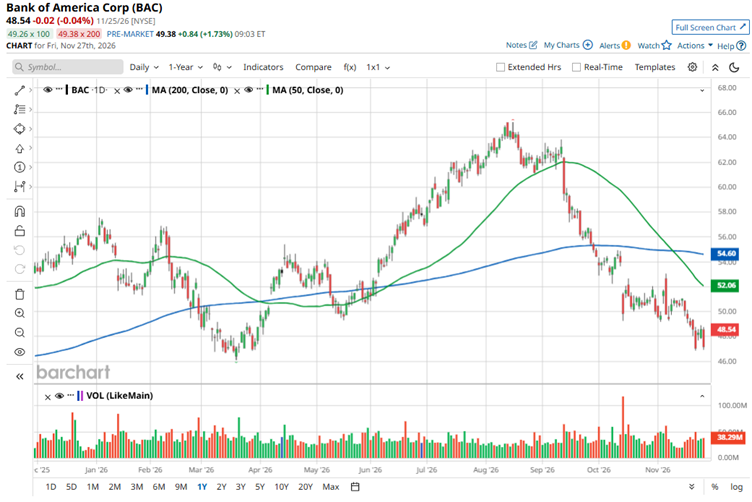
On Nov.25, Bank of America’s shares were swept up in a broader Wall Street sell-off, as mounting concerns over AI valuations, renewed U.S. tariff threats, and hotter-than-expected inflation data rattled investor sentiment ahead of Thanksgiving. Adding to the pressure, the bank’s latest quarterly results fell short of expectations, with EPS of $1.08 missing the $1.10 estimate and revenue of $29.96 billion coming in below the $30.58 billion forecast, despite posting 3.2% year-over-year growth.
Bank of America has also lagged behind some of its major banking peers, including Citigroup Inc. (C), whose shares have climbed 13.2% over the past year despite edging marginally lower in 2026.
Despite Bank of America’s recent share price weakness, Wall Street remains optimistic about the stock’s recovery potential. The stock carries a consensus “Strong Buy” rating from the 27 analysts covering it, underscoring confidence in the bank’s longer-term prospects. Further reinforcing this bullish outlook, the average price target of $62.21 points to a potential upside of approximately 28.2% from current levels.
On the date of publication, Anushka Mukherji did not directly have a position in any of the securities mentioned in this article. All information and data in this article is solely for informational purposes. For more information please view the Barchart Disclosure Policy here.