
Why is Bitcoin Disappointing?
I asked if Bitcoin was heading for another record high in an October 27, 2026, Barchart article, and I concluded with the following:
I am cautiously bullish on Bitcoin at the current price levels, but the potential for extreme volatility remains high. A risk-off period in markets could send prices lower, but a continuation of the current trend since the recent lows could lead to another in a long series of explosive rallies. A plan that includes tight stops, favorable risk-reward dynamics, and the understanding that accepting small losses in pursuit of significant gains could be optimal over the coming weeks and months.
Bitcoin traded at $80,176.67 on October 26, and the price has dropped below $60,000 in November as the rally stalled, and any new high in Bitcoin will have to wait until 2027.
Bitcoin is choppy and has failed three times in 2026
Bitcoin is highly volatile and traded in a wide range, from $57,208.17 to $97,764.04 per token, in 2026.
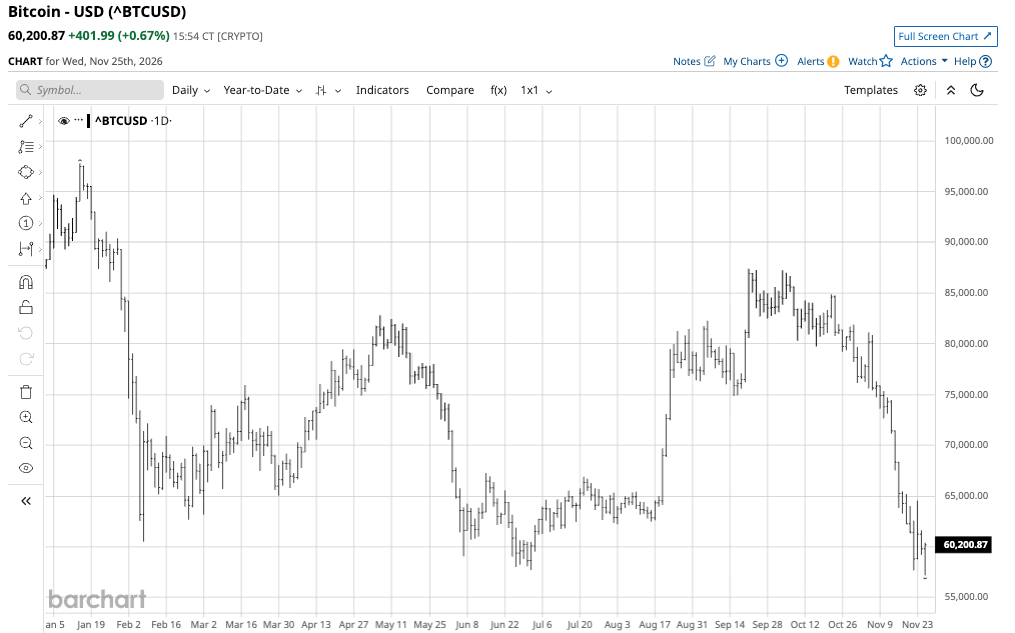
The daily year-to-date Bitcoin in U.S. dollars chart shows that the high occurred in mid-January and the low in late November. The midpoint of the 2026 trading range is 77,740.80 per token, and the price was well below that on November 25, the day Bitcoin reached a new low for 2026. Bitcoin reached three highs in mid-January, a lower high in early May, and a higher high than in May in late September 2026. Each rally attempt failed as the leading cryptocurrency lost upward momentum and fell to a new 2026 low in late November.
The price action in COIN shares is bearish
While Bitcoin’s 2026 price action has been choppy, the trend in Coinbase Global (COIN) shares is clearly bearish.
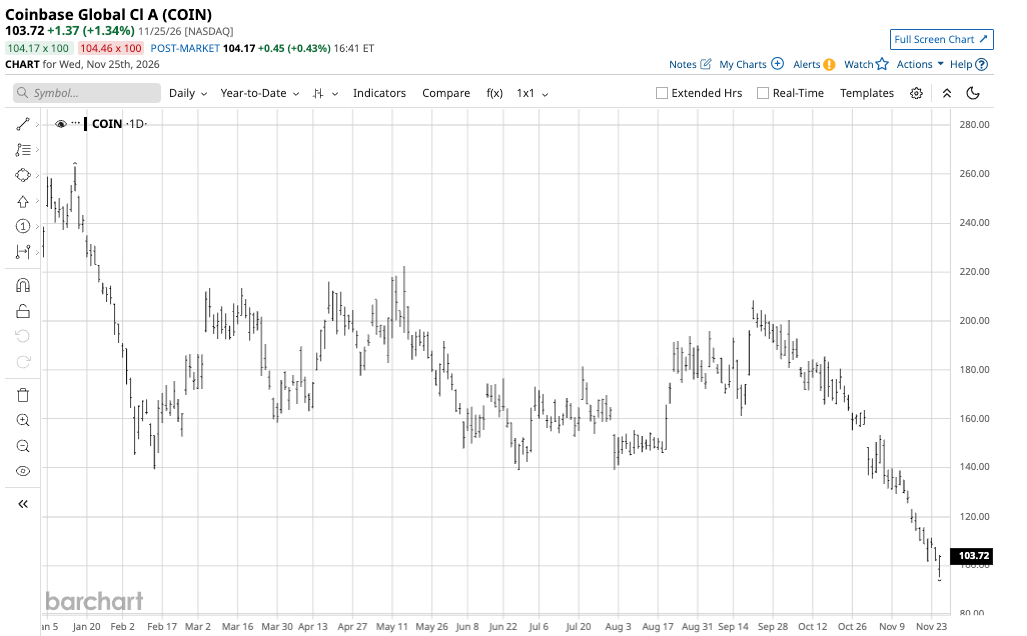
The chart shows a pattern of lower highs and lower lows, with the 2026 high in mid-January when Bitcoin reached its 2026 peak. COIN fell to a lower low in late November. COIN has traded in a $94.88 to $263.07 per share range in 2026 and hit the low in late November.
COIN has tracked but underperformed Bitcoin because the leading trading platform depends on volume for revenue and earnings. While COIN beat analyst EPS forecasts when it reported its latest earnings on October 29, 2026, it missed revenue expectations. COIN tends to track Bitcoin prices during rallies as higher cryptocurrency prices attract trading volume. Price action in 2026 has reduced trading volume, pushing COIN shares lower to their lowest level since February 2024.
Meanwhile, a dramatic power shift in U.S. politics from Republicans to Democrats could threaten cryptocurrencies, as the current administration has supported the asset class. Moreover, COIN’s close relationship with the current administration could run into regulatory problems in 2027 when Democrats take over majorities in the House and Senate.
Risk-off conditions could cause much lower prices
Perhaps the biggest risk for cryptocurrencies in late November 2026 is a risk-off environment in which all asset prices decline. Bitcoin and cryptocurrencies tend to fall when economic, geopolitical, and other events drive selling across asset classes. COIN would likely follow Bitcoin lower if risk-off conditions persist.
Price action after the recent U.S. midterm elections could signal a prolonged risk-off period in markets, which is bearish for cryptocurrencies and related assets. Meanwhile, the current U.S. administration has supported the cryptocurrency asset class with its Genius Act and the stalled Clarity Act. With Democrats taking control of the legislature in early 2027, the ranking House member on the Financial Services Committee, Maxine Waters, favors stricter federal oversight, stronger consumer protections, and expanded SEC regulatory authority over the cryptocurrency market. The ranking member on the Senate Banking Committee, Elizabeth Warren, is the most prominent and aggressive critic of cryptocurrencies, leading the opposition to the Clarity Act and supporting an agenda that protects against money laundering, sanctions evasion, scams, and other nefarious activities enabled by the anomalies of cryptocurrency markets. Moreover, Senator Warren believes that cryptocurrencies could increase systemic financial risks.
The bottom line is that while a risk-off environment could send Bitcoin and related asset prices lower, incoming Democrat majorities in both houses of the U.S. legislature are likely to keep the asset class on a short leash, which could impede appreciation over the coming years. The latest October 29, 2026, $6.3 billion hack of Binance, linked to North Korea, will likely spur more stringent regulation from Democrat majorities in the U.S. Congress.
The factors that could lift prices
While political change in the U.S. is likely bearish for Bitcoin, cryptocurrencies, and related assets, these assets are global and transcend borders. The U.S. may be the world’s wealthiest and most powerful nation, but any regulations or attempts by the U.S. government to control cryptocurrencies depend on international cooperation. Moreover, any legislation on cryptos that seeks to reverse the Genius Act, or any new regulatory efforts, will likely face a veto during the next two years of President Trump’s term.
Like many markets, cryptocurrency prices follow the path of least resistance: market sentiment. When buyers dominate sellers, prices move higher and vice versa. Bitcoin’s boom-and-bust history suggests that each significant price correction has led to a new all-time high. The last record peak was in October 2025, and the long-term trend remains bullish.
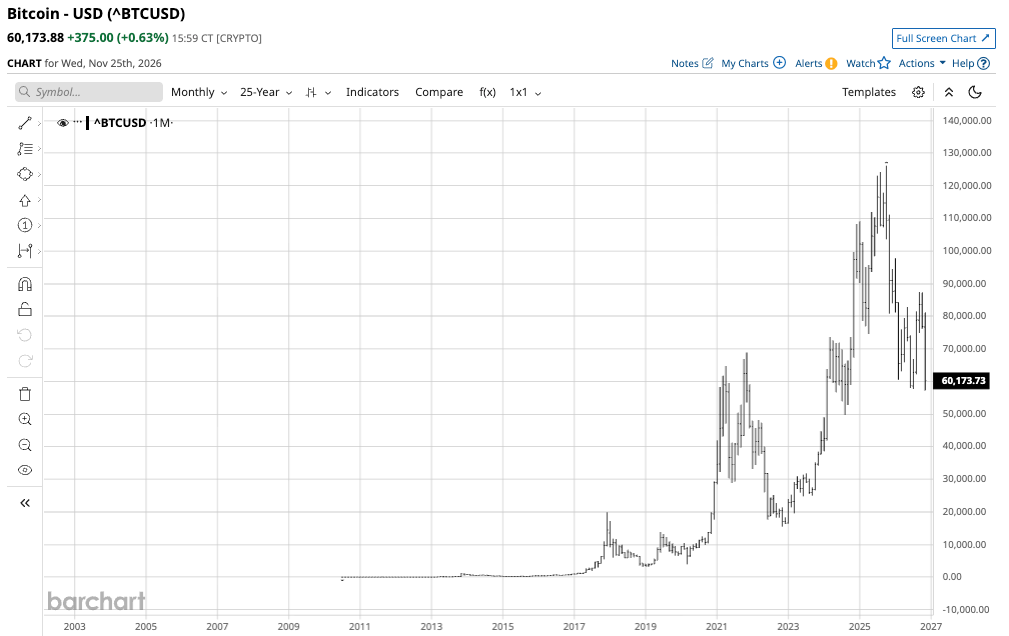
The long-term monthly chart shows that Bitcoin’s price has made higher lows and higher highs for a decade. Current technical support is at the August 2024 low, just below $50,000 per token.
Trading and going with the flow is likely to provide the best results
Cryptocurrency prices have been unprecedentedly volatile, and that is likely to continue in December 2026 and into 2027 and beyond. Blockchain technology is widely accepted, and cryptocurrencies have gained critical mass over the past years as the addressable market has expanded. However, the boom-and-bust price activity is likely to continue.
Volatility creates opportunities for flexible traders who keep their finger on the pulse of markets. Trends are always a trader’s best friend until they bend. Given the volatility, cryptocurrencies are optimal for trading, not investing. While it is acceptable to invest a small percentage of overall portfolios in cryptocurrencies and related assets, any investor should realize that there is a risk of total loss. Traders who follow trends should approach the asset class with a clear, stated risk-reward plan, including stops and profit horizons that reflect a proper balance. It is appropriate to raise profit horizons when price moves in the anticipated direction, but you must adjust stops commensurately to protect profits and capital. When prices move contrary to expectations, sticking to stops protects capital and limits losses, allowing you to seek other opportunities. Accepting small losses in pursuit of substantial gains in cryptocurrencies has been optimal since 2010, and I expect that trend to continue. In late 2026, I am cautious about the asset class’s price direction, as bullish and bearish factors pull in opposite directions.
On the date of publication, Andrew Hecht did not directly have a position in any of the securities mentioned in this article. All information and data in this article is solely for informational purposes. For more information please view the Barchart Disclosure Policy here.